


US President George Bush said Iraq was clearly not disarming and brushed aside increasingly frank opposition from allies, as the momentum for war grew.
He showed impatience with UN weapons inspectors who want more months to check Iraq's denials that it is developing chemical, biological or nuclear arms, and with fellow UN Security Council states that have backed their calls.
"It's clear to me now that he is not disarming," Bush said of Iraq's President Saddam Hussein. "Time is running out."
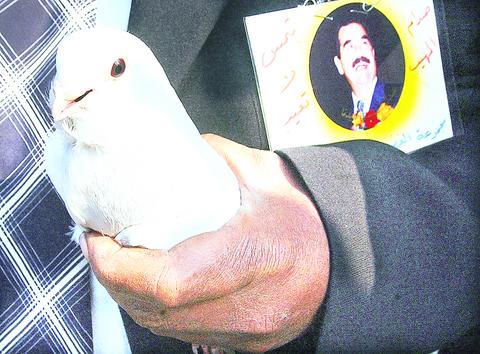
PHOTO: AP
"How much more time do we need to be sure he is not disarming? This looks to me like a re-run of a bad movie and I'm not interested in watching it."
The US sees no need for further UN approval for an attack on Iraq.
With a crucial 10 days ahead on the path to war or peace, France and Russia underlined that the US would not get such a mandate any time soon and cautioned against conflict.
"We see no justification today for [military] intervention, since the inspectors are able to do their work," French Foreign Minister Dominique de Villepin said.
"We could not support unilateral action," he said
France, which has still left the door open to eventual use of force, has a veto on the 15-seat Security Council, along with the US, Britain, Russia and China.
Germany, also on the council, has said it will not join any attack and made clear on Tuesday it would not support UN authorization for war.
"Do not expect that Germany will agree to a resolution that legitimizes war," Chancellor Gerhard Schroeder said in his strongest indication yet of how Berlin would vote.
Bush is massing more than 150,000 troops in the oil-rich Gulf and has made clear he is ready to use them, with or without a new UN mandate, if it considers Iraq has not disarmed.
Oil prices hit two-year highs as the Pentagon ordered two more aircraft carriers and 37,000 troops to the Gulf.
Britain, Bush's main military ally, has also ordered thousands of troops to the region. Australia said yesterday it was sending troops and the transport ship Kanimbla to the Middle East this week for a possible war with Iraq.
The next 10 days appear crucial on the path to possible war.
White House officials said Bush would use his major State of the Union speech on Monday to underscore the threat posed by Iraq but would not deliver an ultimatum or declare war.
The same day, chief UN arms inspector Hans Blix delivers a report to the Security Council, which convenes two days later.
If he voices dissatisfaction with Iraq's cooperation -- and he has said there are still "many questions" unanswered -- it could mean war.
On Jan. 31, Bush hosts British Prime Minister Tony Blair for talks at Camp David which some see as a possible council of war.
Asked on Tuesday how much more time he would give Saddam to comply with UN demands to disarm or face military action, Bush said: "I will let you know when the moment has come."
"We have not seen anything that indicates the Iraqi regime has made a strategic decision to disarm," he told Congress later. "On the contrary, we believe Iraq is actively working to disrupt, deny and defeat inspection efforts."
Resolution 1441, passed unanimously by the Security Council in November to force Baghdad to come clean about its arms programs, threatens "serious consequences" in the event of a "material breach" -- meaning Iraqi evasion or obstruction.
Deputy Secretary of State Richard Armitage said alternatives to force against Baghdad were "just about exhausted."
"This regime has very little time left to undo the legacy of 12 years," he said of the country whose invasion of Kuwait sparked the 1991 Gulf War that expelled its forces.
Russia disagreed. "Most countries believe that opportunities for a diplomatic solution are far from exhausted," Foreign Minister Igor Ivanov said in Moscow.
Armitage flew to the Russian capital yesterday for talks with First Deputy Foreign Minister Vyacheslav Trubnikov.
"I trust ... I can shed some light on why we're thinking as we are and taking the view that our options are just about exhausted," he said.
Mohamed ElBaradei, the UN nuclear agency chief who will report with Blix on Monday, said the inspectors needed "quite a few months" more to finish their work.
He said: "I am pleading for the inspection process to take its course."
Turkey, a staunch NATO ally which has misgivings about helping start a war on its own doorstep, said it would host a meeting of regional foreign ministers in Istanbul today. They would urge Baghdad to obey UN disarmament demands.

Taiwan Semiconductor Manufacturing Co (TSMC, 台積電), the world’s largest foundry service provider, yesterday said that global semiconductor revenue is projected to hit US$1.5 trillion in 2030, after the figure exceeds US$1 trillion this year, as artificial intelligence (AI) demand boosts consumption of token and compute power. “We are still at the beginning of the AI revolution, but we already see a significant impact across the whole semiconductor ecosystem,” TSMC deputy cochief operating officer Kevin Zhang (張曉強) said at the company’s annual technology symposium in Hsinchu City. “It is fair to say that in the past decade, smartphones and other mobile devices were
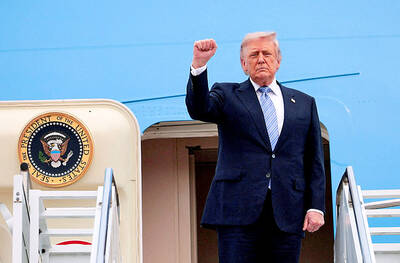
US-CHINA SUMMIT: MOFA welcomed US reassurance of no change in its Taiwan policy; Trump said he did not comment when Xi talked of opposing independence US President Donald Trump yesterday said he has not made a decision on whether to move forward with a major arms package for Taiwan after hearing concerns about it from Chinese President Xi Jinping (習近平). Trump’s comments on Taiwan came as he flew back to Washington after wrapping up critical talks in which both leaders said important progress was made in stabilizing US-China relations even as deep differences persist between the world’s two biggest powers on Iran and Taiwan. “I will make a determination,” Trump said, adding: “I’ll be making decisions. But, you know, I think the last thing we need right
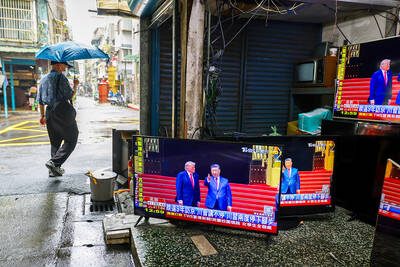
TAIWAN ISSUE: US treasury secretary Scott Bessent said on the first day of meetings that ‘it wouldn’t be a US-China summit without the Taiwan issue coming up’ There were no surprises on the first day of the summit between US President Donald Trump and Chinese President Xi Jinping (習近平), the Mainland Affairs Council (MAC) said yesterday, as the government reiterated that cross-strait stability is crucial to the Asia-Pacific region, as well as the world. As the two presidents met for a highly anticipated summit yesterday, Chinese state media reported that Xi warned Trump that missteps regarding Taiwan could push their two countries into “conflict.” Trump arrived in China with accolades for his host, calling Xi a “great leader” and “friend,” and extending an invitation to visit the White House
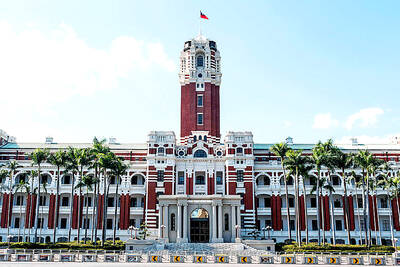
SECURITY: Taipei presses the US for arms supplies, saying the arms sales are not only a reflection of the US security commitment to Taiwan but also serve as a mutual deterrent against regional threats Taiwan is committed to preserving the cross-strait “status quo” and contributing to regional peace and stability, the Presidential Office said yesterday. “It is an undeniable fact that the Republic of China is a sovereign and independent democratic nation,” Presidential Office spokeswoman Karen Kuo (郭雅慧) reiterated, adding that Beijing has no right to claim sovereignty over Taiwan. The statements came after US President Donald Trump warned against Taiwanese independence. Trump wrapped up a state visit to Beijing on Friday, during which Chinese President Xi Jinping (習近平) had pressed him not to support Taiwan. Taiwan depends heavily on US security backing to deter China from carrying


 RSS
RSS