


The Pentagon has confirmed that US troops will be present at upcoming military exercises in Taiwan, but US officials deny press reports that Americans will take an active part in the drills.
US officials say the troops will serve only as observers and analysts.
US activities during the exercises will be "in the realm of things we do with Taiwan that are consistent with the Taiwan Relations Act [TRA], and appropriate for helping Taiwan meet their self-defense capabilities," said US Defense Department East Asia spokesman Jeff Davis.
"We routinely interact with Taiwan's military in order to carry out our obligations under the TRA. As a matter of practice, we don't discuss the details of those contacts," he told the Taipei Times.
US military personnel will only be at the Hankuang exercises to "observe and assess" the performance of Taiwan's military teams, US officials told the Times.
There is a "fine line" between this and actual participation, which would be a violation of the TRA and arrangements for military contacts, the officials say.
While US military personnel have had observers' roles at previous Hankuang exercises, US officials are angry over leaks in the Taiwanese media of the US participation this year.
Sources say the anger was so strong that President Chen Shui-bian (
Observing the annual exercises helps the US shape its security assistance to Taipei in order to help Taiwan meet it's "legitimate self defense needs under the TRA," US officials say. Actual participation, they say, would not be consistent with the TRA.
Nevertheless, officials have revealed that the US was considering active participation this year, although discussions had only taken place at a low level. The officials say that if the discussions had reached a high level, they probably would have been rejected.
While US military assistance has focused in the past almost entirely on the armaments that Washington has sold Taipei, the situation is changing.
"There are a number of things we are doing with Taiwan on the security assistance front that go beyond hardware," an official said.
This includes helping Taiwanese military on a person-to-person level.
US officials complain that while Taiwan has a good deal of advanced hardware, its military does not have the know-how to put the equipment to good use or to run an efficient defense ministry. Part of this, the officials note, stems from Taiwan's having been locked out of various defense forums in recent years.
The US officials say that the Pentagon is especially interested in helping Taiwan's military improve ways to carry out joint operations among the armed forces, establish civilian control of the military and reform its antiquated defense acquisition systems.
Late last year, the US Con-gress approved, and President George W. Bush signed into law, a defense authorization bill for fiscal 2003 that called for the Pentagon to report to Congress this spring on the feasibility of closer military ties between Washington and Taipei, including joint exercises and US training programs for Taiwan-ese officers.
It is still unclear whether the administration will meet the congressional deadline.
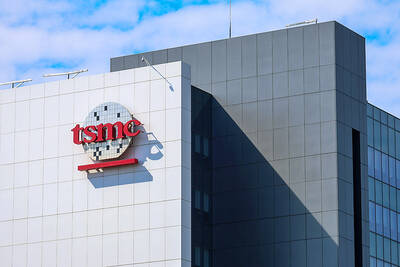
Taiwan Semiconductor Manufacturing Co (TSMC, 台積電), the world’s largest foundry service provider, yesterday said that global semiconductor revenue is projected to hit US$1.5 trillion in 2030, after the figure exceeds US$1 trillion this year, as artificial intelligence (AI) demand boosts consumption of token and compute power. “We are still at the beginning of the AI revolution, but we already see a significant impact across the whole semiconductor ecosystem,” TSMC deputy cochief operating officer Kevin Zhang (張曉強) said at the company’s annual technology symposium in Hsinchu City. “It is fair to say that in the past decade, smartphones and other mobile devices were
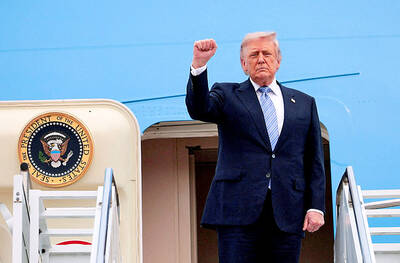
US-CHINA SUMMIT: MOFA welcomed US reassurance of no change in its Taiwan policy; Trump said he did not comment when Xi talked of opposing independence US President Donald Trump yesterday said he has not made a decision on whether to move forward with a major arms package for Taiwan after hearing concerns about it from Chinese President Xi Jinping (習近平). Trump’s comments on Taiwan came as he flew back to Washington after wrapping up critical talks in which both leaders said important progress was made in stabilizing US-China relations even as deep differences persist between the world’s two biggest powers on Iran and Taiwan. “I will make a determination,” Trump said, adding: “I’ll be making decisions. But, you know, I think the last thing we need right
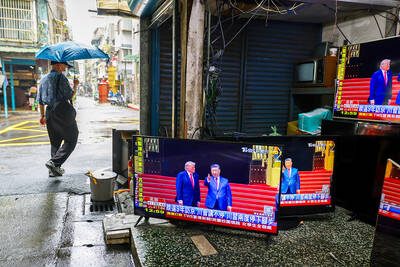
TAIWAN ISSUE: US treasury secretary Scott Bessent said on the first day of meetings that ‘it wouldn’t be a US-China summit without the Taiwan issue coming up’ There were no surprises on the first day of the summit between US President Donald Trump and Chinese President Xi Jinping (習近平), the Mainland Affairs Council (MAC) said yesterday, as the government reiterated that cross-strait stability is crucial to the Asia-Pacific region, as well as the world. As the two presidents met for a highly anticipated summit yesterday, Chinese state media reported that Xi warned Trump that missteps regarding Taiwan could push their two countries into “conflict.” Trump arrived in China with accolades for his host, calling Xi a “great leader” and “friend,” and extending an invitation to visit the White House
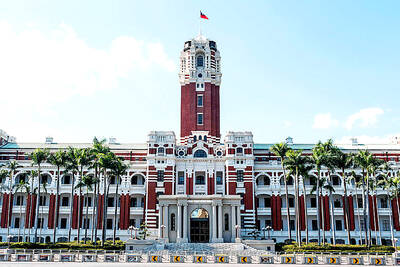
SECURITY: Taipei presses the US for arms supplies, saying the arms sales are not only a reflection of the US security commitment to Taiwan but also serve as a mutual deterrent against regional threats Taiwan is committed to preserving the cross-strait “status quo” and contributing to regional peace and stability, the Presidential Office said yesterday. “It is an undeniable fact that the Republic of China is a sovereign and independent democratic nation,” Presidential Office spokeswoman Karen Kuo (郭雅慧) reiterated, adding that Beijing has no right to claim sovereignty over Taiwan. The statements came after US President Donald Trump warned against Taiwanese independence. Trump wrapped up a state visit to Beijing on Friday, during which Chinese President Xi Jinping (習近平) had pressed him not to support Taiwan. Taiwan depends heavily on US security backing to deter China from carrying


 RSS
RSS