

Police and rail officials denied responsibility yesterday after a truck smashed into a train overpass, damaging the track above and leading to a derailment 30 minutes later.
It was the second rail crash in less than three weeks.
Two people were injured in the accident, and rail traffic between Taichung and Changhwa was paralyzed after the crash yesterday. The Taiwan Railway Administration (TRA, 台灣鐵路局) announced that normal rail service would resume at 6am today.
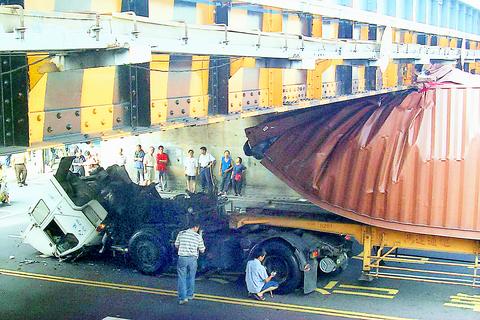
PHOTO: SUN YI-FANG, TAIPEI TIMES
The passenger train was out of service at the time, but the engineer, conductor and the truck driver were injured in the incident.
The container truck, at around
4:50am, crashed into a rail overpass about 200m from the Taichung Train Station, bending the rail tracks on the bridge. The 4.2m-high truck crashed and stuck under the bridge as it tried to pass under it. The height limit of the bridge is 3.7m.
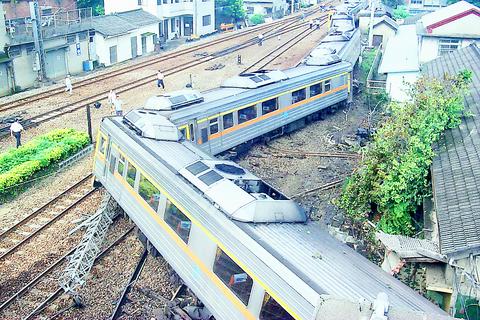
PHOTO: SUN YI-FANG, TAIPEI TIMES
At 5:20am, as a Tzu Chiang express train crossed the bridge, its nine coaches derailed and careened into one of the station platforms.
"To my shock I discovered that the rail track had deformed into an "S" shape about 100 meters before we reached the bent rail. I pulled the emergency break and the train lost control and derailed. We didn't receive any warning," train engineer Su Shih-shui (蘇石水) said yesterday after he was sent to the hospital.
Su recieved three stitches in his right arm.
The train was out of service when the accident occurred, carrying only a crew of three. The train's conductor, Wu Chin-chuan (吳進傳), and the truck driver Hsu Chieh-shi (徐結士), were sent to Cheng Ching Hospital (澄清醫院) in Taichung City. Although the doctor at the hospital said that the injured were not in critical condition, they were being held for further observation.
The police opened a full investigation into the accident yesterday.
The accident damaged two electric polls, one platform and part of a building at the Taichung Train Station.
"When the accident [with the truck] happened, the police didn't realize it's possible impact on the rail track, so we were not informed," said Chang Hsien-chang (
Seeking to deflect blame for the mishap, Chang said, "With all the damage caused by the derailment -- a result of the violation of traffic regulations by a truck driver -- the TRA is actually the victim in this accident," he said.
The head of Taichung's West District police station sought to dispel any charges of police responsibility, saying, "We were sent to record the accident, not knowing that the railway line was damaged."
Both the West District police station and the Taichung City First Police Station, which informed the former of the accident, told the Taipei Times last night that they didn't know who had initially informed police of the accident.
The TRA yesterday arranged shuttle buses to transfer passengers between Taichung and Changhwa.
Meanwhile, two cars of a construction train loaded with logs derailed at 3.30pm yesterday on a level crossing near Kunyang (
Although no injuries were reported, three southbound trains were delayed because of the incident. Normal service on the that line resumed at 5:30pm yesterday.
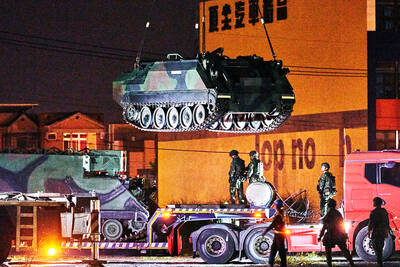
CHINESE THREAT: The military also simulated repelling an attack on Penghu and transporting military vehicles from Hualien to Yilan to reinforce defenses in the north The government yesterday slowed mobile Internet coverage for a large swathe of the central part of Taiwan proper for the first time during annual war games, simulating communication disruption in the event of a Chinese attack or natural disaster. Taiwan, which has long lived with the threat of a Chinese invasion, holds air raid drills along with its war games every year, clearing people from the streets for 30 minutes. During the Internet “throttling” drill, centered on Taichung, only basic mobile phone services worked, although other functions, including ATMs, traffic signals, landlines and fixed-line Internet services, were not affected. Air raid sirens rang
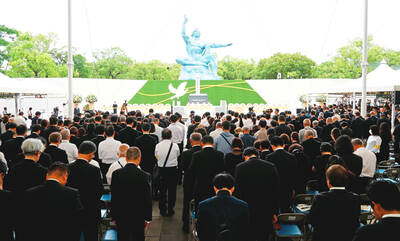
‘IRONIC’: The Nagasaki memorial calls for the abolition of nuclear weapons and peace, but it sided with China, which has been threatening peace in the Strait, an official said Taipei yesterday protested the seating arrangement at the Nagasaki atomic bombing memorial ceremony, saying that the Nagasaki City Government’s decision to place its representative outside the diplomatic delegation area slighted Taiwan’s national status and played into Beijing’s efforts to suppress the nation. Representative to Japan Lee Yi-yang (李逸洋) said he declined to attend the event, because the seat placement deliberately diminished Taiwan’s status and dignity, with Chen Ming-chun (陳銘俊), head of the Fukuoka Branch of the Taipei Economic and Cultural Office in Osaka, attending in his place. Taiwan is known worldwide for its commitment to peace and democracy, Lee said, adding that

CHINESE INFLUENCE? The TPP denied any knowledge that the Chinese immigrant had been reporting to Beijing or that she had participated in the party’s decisionmaking The New Taipei District Court yesterday sentenced Chinese immigrant Xu Chunying (徐春鶯) to seven years in prison for fraud, helping Chinese nationals illegally enter Taiwan and acting at Beijing’s direction to influence Taiwanese politics. The New Taipei District Prosecutors’ Office said it found that Xu and Cross-Strait Marriage Harmony Promotion Association chairman Chung Chin-ming (鍾錦明) had maintained long-term contact with Yang Wentao (楊文濤), director of the Cross-Strait Marriage and Family Service Center, and Sun Xian (孫憲), vice director of the Shanghai China Council for the Promotion of Peaceful National Reunification. Prosecutors accused Xu and Chung of accepting instructions to campaign for certain
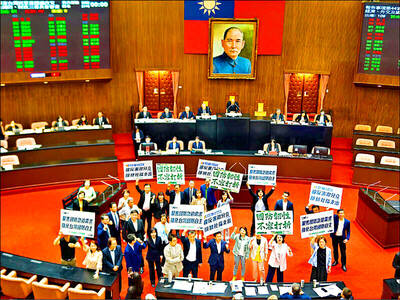
The Chinese Nationalist Party (KMT) and other opposition politicians are “taking Taiwan’s democracy hostage” for selfish gain, The Economist said in a column published online on Tuesday. “Taiwan’s freedoms should be a strength, raising the costs to China of a takeover. Shamefully, they are being betrayed from within,” the British news magazine said. While a lot of countries have toxic politicians, Taiwan’s stand out as particularly irresponsible, and “the blame is not evenly distributed,” it said. Although President William Lai (賴清德) is stubborn and, unlike his predecessor, does not consult KMT moderates, the opposition has triggered a “rolling constitutional crisis,”


 RSS
RSS