

Taipei prosecutors investigating the Chu Mei-feng (
Investigators say Tsai's testimony may be crucial to the case.
According to one witness, Tsai accompanied Kuo Yu-ling (
Kuo, a "spiritual-growth" instructor and Chu's former friend, was detained by prosecutors on Wednesday.
"According to Kuo's statements, she admitted that she hired a private detective agency in Hsinchu to install the hidden camera at Chu's Tamsui apartment," Chen Hung-ta (陳宏達), spokesman for the Taipei District Prosecutors' Office, said yesterday.
According to Chen, Tsai and Kuo visited a private detective agency together. Kuo had asked about details concerning hidden cameras, the spokesman said.
"The detective agency's employees told us that Tsai once showed up with Kuo at the shop to ask for information about installing a hidden camera," Chen said. "At this time, he's still not on the suspect list, but we will definitely interview him when necessary."
Tsai was unavailable for comment yesterday.
Though Kuo concedes she installed a pinhole camera in Chu's apartment, she said she did so at Chu's request.
Lee Ming-yu (
"Kuo said that it is impossible for Tsai to be involved," Lee told reporters yesterday after meeting with Kuo in her prison cell.
"She said that she didn't understand why Tsai was now a suspect, as Chu was the one who asked her to install the hidden camera. Tsai had nothing to do with this."
Prosecutors and police conducted additional searches of Chu's Tamsui apartment yesterday. Investigators uncovered two hidden audio recorders and two tapes. The search was still continuing as of press time yesterday.
Investigators also found fingerprints that belong to neither Chu, Kuo, Tsai nor Tseng Chung-ming (
"Almost all of the fingerprints [found so far] belong to Chu, Tseng, Kuo and Tsai," Chen said. "But we found one set of fingerprints that doesn't belong to anyone who can be placed at the scene. Investigators are now ... trying to find out the identity of that person."
Investigators yesterday also searched the offices of Hsinchu's Cultural Affairs Bureau, where Chu served as director until August this year.
With the help of a local private-detective agency, investigators uncovered special cables attached to the computer of Tseng Huan-peng (
Tseng's office was formerly used by Chu. Investigators believe the cables at one time could have been attached to device for recording video or audio.

SOFT TENNIS: Yu Kai-wen and Huang Shih-yuan narrowly defeated their Japanese rivals to capture Taiwan’s first gold at the Asian Games in Nagoya Yu Kai-wen (余凱文) and Huang Shih-yuan (黃詩媛) won Taiwan’s first gold of this year’s Asian Games, defeating a Japanese duo in a nail-biter in the soft tennis mixed doubles final in Nagoya, Japan, while Johnny Sun (孫家閎) won silver in wushu and Shih Cheng-chung (石政中) won bronze in men’s kumite. Yu and Huang narrowly defeated Japan’s Toshiki Uematsu and Rena Temma 5-4 (2-4, 5-3, 4-2, 1-4, 1-4, 4-0, 1-4, 4-1, 7-5) to give Taiwan its first gold in soft tennis mixed doubles at an Asian Games since 2018. Sun secured Taiwan’s first wushu medal at this year’s game, with a combined score
CALL FOR CHANGE: They urged the UN to facilitate Taiwan’s involvement in the body, recognize its peace efforts and to work with members in preventing military conflict Representatives to the UN from five of Taiwan’s diplomatic allies sent a joint letter to UN Secretary-General Antonio Guterres on Friday, calling for the country’s inclusion in the body. Allies in the letter sent ahead of the 81st session of the UN General Assembly General Debate made three demands in support of Taiwan: inclusion, recognition and camaraderie. They implored the UN to seek an appropriate way to facilitate Taiwan’s meaningful involvement in the world governing body, saying that UN Resolution 2758, which accepted the People’s Republic of China (PRC) as a member of the UN, does not exclude Taiwan. Beijing claims that the
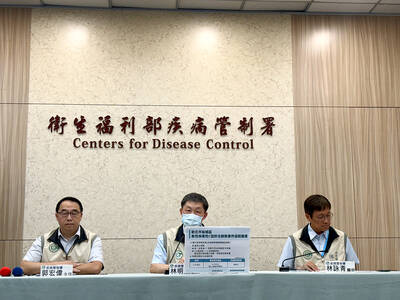
AT-RISK GROUPS: Of the accumulated 1,586 severe cases and 304 related deaths in this flu season, 65.8% were older people and 83.2% had chronic diseases, an official said The Centers for Disease Control (CDC) yesterday said that 165 severe flu cases and 30 flu-related deaths were reported last week, the highest weekly numbers in this flu season, and that cases might continue to increase, urging people to take precautions. Medical visits for flu-like illnesses increased by 1.4 percent to 141,374 last week, with 11.8 percent being emergency visits, showing that the seasonal flu is still in its epidemic period, CDC Epidemic Intelligence Center Director Guo Hung-wei (郭宏偉) said. From Tuesday last week to Monday, 165 severe flu cases and 30 flu-related deaths were confirmed, the highest weekly numbers
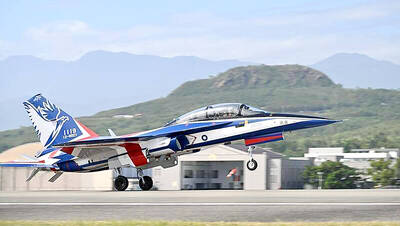
Aerospace Industrial Development Corp (AIDC, 漢翔航空工業) has finished production of the nation’s T-5 Brave Eagle (勇鷹) advanced jet trainers, with the final aircraft scheduled to be formally delivered at a ceremony on Thursday. The delivery of the trainer jets marks the end of the program, which dates back to 2017, with the first prototypes completed in 2019. Fifty-six of the 66 trainers had been delivered as of May. The Brave Eagle was developed and produced by AIDC and the National Chungshan Institute of Science and Technology. The program has provided a foundation for the development of a domestically produced next-generation primary trainer and


 RSS
RSS