


Tang Fei (唐飛) yesterday offered his resignation to President Chen Shui-bian (陳水扁) to take full political responsibility in a bid to ease public outrage over the Pachang Creek (八掌溪) tragedy.
However, Chen declined to accept the resignation, and instead encouraged him to conquer the challenges that the new government is facing.
"The new government has no excuse for mishandling the rescue. The only thing I can do is to resign," Tang said at a press conference held yesterday morning.
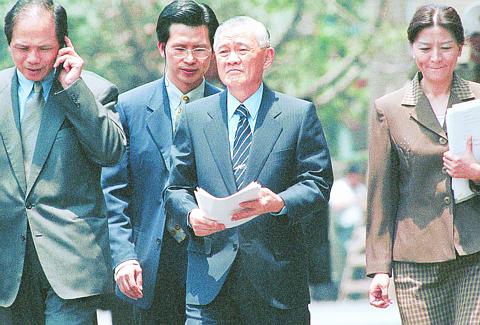
PHOTO: LIAO RAY-SHANG, THE LIBERTY TIMES
Four workers conducting riverbed work in Pachang Creek found themselves overwhelmed by a rapidly rising torrent on Saturday afternoon. The four waited in vain for a rescue helicopter and finally were swept into the muddy water and drowned.
Only two bodies have been found so far, while public outrage over the government's failure to mount a rescue continues to rise.
Chen called an urgent Cabinet meeting around 8pm yesterday to work out how to minimize the political damage the event has caused his administration.
Tang held a second review meeting yesterday morning to clarify details and responsibilities concerning the rescue delay.
A demerit was handed down to 13 ministers, including Director of the National Fire Administration Chen Horng-i (
Tang has authorized the Military Rescue and Coordination Center (
"Poor communications and a lack of ability to deal with a crisis led to the failure of the rescue. The first "life-critical" 32 minutes had been wasted on following administrative procedure authorizing the dispatch of the rescue team. We will thoroughly review the government's mechanism to deal with such a situation and strengthen rescue forces and equipment," Tang said.
He then dispatched Secretary-General of the Cabinet Wea Chi-lin (
The body of Liu Chih (劉智) was pulled from the mud of the Pachang Creek yesterday at about 2pm. Liu's relatives identified the body.
The military has vowed to keep up its search effort, while the families of the two missing victims, Yang Tzu-chung (
Each of the four victims or their families are entitled to NT$200,000 in compensation under the National Compensation Law. In addition, the victims' families can claim compensation for occupational injury and death according to the Labor Insurance Law (勞保條例).
Approximately NT$820,000 will be awarded to Yang Tzu-chung, who is covered by labor insurance, while the remaining three are entitled to farmers' insurance of approximately NT$150,000.
The Council of Labor Affairs (
Chang Chun-hsiung (
"The president is both saddened and furious over the tragedy. He has ordered that further investigations into the government's negligence be conducted," Chang said.
"Saving lives should be the top priority of any rescue mission and the president fully respects Tang Fei's decision to penalize the authorities responsible for the mistake," Chang said.
Chang also responded to New Party legislators' accusations that two out of the four Seagull rescue helicopters were reserved for the president's use.
He said that Chen was not aware of the former government's arrangements, and that the president had immediately ordered the two helicopters concerned to be assigned to rescue missions only.

‘NO SECURITY RISK’: The Railway Bureau reassured the public that the technicians’ activities were limited to technical guidance and did not involve sensitive systems The Railway Bureau yesterday said it had invited eight Chinese technicians to assist with an airport MRT construction project. The bureau issued the confirmation after an Internet user said Chinese nationals had entered the construction zone of Taiwan Taoyuan International Airport’s Terminal 3 project. They asked why “individuals from an enemy state” were allowed access to such a major national infrastructure project, which raised serious concerns over Taiwan’s industrial safety, sensitive systems and information security. The bureau’s Northern Region Engineering Branch Office said subcontractor Taiwan Handle Industrial Co (台灣手把工業) of the Taoyuan airport MRT’s “Contract No. CU05 Project A14 Station Civil, MEP &

A US uncrewed surface vessel (USV) encountered multiple Chinese warships during an autonomous transit of the Taiwan Strait, US defense company Seasats said in a statement on Wednesday. Seasats announced that a Lightfish USV had completed the first autonomous transit of the Taiwan Strait. Over five days, the USV traversed the entire length of the Strait while constantly monitoring surface vessel traffic, the company said. The Lightfish encountered multiple Chinese warships, one of which was a Chinese People’s Liberation Army Navy (PLAN) Type 056 corvette, it said. The Chinese vessels were operating “well within Taiwan’s exclusive economic zone without transmitting their identity via the
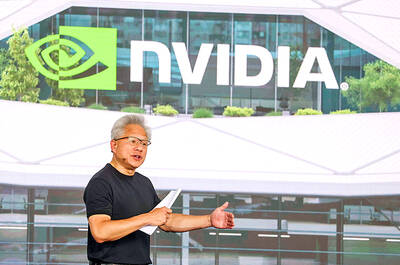
‘BOOMING’: ’ The number of partners we have here is incredible. You can see from their stock prices. They’re doing so well, they’re so happy,’ Jensen Huang said Nvidia Corp’s spending in Taiwan has ballooned to about US$150 billion a year, 10 times the US$10 billion to US$15 billion the company spent five years ago, Nvidia chief executive officer Jensen Huang (黃仁勳) said yesterday, suggesting Taiwan’s strategic importance in the global artificial intelligence (AI) supply chain. “Taiwan is the epicenter of the AI revolution. This is where the chips come, packaging comes. This is where the systems are made. This is where AI supercomputers were created,” Huang said at a meeting for the company’s employees in Beitou-Shilin Technology Park (北投士林科技園區) in Taipei, the planned site of Nvidia’s Taipei headquarters. “Taiwan
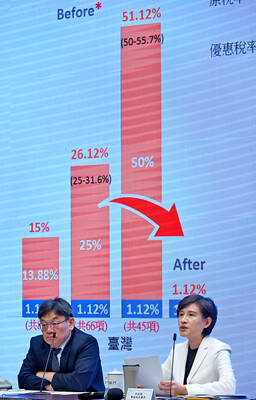
GREATER REACH? Auto parts and wood products would face tariffs of up to 15%, matching those targeting the EU, Japan and South Korea, Vice Premier said The US has announced that preferential tariff treatment for Taiwan’s non-semiconductor Section 232 goods would take effect retroactively from May 1, the Executive Yuan said yesterday. The US government yesterday posted a notice on the Federal Register’s public inspection Web site previewing tariff concessions for Taiwan under a memorandum of understanding (MOU) on Taiwan-US investment after two months of negotiations. The MOU signed on Jan. 15 stipulated three major preferential tariff arrangements: a 15 percent “reciprocal” tariff rate for Taiwan without stacking most-favored nation (MFN) rates; preferential Section 232 treatment for semiconductors and related products; and preferential Section 232 treatment for non-semiconductor


 RSS
RSS