


Taiwan's political temperature rose several degrees yesterday as the KMT and DPP traded fierce accusations and insinuations of unfair play in the runup to Saturday's vote.
While campaigning in Miaoli last night, DPP candidate Chen Shui-bian claimed that the KMT had dispatched senior officials to Beijing to ask authorities there for quick military action -- possibly military exercises near Taiwan -- in order to influence the election.
The KMT is "conspiring with outside forces against their own people," he said.
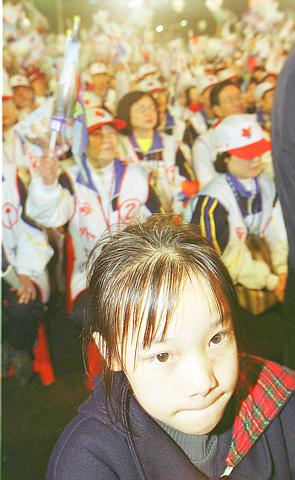
PHOTO: CHIANG YING-YING, TAIPEI TIMES
Chen provided no evidence to back up his claims, however, and the KMT's official spokesman immediately dismissed them as "unfounded slander" and "empty talk."
"Now that the campaign has entered into its final stage, the opposition is spreading rumors about the KMT," Huang said.
Huang said voters would surely make a "rational deci-sion," adding the KMT would never contemplate such a thing.
Earlier in the day, the election seemed to be degenerating into a name-dropping competition as the KMT tried to overtake the DPP in projecting itself as the party favored by Taiwan's social and business elite -- while at the same time repudiating claims that Chen Shui-bian was the natural choice to continue President Lee Teng-hui's (
President Lee himself denied that there was anything resembling a "Lee Teng-hui path" for Taiwan, insisting there was only the road of freedom and democracy.
"In fact, the so-called `such-and-such's line' can only emerge from an authoritarian regime, such as the `Mao Zedong (
The president's comments came as a response to statements made the previous day by one of this closest friends, Chi Mei President Hsu Wen-lung (
Lee was speaking to more than 200 representatives from the International Youth Chamber of Commerce and the Lions Club who visited the Presidential Office yesterday.
The president said he firmly disagreed with "certain people" when they talked at length about the so-called "Lee Teng-hui path."
"I must reiterate that I am against concocting such a groundless and authoritarian slogan," Lee said. "It is not only inconsistent with Taiwan's interests, but also meaningless."
Hsu, the founder of Chi Mei Corp -- the biggest ABS supplier in the world -- is well known for his management skills, a passion for art and a devotion to Taiwan independence.
As a confidant of the president's, Hsu's endorsement of Chen is widely believed to have negatively affected Lien Chan's (
The KMT candidate struck back yesterday with a list of his own, however, containing the names of 100 prominent figures in business and academic circles.
They include Koo Chen-fu (
None appeared at Lien's press conference yesterday, and speculation centered on the fact that some of the names on the list had already endorsed the DPP's Chen.
They included Lin Hsin-yi (
Chen was also struggling to attract an audience to his press conference yesterday, this one with members of foreign securities houses. After Monday's 600-point drop in the TAIEX, the DPP candidate was at pains to reassure foreign investors that he would be a safe bet after the election as far as economic policy was concerned.
But several members of Taiwan's foreign broking community apparently were scared off by the sight of reporters at the venue where the meeting was to be held.
To those that did attend, Chen pledged that he would accelerate the process of internationalization of Taiwan's financial markets if he is elected president.
"Politics is temporary but the economy is forever," Chen said, adding that as an island, Taiwan's national security could be secured only when its economy is fully liberalized and globalized.

‘NO SECURITY RISK’: The Railway Bureau reassured the public that the technicians’ activities were limited to technical guidance and did not involve sensitive systems The Railway Bureau yesterday said it had invited eight Chinese technicians to assist with an airport MRT construction project. The bureau issued the confirmation after an Internet user said Chinese nationals had entered the construction zone of Taiwan Taoyuan International Airport’s Terminal 3 project. They asked why “individuals from an enemy state” were allowed access to such a major national infrastructure project, which raised serious concerns over Taiwan’s industrial safety, sensitive systems and information security. The bureau’s Northern Region Engineering Branch Office said subcontractor Taiwan Handle Industrial Co (台灣手把工業) of the Taoyuan airport MRT’s “Contract No. CU05 Project A14 Station Civil, MEP &

A US uncrewed surface vessel (USV) encountered multiple Chinese warships during an autonomous transit of the Taiwan Strait, US defense company Seasats said in a statement on Wednesday. Seasats announced that a Lightfish USV had completed the first autonomous transit of the Taiwan Strait. Over five days, the USV traversed the entire length of the Strait while constantly monitoring surface vessel traffic, the company said. The Lightfish encountered multiple Chinese warships, one of which was a Chinese People’s Liberation Army Navy (PLAN) Type 056 corvette, it said. The Chinese vessels were operating “well within Taiwan’s exclusive economic zone without transmitting their identity via the
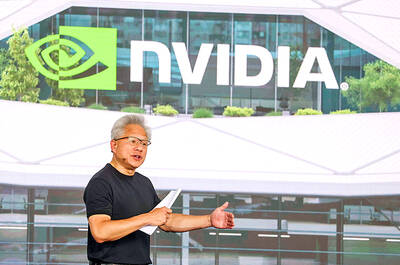
‘BOOMING’: ’ The number of partners we have here is incredible. You can see from their stock prices. They’re doing so well, they’re so happy,’ Jensen Huang said Nvidia Corp’s spending in Taiwan has ballooned to about US$150 billion a year, 10 times the US$10 billion to US$15 billion the company spent five years ago, Nvidia chief executive officer Jensen Huang (黃仁勳) said yesterday, suggesting Taiwan’s strategic importance in the global artificial intelligence (AI) supply chain. “Taiwan is the epicenter of the AI revolution. This is where the chips come, packaging comes. This is where the systems are made. This is where AI supercomputers were created,” Huang said at a meeting for the company’s employees in Beitou-Shilin Technology Park (北投士林科技園區) in Taipei, the planned site of Nvidia’s Taipei headquarters. “Taiwan
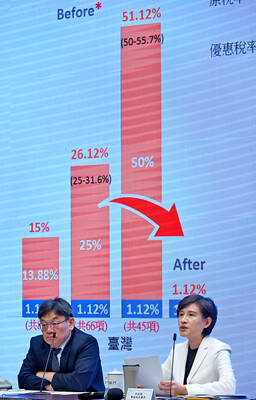
GREATER REACH? Auto parts and wood products would face tariffs of up to 15%, matching those targeting the EU, Japan and South Korea, Vice Premier said The US has announced that preferential tariff treatment for Taiwan’s non-semiconductor Section 232 goods would take effect retroactively from May 1, the Executive Yuan said yesterday. The US government yesterday posted a notice on the Federal Register’s public inspection Web site previewing tariff concessions for Taiwan under a memorandum of understanding (MOU) on Taiwan-US investment after two months of negotiations. The MOU signed on Jan. 15 stipulated three major preferential tariff arrangements: a 15 percent “reciprocal” tariff rate for Taiwan without stacking most-favored nation (MFN) rates; preferential Section 232 treatment for semiconductors and related products; and preferential Section 232 treatment for non-semiconductor


 RSS
RSS