


Officials from the Tuntex Corporation (
In a statement released yesterday, Tuntex said due to its long-term business relationship with the KMT, the company had been willing to contribute money to the party.
The company then went on to appeal to all presidential candidates to tell the truth and return quickly to a campaign based on policy debate.
The statement follows claims made two days ago by a high-ranking government official that a business tycoon -- who he identified as being surnamed Chen -- had given a NT$100 million check to the KMT on June 10, 1991 to fund campaigning.
At that time, Soong served as the KMT's secretary-general. However, Chen refused to say whether he had given the money to Soong directly.
But the official, who was closely involved with the KMT's internal affairs, said the money had not been deposited in the KMT's public accounts, but instead was stashed in the account of Soong Chen-yuan at the Chung Hsing Bills Finance Corp (
When the first allegations in the mushrooming scandal were made public by KMT legislator at-large Yang Chi-hsiung (
Once the financial dealings were made public, members of Soong's campaign reportedly made private visits to Chen to ask him to be the "elder" that Soong had mentioned. But, the official said, when Chen realized that the donation had been transferred to Soong's son's account, the Tuntex president was too angry to play the role.
In addition to Chen, the official said, Soong also called on the son-in-law of the Shin Kong Corporation's (新光集團) Kuo Jui-sung (郭瑞嵩) -- who now serves as professor at Soochow University -- to ask for help, but that bid also failed.
Soong and Kuo had once been classmates, according to media reports.
Chief secretary to President Lee Teng-hui (
"Soong's secretary Yang Yun-tai (
Standing firm on his position, Su yesterday held a news conference urging Soong to apologize to both President Lee and the Taiwanese people.
Su said the media had exposed the fact that Chen might be the "elder" that Soong was looking for. This was proof Soong had concocted the entire story in a bid to cover his tracks, Su said.
"Having watched the development of events and heard Soong's statements regarding Chung Hsing Bills Finance, it proves that in order to get away from the money scandal, Soong cooked up the story by saying he acted under Lee's direction,'' Su said.
Soong, meanwhile, refused further comments yesterday. However, he has asked former National Chungshing University president Huang Tong-shong (
Huang said that if the KMT still refuses to accept the money, Soong would probably hand the money over to the courts instead. According to current regulations, Huang said, the money would automatically be delivered to the national treasury within 10 years.
KMT officials dismissed Soong's gesture yesterday as a mere "political show.''
"The action [referring to Soong's move to end the trust deal with the KMT] is meaningless. Since Lee never demanded Soong conduct any private work, there is need to end such an appointment,'' said KMT spokesman Huang Huei-chen (
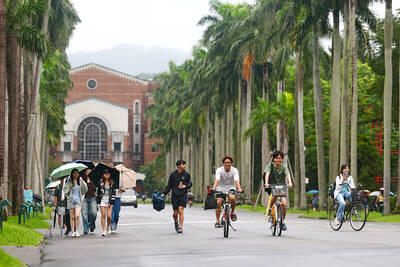
National Taiwan University (NTU) yesterday said it disqualified a person from an entrance examination for using AI smart glasses to cheat, along with two others for making untruthful statements in their curriculum vitae. The three applicants were given null scores, Taiwan’s highest-ranked university said, calling on prospective students to be honest in the admissions process. NTU registrar Lee Hung-sen (李宏森) said that the cheating applicant wore a hat and thick-rimmed glasses to the second written exam for medical school, claiming that they felt cold. Suspicions were aroused when the applicant stared oddly at the test for long stretches while steadily bringing the paper

The Tourism Administration yesterday announced that it would reward repeat international visitors with incentives of up to NT$8,000 to boost inbound tourism. The incentives are available to all international tourists, it said, adding that repeat visitors would be rewarded with NT$5,000 and would receive an additional NT$3,000 if they bring travel companions. The nation received 2,990,657 inbound visitors during the first quarter, marking a 3.8 percent increase from the same period last year, agency data showed. Japanese nationals are among groups visiting Taiwan the most. About 1.48 million Japanese tourists arrived last year, a year-on-year increase of more than 12
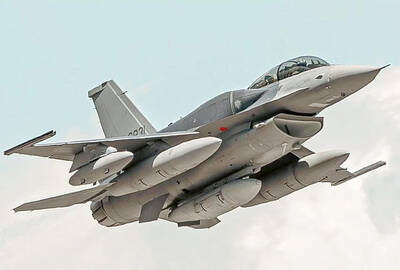
66 FIGHTER JETS: The aircraft is likely undergoing preparations for its transfer to Taiwan — a significant step forward in the nation’s modernization program, a lawmaker said The first of Taiwan’s order of F-16V Block 70 aircraft has been sighted in Texas ahead of delivery, Democratic Progressive Party (DPP) Legislator Wang Ting-yu (王定宇) said. Taiwan’s first F-16V Block 70 two-seat aircraft, tail number 6831, was seen flying from Lockheed Martin’s production facility in Greenville, South Carolina, to Naval Air Station Joint Reserve Base Fort Worth in Texas, Wang wrote on Facebook yesterday. The plane is likely undergoing preparations for its transfer to Taiwan, marking a significant step forward in the Republic of China Air Force’s modernization program, Wang said, citing military analysts. The F-16V Block 70 is a new-build version
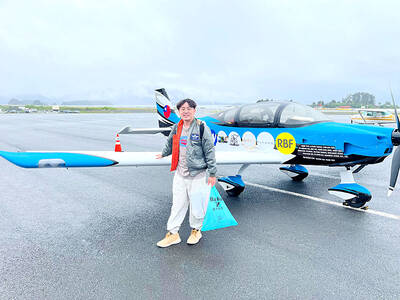
Taiwanese aviator Roger Lin (林睿哲) returned to Taiwan on Saturday after completing a nine-day round-the-world journey in a single-engine aircraft, becoming the first Taiwanese pilot to achieve the feat. Lin departed on June 5 from Los Angeles, California, and continued through Alaska, Japan, Taiwan, the Philippines, Indonesia, Malaysia, Thailand, Nepal, Jordan, Norway, Iceland and Canada before landing at the Taipei International Airport (Songshan) via Los Angeles and Japan. Lin shared numerous photos and videos of his journey on a Facebook page titled “Pilot Roger’s Around the World Flight,” including a video showing his aircraft flying over the Danjiang Bridge and


 RSS
RSS