


The central bank yesterday kept its policy rates in place, while raising its forecast for GDP growth this year from 4.53 percent to 5.08 percent, saying that this month’s COVID-19 outbreak has had little negative effect on exports and private investment, although uncertainty lingers.
Despite a vibrant economy, the central bank said it was not worried about inflation, nor was it inclined to further tighten credit, as the level-3 COVID-19 alert and coming property tax hikes have already helped cool the real-estate market.
Central bank Governor Yang Chin-long (楊金龍) said he agreed with the US Federal Reserve that current inflationary pressures are temporary and would start to subdue next quarter when the low base effect tapers off.
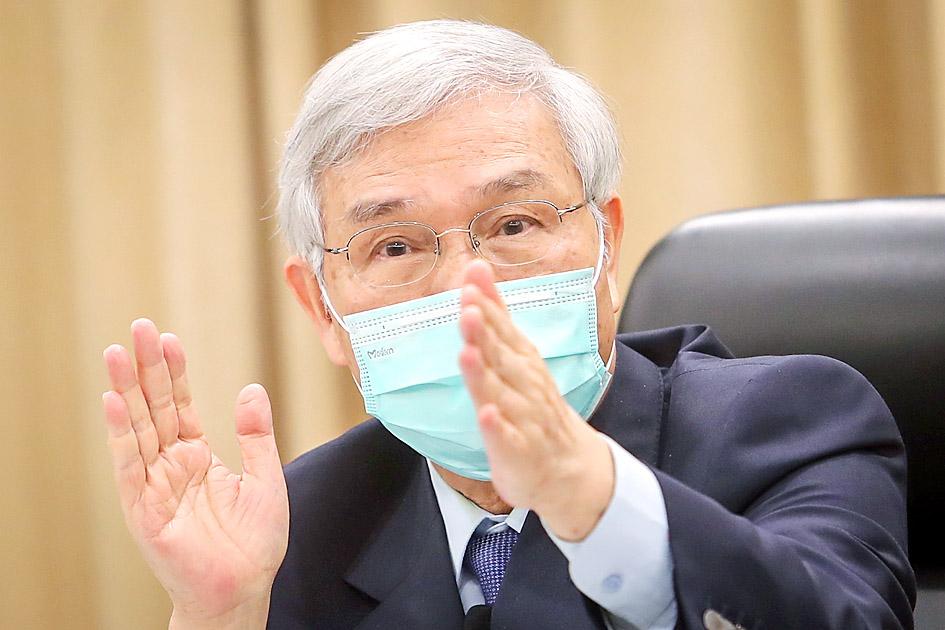
Photo: CNA
Excluding spikes in oil prices and airfares, consumer prices remain stable, giving the central bank room to hold policy rates unchanged, Yang told an online news conference.
It is the first time that the central bank has moved the quarterly media briefing online after its board members met in three separate rooms to avoid infection risks.
The central bank is looking at an annual increase of 1.58 percent in consumer prices this year with the core consumer price index, a more reliable long-term price tracker because it expels volatile items, clocking a 1.1 percent gain.
Although consumer activity has come to an abrupt halt, exports and private investment continue to pick up as the US and Europe reopen their economies, favorable for global trade, Yang said.
Exports this quarter are likely to rise by more than 30 percent from a year earlier, riding on strong inventory demand worldwide for tech and non-tech products, Ministry of Finance data showed.
The governor reiterated that he was uncomfortable about increasing interest rates soon, as even talking about it could attract hot money, while peers around the world maintain quantitative easing to support their economies.
The New Taiwan dollar has climbed to a near three-decade high against the US dollar this year on the back of robust exports and relatively generous dividend payouts by local listed firms, Yang said.
Yang said he understood that tight movement restrictions were responsible for sluggish property transactions, and the market could regain traction once the level 3 alert is lifted.
“The central bank will keep a close watch, and take quick action to rein in property price hikes whenever necessary,” he said, as the effect of selective credit controls is not yet evident.
However, the governor said he has been pleased with ultra-low instances of bad loans linked to mortgage and construction financing.
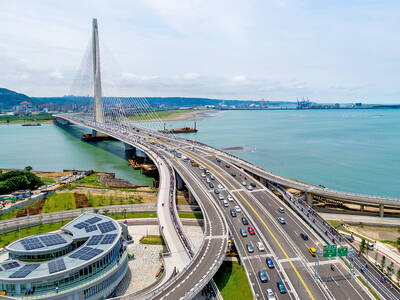
The Ministry of Transportation and Communications yesterday inaugurated the Danjiang Bridge across the Tamsui River in New Taipei City, saying that the structure would be an architectural icon and traffic artery for Taiwan. Feted as a major engineering achievement, the Danjiang Bridge is 920m long, 211m tall at the top of its pylon, and is the longest single-pylon asymmetric cable-stayed bridge in the world, the government’s Web site for the structure said. It was designed by late Iraqi-British architect Zaha Hadid. The structure, with a maximum deck of 70m, accommodates road and light rail traffic, and affords a 200m navigation channel for boats,
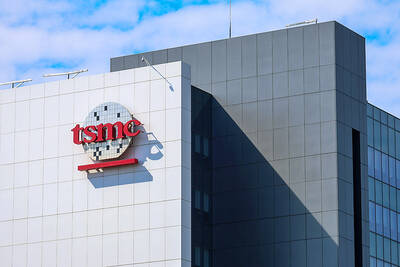
Taiwan Semiconductor Manufacturing Co (TSMC, 台積電), the world’s largest foundry service provider, yesterday said that global semiconductor revenue is projected to hit US$1.5 trillion in 2030, after the figure exceeds US$1 trillion this year, as artificial intelligence (AI) demand boosts consumption of token and compute power. “We are still at the beginning of the AI revolution, but we already see a significant impact across the whole semiconductor ecosystem,” TSMC deputy cochief operating officer Kevin Zhang (張曉強) said at the company’s annual technology symposium in Hsinchu City. “It is fair to say that in the past decade, smartphones and other mobile devices were
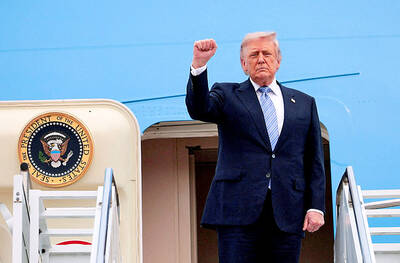
US-CHINA SUMMIT: MOFA welcomed US reassurance of no change in its Taiwan policy; Trump said he did not comment when Xi talked of opposing independence US President Donald Trump yesterday said he has not made a decision on whether to move forward with a major arms package for Taiwan after hearing concerns about it from Chinese President Xi Jinping (習近平). Trump’s comments on Taiwan came as he flew back to Washington after wrapping up critical talks in which both leaders said important progress was made in stabilizing US-China relations even as deep differences persist between the world’s two biggest powers on Iran and Taiwan. “I will make a determination,” Trump said, adding: “I’ll be making decisions. But, you know, I think the last thing we need right
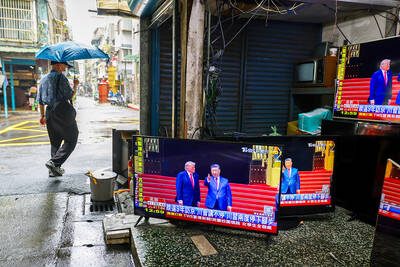
TAIWAN ISSUE: US treasury secretary Scott Bessent said on the first day of meetings that ‘it wouldn’t be a US-China summit without the Taiwan issue coming up’ There were no surprises on the first day of the summit between US President Donald Trump and Chinese President Xi Jinping (習近平), the Mainland Affairs Council (MAC) said yesterday, as the government reiterated that cross-strait stability is crucial to the Asia-Pacific region, as well as the world. As the two presidents met for a highly anticipated summit yesterday, Chinese state media reported that Xi warned Trump that missteps regarding Taiwan could push their two countries into “conflict.” Trump arrived in China with accolades for his host, calling Xi a “great leader” and “friend,” and extending an invitation to visit the White House


 RSS
RSS