


“Electrifying” would be the best way to describe a live performance from rising stars Future After a Second (FAAS, 瞬轉未來), who will open for Infernal Chaos tomorrow night at Legacy Taipei. In a country where many a rock show conducts a stationary group of spectators, theirs is a refreshing relief from the norm.
Granted, any band that dares to record with Jesse “Black” Liu (劉笙彙) is bound to be good; the man is a demon and perfectionist. Masochists the likes of Flesh Juicer (血肉果汁機) and Emerging from the Cocoon (破繭而出) have produced tracks there, and sessions in excess of nine hours aren’t unheard of.
But the trials have been worth it: FAAS’ debut EP, To The Light, which was released on iTunes in January of last year, is highly polished. Lyrical themes centering on positivity are central to their music and sets them apart from others in a genre known for its darker content.

Photo courtesy of ZL Ltd Photography
“I have a lot of friends that often feel [depressed],” says Tak Wu (武克彥), the band’s vocalist. “I hope our songs can be the spiders’ silk that pulls you back up.”
After putting in four years at the Beastie Rock Festival (巨獸搖滾音樂祭), a well known indie rock fest for new bands to show off their chops, the band joins a slew of Taiwanese indie artists gaining acclaim further afield.
The quintet has signed with Japan’s Far Channel Records, and organized their own music festival, Autumn Attack, which featured headliner veterans Emerging From The Cocoon as well as hard emo Faded Moment (凋零瞬間) and the genre-less Endtrocity (暴行終止).

pHOTO COURTESY OF Marginalman A Tse
This year they made their game debut on Cytus II, the second iteration of the highly rated rhythm game by Rayark Inc, a Taiwanese indie game company with over 6 million players worldwide.
When asked the reason for their rapid rise, band members point to drummer Shun Hsu (許原峻).
“We [almost] split up,” says guitarist Nicky Li (李秉諺). “Our previous drummer ... was leaving, and we just didn’t know if we could go on.”

Photo courtesy of ZL Ltd Photography
It’s a good thing they did.
The recent trend in Taiwanese indie music to incorporate local elements — lyrics in Hoklo (more commonly known as Taiwanese) or to focus on the nation’s culture — has worked well for their predecessors, but it isn’t what FAAS is trying to convey. Their emphasis lies in their live shows and their interaction with the audience.
In addition to the continuation of Autumn Attack, this year they are hoping to build upon their international expansion to include tours in Thailand and Southeast Asia with plans for an album out by the end of the year.
“If everything goes according to plan, I don’t think we will have time for it all,” jokes bassist Artie Lo (羅正輝).
Ambitious words but probably not far from the truth.

The Portuguese never established a presence on Taiwan, but they must have traded with the indigenous people because later traders reported that the locals referred to parts of deer using Portuguese words. What goods might the Portuguese have offered their indigenous trade partners? Among them must have been slaves, for the Portuguese dealt slaves across Asia. Though we often speak of “Portuguese” ships, imagining them as picturesque vessels manned by pointy-bearded Iberians, in Asia Portuguese shipping between local destinations was crewed by Asian seamen, with a handful of white or Eurasian officers. “Even the great carracks of 1,000-2,000 tons which plied

It’s only half the size of its more famous counterpart in Taipei, but the Botanical Garden of the National Museum of Nature Science (NMNS, 國立自然科學博物館植物園) is surely one of urban Taiwan’s most inviting green spaces. Covering 4.5 hectares immediately northeast of the government-run museum in Taichung’s North District (北區), the garden features more than 700 plant species, many of which are labeled in Chinese but not in English. Since its establishment in 1999, the site’s managers have done their best to replicate a number of native ecosystems, dividing the site into eight areas. The name of the Coral Atoll Zone might
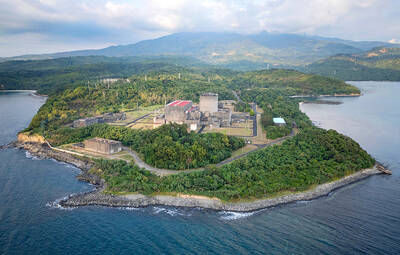
Nuclear power is getting a second look in Southeast Asia as countries prepare to meet surging energy demand as they vie for artificial intelligence-focused data centers. Several Southeast Asian nations are reviving mothballed nuclear plans and setting ambitious targets and nearly half of the region could, if they pursue those goals, have nuclear energy in the 2030s. Even countries without current plans have signaled their interest. Southeast Asia has never produced a single watt of nuclear energy, despite long-held atomic ambitions. But that may soon change as pressure mounts to reduce emissions that contribute to climate change, while meeting growing power needs. The

On Monday morning, in quick succession, the Chinese Communist Party (CCP) and the Chinese Nationalist Party (KMT) released statements announcing “that the Central Committee of the Communist Party of China and General Secretary Xi Jinping (習近平) have invited KMT Chairwoman Cheng Li-wun (鄭麗文) to lead a delegation on a visit to the mainland” as the KMT’s press release worded it. The KMT’s press release added “Chairwoman Cheng expressed her gratitude for the invitation and has gladly accepted it.” Beijing’s official Xinhua news release described Song Tao (宋濤), head of the Taiwan Work Office of the CCP Central Committee, as


 RSS
RSS