


One of China’s top art academies is facing criticism for moving ahead with a major exhibition of work by Anselm Kiefer, even after the blue-chip German artist expressly disavowed the show, which he said was organized without his consent.
In a statement issued last week, Kiefer called for the cancellation of the exhibition, “Anselm Kiefer in China,” which was co-organized by the Central Academy of Fine Arts Museum in Beijing and the Bell Art Center in Hamburg, Germany.
“Throughout my career I have been heavily involved in all my major international exhibitions, and it is a matter of deep regret and frustration that the organizers of my first show in China have seen fit to exclude me from the process,” Kiefer said in the statement.
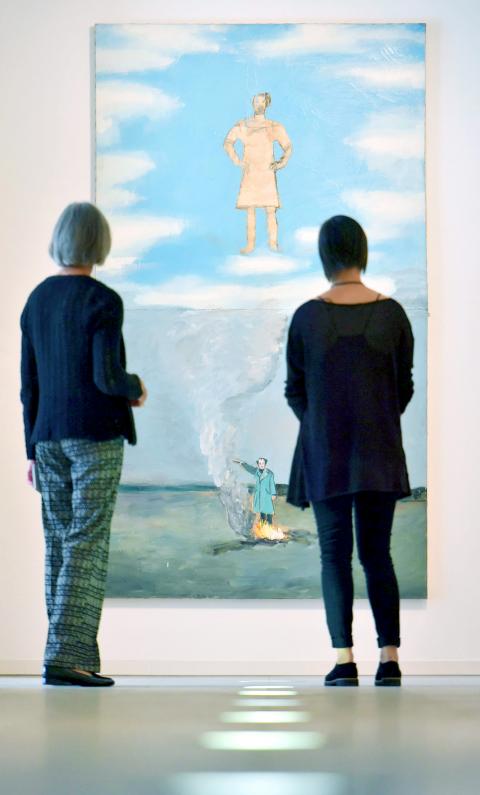
Photo: EPA /Jan-Philpp Strobel
The artist, who did not respond to requests for an interview, is in London to oversee the installation of his latest show, which opened Wednesday at White Cube Bermondsey.
Despite Kiefer’s plea, “Anselm Kiefer in China” opened last Saturday as originally planned and is scheduled to run until Jan. 8. The show, which contains about 85 works, is being billed as Kiefer’s first-ever exhibition in China.
In a statement released before the opening, the Central Academy of Fine Arts Museum emphasized that because all of the owners gave permission to loan the works, the exhibition presented no problems on legal grounds. Organizers have said that most of the works are drawn from the collection of one unnamed individual.
But some experts say the issue is an ethical one. For major survey shows of living artists, many museums will typically go out of their way to obtain the consent of the artist.
“It’s not only about respecting the artist, it’s about respecting the audience,” said Pi Li (皮力), a senior curator at M+, the planned museum for visual culture in Hong Kong. “It’s very difficult to imagine how you can select the best works of an artist from a huge oeuvre and present them in a limited museum space without the involvement of the artist.”
In its statement, the museum blamed the show’s German co-organizers for misrepresenting Kiefer’s involvement in the show.
“It was not until after the agreement with the German partners had been signed that we learned that Mr. Kiefer actually had not signed off on the show,” the statement said.
Wang Huangsheng (王璜生), the director of the Central Academy of Fine Arts Museum, said that his museum had been hoping to do a Kiefer show for many years but that funding was a problem. So when Bell Art Center approached the museum team this year and offered to cover most of the costs, he said, the museum was eager to sign on.
“We invested very little money in the exhibition,” Wang said in a telephone interview. “We mostly just provided the venue.”
He added: “We have learned a lesson from this. In the future, we will be extremely careful when working with such companies.”
On its Web site, Bell Art Center describes itself as offering a “series of services such as research, teaching and preparation and display of artwork.” Beate Reifenscheid, the German co-curator of the exhibition and the director of the Ludwig Museum in Koblenz, Germany, is listed as the center’s “main curator and main art adviser.”
In a telephone interview, Reifenscheid disputed Kiefer’s statement, insisting that multiple attempts had been made to reach out to him through one of his friends and several dealers of his work.
“We finally found out he personally had no time,” Reifenscheid said, declining to specify who relayed this information.
To many within China’s art circles, the situation is surprising given the Central Academy of Fine Arts Museum’s prominence as a government-backed institution and its past experience organizing solo shows featuring prominent Western artists like Andy Warhol and Joseph Beuys. While many of these exhibitions were also organized with partner institutions, Wang said that the museum had not had any problems communicating with the artists or their estates.
Some experts said the debate over the Kiefer show reflected a persistent problem in China, where professional practices sometimes remain at odds with international standards.
“In China, museums have been built at such a rapid pace that people haven’t had time to stop and think about the culture and ethics surrounding the content that’s going inside,” said Pi, the M+ curator. “China is so eager to be involved in the international community at a museum level, but it’s clear there is still a lot to learn.”


The US war on Iran has illuminated the deep interdependence of Asia on flows of oil and related items as raw materials that become the basis of modern human civilization. Australians and New Zealanders had a wake up call. The crisis also emphasizes how the Philippines is a swatch of islands linked by jet fuel. These revelations have deep implications for an invasion of Taiwan. Much of the commentary on the Taiwan scenario has looked at the disruptions to world trade, which will be in the trillions. However, the Iran war offers additional specific lessons for a Taiwan scenario. An insightful
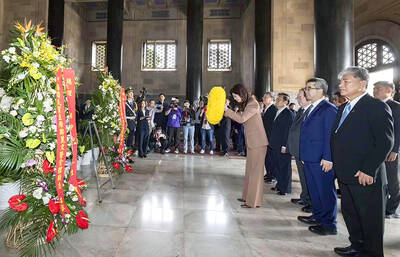
The problem with Marx’s famous remark that history repeats itself, first as tragedy, the second time as farce, is that the first time is usually farce as well. This week Chinese Nationalist Party (KMT) Chair Cheng Li-wun (鄭麗文) made a pilgrimage to the People’s Republic of China (PRC) “to confer, converse and otherwise hob-nob” with Chinese Communist Party (CCP) officials. The visit was an instant international media hit, with major media reporting almost entirely shorn of context. “Taiwan’s main opposition leader landed in China Tuesday for a rare visit aimed at cross-strait ‘peace’”, crowed Agence-France Presse (AFP) from Shanghai. Rare!
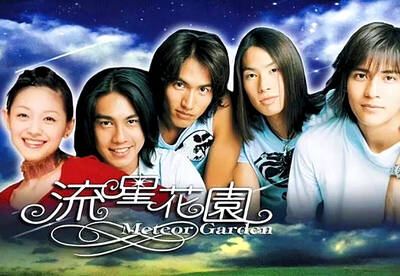
April 6 to April 13 Few expected a Japanese manga adaptation featuring four tall, long-haired heartthrobs and a plucky heroine to transform Taiwan’s television industry. But Meteor Garden (流星花園) took the nation by storm after premiering on April 12, 2001, single-handedly creating the “idol drama” (偶像劇) craze that captivated young viewers across Asia. The show was so successful that Japan produced its own remake in 2005, followed by South Korea, China and Thailand. Other channels quickly followed suit, with more than 50 such shows appearing over the following two years. Departing from the melodramatic

Sunflower movement superstar Lin Fei-fan (林飛帆) once quipped that the Democratic Progressive Party (DPP) could nominate a watermelon to run for Tainan mayor and win. Conversely, the DPP could run a living saint for mayor in Taipei and still lose. In 2022, the DPP ran with the closest thing to a living saint they could find: former Minister of Health and Welfare Chen Shih-chung (陳時中). During the pandemic, his polling was astronomically high, with the approval of his performance reaching as high as 91 percent in one TVBS poll. He was such a phenomenon that people printed out pop-up cartoon


 RSS
RSS