


Looking at Chang Jui-pin’s (張瑞頻) new series of gouache on polyethylene “bucket men” paintings, I was reminded of Oscar Wilde’s dictum: When bankers get together for dinner, they discuss Art. When artists get together for dinner, they discuss money.
New Taiwan dollars, Japanese yen, Chinese renminbi, Korean won and Hong Kong dollars are among the currencies the artist reproduces in her solo exhibition Cash Bucket < Ever Increasing (錢桶 < 越來越大), currently on view at ArtDoor Gallery. To lend the paintings a larger-than-life, almost archetypal, aspect, Chang enlarges the original banknotes, slightly alters their design, and replaces the original personages with her bucket men, plump figures dressed in green and blue with a black bucket on their head, which are meant to hide the frightening contingencies of history.
Diverging thematically from other money art, which generally disparages rampant materialism or social inequality, Chang’s paintings symbolize the “mental and physical baptism” or estrangement one undergoes after arriving in a new country.
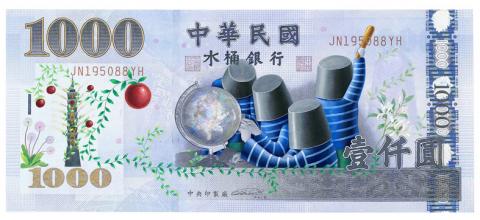
Photo courtesy of Artdoor Gallery
But the works also suggest that a country should be seen as more than the sum total of its currency, perhaps rare in our money-obsessed times. With Korea’s 50,000 KRW, 2009 Edition (2013), this takes a humorous turn as the bucket men dance gangnam style within the frame of a smartphone. In others, the bucket men become the heroic figures in epochal events depicted in the scenes that a particular country deems worthy of putting on its legal tender. Rather than subverting the symbolism of money, Chang employs it — perhaps a little too superficially — to celebrate difference.
■ ArtDoor Gallery (藝境畫廊), 5F, 36, Ln 164, Hulin St, Taipei City (台北市虎林街164巷36號5樓), tel: (02) 2345-6773. Open Tuesdays to Sundays from 2pm to 7pm
■ Until June 2
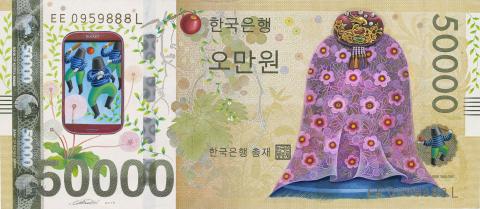
Photo courtesy of Artdoor Gallery
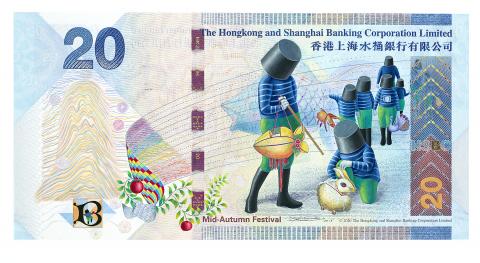
Photo courtesy of Artdoor Gallery
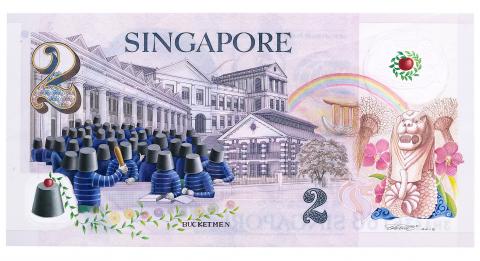
Photo courtesy of Artdoor Gallery
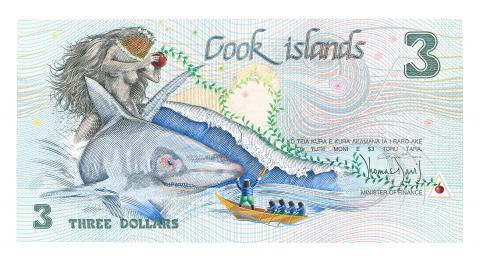
Photo courtesy of Artdoor Gallery
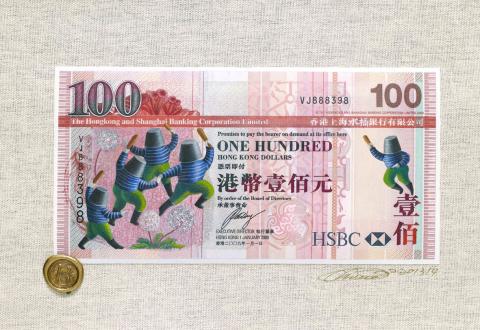
Photo courtesy of Artdoor Gallery
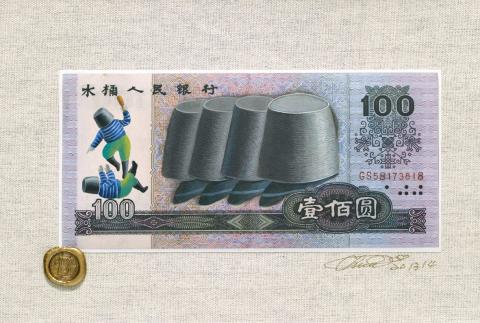
Photo courtesy of Artdoor Gallery
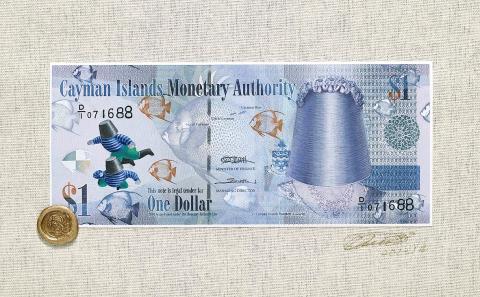
Photo courtesy of Artdoor Gallery

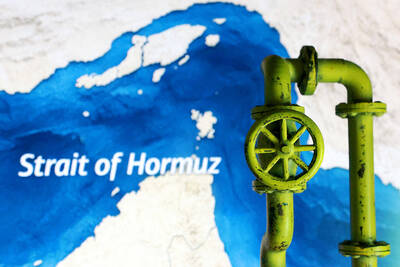
The US war on Iran has illuminated the deep interdependence of Asia on flows of oil and related items as raw materials that become the basis of modern human civilization. Australians and New Zealanders had a wake up call. The crisis also emphasizes how the Philippines is a swatch of islands linked by jet fuel. These revelations have deep implications for an invasion of Taiwan. Much of the commentary on the Taiwan scenario has looked at the disruptions to world trade, which will be in the trillions. However, the Iran war offers additional specific lessons for a Taiwan scenario. An insightful
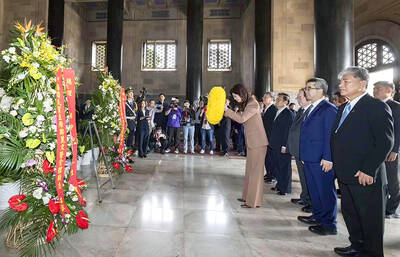
The problem with Marx’s famous remark that history repeats itself, first as tragedy, the second time as farce, is that the first time is usually farce as well. This week Chinese Nationalist Party (KMT) Chair Cheng Li-wun (鄭麗文) made a pilgrimage to the People’s Republic of China (PRC) “to confer, converse and otherwise hob-nob” with Chinese Communist Party (CCP) officials. The visit was an instant international media hit, with major media reporting almost entirely shorn of context. “Taiwan’s main opposition leader landed in China Tuesday for a rare visit aimed at cross-strait ‘peace’”, crowed Agence-France Presse (AFP) from Shanghai. Rare!
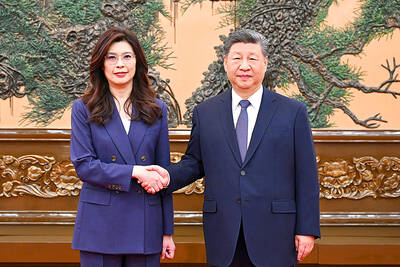
What is the importance within the Chinese Nationalist Party (KMT) of the meeting between Xi Jinping (習近平), the leader Chinese Communist Party (CCP), and Cheng Li-wun (鄭麗文), the leader of the KMT? Local media is an excellent guide to determine how important — or unimportant — a news event is to the public. Taiwan has a vast online media ecosystem, and if a news item is gaining traction among readers, editors shift resources in near real time to boost coverage to meet the demand and drive up traffic. Cheng’s China trip is among the top headlines, but by no means
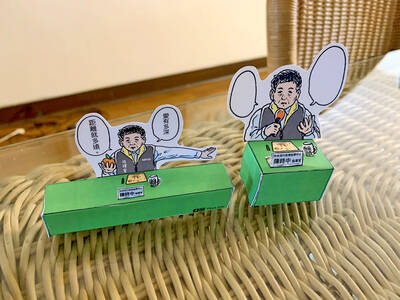
Sunflower movement superstar Lin Fei-fan (林飛帆) once quipped that the Democratic Progressive Party (DPP) could nominate a watermelon to run for Tainan mayor and win. Conversely, the DPP could run a living saint for mayor in Taipei and still lose. In 2022, the DPP ran with the closest thing to a living saint they could find: former Minister of Health and Welfare Chen Shih-chung (陳時中). During the pandemic, his polling was astronomically high, with the approval of his performance reaching as high as 91 percent in one TVBS poll. He was such a phenomenon that people printed out pop-up cartoon


 RSS
RSS