


The Taiwan Kunqu Opera Theater (台灣崑劇團), and particularly its founder Hung Wei-chu (洪惟助), has been instrumental in the revival of kun opera in the 21st century. While its productions have not received the same kind of popular adulation as the modernized reworking of The Peony Pavilion (牡丹亭) and The Jade Hairpin (玉簪記) sponsored by author and kun opera aficionado Kenneth Pai (白先勇), its roots in academia have meant a meticulous mining of historical materials to flesh out the still relatively small kun repertoire.
Fan Li and Xi Shi (范蠡與西施) is a new opera based on the Washing Silk Tale (浣紗記), an important work in the history of kun opera that has been handled roughly by history, and until the present reworking, only existed in fragments. At the time it was first produced, it was notable for its innovative style of singing, but its loose narrative structure, flat characterization and heavy-handed moralizing led to its subsequent demise as a regular item of kun performance.
According to Hung, the new production has almost 80 percent new material, with the original story cut from 45 acts to 11 acts performed over two-and-a-half hours. The characterization of the protagonists has also been extensively tampered with to make the story more acceptable to a modern audience.
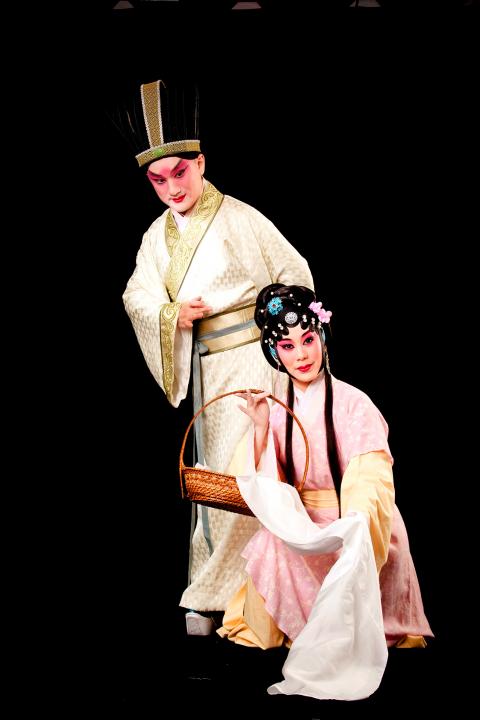
Photo Courtesy of New Aspect
Fan Li and Xi Shi tells the story of Fan Li (范蠡), a prime minister of Yue (越), one of the warring kingdoms of the Spring and Autumn period (approximately 771 until 476 BC). His lover was the great beauty Xi Shi (西施), the Helen of Troy of Chinese literature. When the king of Yue was hard-pressed by the king of Wu, he begged Fan to use Xi Shi in a honey trap to bring down his rival. Fan, loyal to his master, gave up Xi Shi, who obediently worked her seductive wiles, and was so effective that the king of Wu neglected his duties as a monarch, and ultimately lost his kingdom and his life.
This story, which casts Xi Shi as little more than a pawn in a game played by men, and whose main theme is national pride and manly sacrifice, does not stint on banging a patriotic drum, and Hung has considerably reworked the story to bring the romantic involvement of the two protagonists to the fore, giving Xi Shi a much more complex role than existed in the original story. “I wanted to make the characters come alive,” Hung said, adding that the characterization of the original was absolutely divorced from real human emotions.
The current production has been created in cooperation with the Zhejiang Province Kun Opera Company (浙江崑劇團), and draws on the outstanding talents of director Shen Bin (沈斌) and composer Zhou Xuehua (周雪華) from the Shanghai Kun Opera Company (上海崑劇團). The roles of the protagonists will be played by a different performer for each of the three performances at the Metropolitan Hall (城市舞台), showcasing the wealth of talent that is growing up around kun opera.
Director Shen said that he had sought to shift the emphasis of Fan Li and Xi Shi from historical epic to a more intimate drama of human emotions. Nevertheless, the broad background of the story means that there are roles for many different types of character players. “With so many roles, this opera is a great challenge for any opera troupe, but for this same reason, it has the potential to become a much performed piece in a company’s repertoire as a proving ground for the talents of both major and minor players.”


The US war on Iran has illuminated the deep interdependence of Asia on flows of oil and related items as raw materials that become the basis of modern human civilization. Australians and New Zealanders had a wake up call. The crisis also emphasizes how the Philippines is a swatch of islands linked by jet fuel. These revelations have deep implications for an invasion of Taiwan. Much of the commentary on the Taiwan scenario has looked at the disruptions to world trade, which will be in the trillions. However, the Iran war offers additional specific lessons for a Taiwan scenario. An insightful
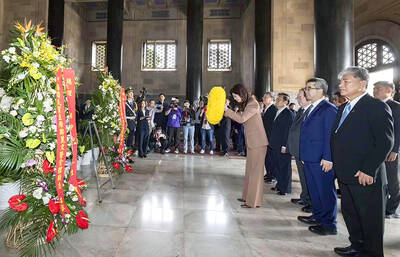
The problem with Marx’s famous remark that history repeats itself, first as tragedy, the second time as farce, is that the first time is usually farce as well. This week Chinese Nationalist Party (KMT) Chair Cheng Li-wun (鄭麗文) made a pilgrimage to the People’s Republic of China (PRC) “to confer, converse and otherwise hob-nob” with Chinese Communist Party (CCP) officials. The visit was an instant international media hit, with major media reporting almost entirely shorn of context. “Taiwan’s main opposition leader landed in China Tuesday for a rare visit aimed at cross-strait ‘peace’”, crowed Agence-France Presse (AFP) from Shanghai. Rare!
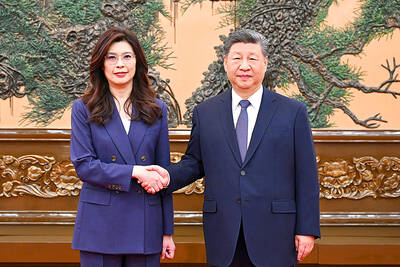
What is the importance within the Chinese Nationalist Party (KMT) of the meeting between Xi Jinping (習近平), the leader Chinese Communist Party (CCP), and Cheng Li-wun (鄭麗文), the leader of the KMT? Local media is an excellent guide to determine how important — or unimportant — a news event is to the public. Taiwan has a vast online media ecosystem, and if a news item is gaining traction among readers, editors shift resources in near real time to boost coverage to meet the demand and drive up traffic. Cheng’s China trip is among the top headlines, but by no means

Sunflower movement superstar Lin Fei-fan (林飛帆) once quipped that the Democratic Progressive Party (DPP) could nominate a watermelon to run for Tainan mayor and win. Conversely, the DPP could run a living saint for mayor in Taipei and still lose. In 2022, the DPP ran with the closest thing to a living saint they could find: former Minister of Health and Welfare Chen Shih-chung (陳時中). During the pandemic, his polling was astronomically high, with the approval of his performance reaching as high as 91 percent in one TVBS poll. He was such a phenomenon that people printed out pop-up cartoon


 RSS
RSS