


Buffeted by the formidable Coastal Mountain Range (海岸山脈), Taiwan’s isolated east coast has managed to avoid the recent growth of mass tourism seen across much of the rest of the country. Highway 9 (台九線) — often drenched by powerful typhoons — remains the area’s only major road, north or south, and rail passengers have to endure train journeys on limited services from Taipei that can take up to eight hours. There are even fewer planes. This is a place reserved for the determined.
However, plans are now well underway to develop Taitung’s largely untouched 231km-long coastline and at this very moment bulldozers are ploughing their way through heavily-forested hillsides as Highway 9 is widened south to Taitung from neighboring Pingtung.
As development gathers pace a debate has followed. At the center of this increasingly heated row sits the controversial Miramar Resort Village. Located in Taitung’s Shanyuan Bay (杉原灣), approximately 10km north of Taitung City, the 80-room giant, which remains unopened amid a bitter legal battle, is where the war over the future of this undeveloped coastal region is being fought.

Photo: Sam Sky Wild
KEEP IT PRISTINE
The Anti, Anti, Anti (反反反行動聯盟) movement — an amalgamation of environmental groups dedicated to removing the hotel — has become a cause celebre since 2011, with several prominent personalities, including The Chairman vocalist A-chi (阿吉) and popular indie-pop singer Deserts Chang (張懸), lending their support.
Five years ago 33-year-old shop-keeper and anti-hotel activist Chiu Chui-ta (邱垂達) moved to the sleepy town of Dulan (都蘭) — now the hideaway of choice for many Taiwanese artists and host to the famous Siki Workshop (Siki木雕工作室) and the arts venue Moonlight Inn (月光小棧). Chiu says the seven-story hotel should be pulled down.

Photo: Sam Sky Wild
“If the hotel opens it will be the beginning of the destruction of Taitung and if Taitung goes in this direction, [that’s the end of the] region. I want to keep this place intact … I didn’t come to Taitung to make money, I came here for the culture, the environment, the people and the lifestyle.”
BOOST IN TOURISM
At the resort’s temporary offices — nestled in rocks overlooking the coral-rich, sandy bay, and just a stone’s throw from the hotel itself — 45-year-old Jeffrey Chiu (邱聰得), the man charged with spearheading the development of the resort’s leisure facilities should it finally open, sips a cappuccino in the afternoon heat. Chiu says that the region desperately needs tourism and the financial stimulus it would bring.

Photo: Sam Sky Wild
“I am a Taitung local … in Taitung [we] are so lucky that [Miramar Hotel’s parent company Durban Group] invested here because Taitung really needs a five-star hotel. It really needs touristic development for the local economy … Tourism is the only way,” Chiu says.
Shanyuan Bay — once visible from the nearby road — hosts an impressive, open stretch of yellow sand beach and the sea teems with coral. While there is no questioning the presence of the NT1.1 billion (US$37 million) hotel — the structure commands a beachside position so great it casts a late afternoon shadow over the entire bay — the merits of its construction continues to fuel acrimonious debate in Taitung.
The 2004 Build-Operate-Transfer (BOD) hotel project signed between the Taitung County Government and the Miramar Resort Hotel Company is to see the touristic complex returned to public hands 50 years after the agreement was inked. BOD is a model of government infrastructure development, borrowed in part from systems first trialed in the UK, that allows private firms to build and operate key public facilities for an agreed period of time.

Photo: Sam Sky Wild
Work on the hotel finally began in 2005 amid widespread anger over the impact of the hotel’s construction. Of particular concern to protest groups was the fact that because the resort itself occupies an area of 9997-square meters — one sixth of the beach’s total area — it did not have to undergo an environmental impact assessment (EIA) as this is reserved exclusively for projects of more than one-hectare in size. The Mirimar Hotel was just three-square meters too small.
TENSE DEBATE
However, later that year the hotel developers applied for an extension of the original site to include the entire beach, said a source close to the hotel project who requested anonymity due to the sensitivity of the project. The purpose of the plan, the source indicated, was to allow the hotel to potentially have additional chalets on the beachside property at some point in the future. The fact that the new extension encompassed the entire beach, as well as alarm over the size of the hotel under construction, further angered protest groups.
Despite a raft of successful legal challenges by eco-oriented organizations — spearheaded by a group of lawyers largely working unpaid — construction of the hotel continued. A series of landmark Supreme Court decisions in 2008, 2010 and 2012 were seemingly ignored even after the legal body “found [Taitung County Government’s EIA] review flawed because five out of the 15 members on the EIA committee organized by the county were government officials.”
On Dec. 23 last year, the atmosphere outside Taitung’s imposing County Hall was tense. Over 100 police officers wielding meter-long batons and riot-control shields stood facing a crowd of anti-hotel development protesters perhaps 250-strong. Behind them another group of equal size had gathered in support of the hotel, shouting that it would bring work to the region. Police refused to allow journalists to access the crowd within the town hall complex and instead demanded to see ID papers.
Within the town hall, and after seven years of bitter legal wrangling, a meeting of the Taitung City Government’s EIA panel finally gave the hotel the green light. The respective anger and jubilation on the streets outside was palpable. Representatives from the Miramar Resort have cheerfully reported since then that the hotel is to stage a “soft opening” this summer. Protesters have pledged to mount a further legal challenge and are vowing to carry out a three-week long walk from Taitung to Taipei to highlight their anger at the decision.
RUSHED PROCESS
Chiu Fong-ching (邱鴻慶), 62, a retired Taitung County Environmental Protection Bureau officer who was working at the time the hotel came into being and who has watched the case closely ever since, says the whole process was rushed and that the local government did not take the process seriously enough. “In my opinion the EIA was legal, but the building itself was not,” he says.
Chiu maintains that the county government has no choice however, despite a recent change of administration, as it is contractually obliged to pursue the hotel to its completion and would face a multi-million-dollar lawsuit if it reneged on the deal. “It’s like once you have started washing your hair, there is no turning back”.
However, Chiu, who was intimately involved in assessing the environmental impact of many projects in Taitung throughout a decades-long career, says the future will be different for developers seeking to build in Taitung. “New projects could be assessed by the central government in the future and this would challenge the closeness of the relationship between the local government and developers — it won’t be so easy”, he added.
The second part of this feature will appear in tomorrow’s edition

It seems every few days one bumps into one of those “real man” comments in which Taiwan is urged to “face reality” or similar, and “make a deal,” with the speaker implying that soon it will be too late. “Deal” advocates always present themselves as having a superior grip on reality, and the manly ability to make the “hard choice.” Their testosterone-laden language often echoes that of Taiwan sellout advocates. Note that such commentary always specifies a process (“make a deal, work with, make progress”), never the end state of what occupation by a violent authoritarian colonialist state will entail. In

There are shadowy cabals plotting to sell out Taiwan to be annexed by China, by invasion if necessary. Fortunately, they are buffoons. In 2019, former Bamboo Union gangster and founder of the China Unification Promotion Party (CUPP), Chang An-le (張安樂, colorfully known as “White Wolf”), led a protest at the Legislative Yuan against comments made by then-premier Su Tseng-chang (蘇貞昌) that in the event of an attack by China, he would never surrender, but would protect the nation by fighting to the end, even if he only had a broom. Chang had party members bring a wooden casket that they
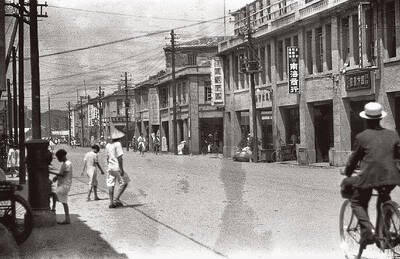
June 1 to June 7 "If all Taiwanese were as afraid of dying as you, then what would happen?” Physician Shih Chiang-nan (施江南) reportedly said this to his wife Chen Chiao-tung (陳焦桐) after she urged him to stop intervening on behalf of Taiwanese soldiers stranded overseas after serving in the Japanese Army during World War II. Shih had clashed with high-ranking officials over the issue, engaged in several heated arguments with Taiwan governor-general Chen Yi (陳儀) and allegedly shouted at general Ko Yuan-fen (柯遠芬), chief of staff of the Taiwan Garrison Command, over
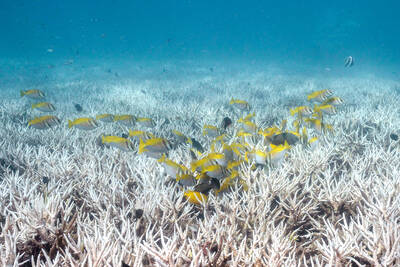
Food prices have often played a major role in Taiwan’s history. The first major wave of migration from China occurred in 1628. A moderate drought, the Ming Dynasty maritime ban that prohibited fishing and trading (intended to reduce piracy) and a temporary tax, conspired to exhaust local resources, leading to famine in Fujian Province. The famed pirate and trader Zheng Zhilong (鄭芝龍), scooped up starving people from Fujian and transported them across the Taiwan Strait, where they settled under the Dutch. Two factors enabled Zheng. First, by 1624 he had settlements around today’s Beigang (北港) in Yunlin County with a small


 RSS
RSS