


When Kung Fu Panda 3 kicks its way into China’s theaters in 2016, the country’s vigilant film censors will find no nasty surprises.
After all, they have already dropped in to monitor the movie at the DreamWorks Animation campus here. And the story line, production art and other creative elements have met their approval.
The lure of access to China’s fast-growing film market — now the world’s second largest, behind that of the US — is entangling studios and moviemakers with the state censors of a country in which American notions of free expression simply do not apply.

Photo courtesy of 20th Century Fox
Whether studios are seeking to distribute a completed film in China or join with a Chinese company for a co-production shot partly in that country, they have discovered that navigating the murky, often shifting terrain of censorship is part of the process.
Billions of dollars ride on whether they get it right. International box-office revenue is the driving force behind many of Hollywood’s biggest films, and often plays a deciding role in whether a movie is made. Studios rely on consultants and past experience — and increasingly on informal advance nods from foreign officials — to help gauge whether a film will pass censorship; if there are problems they can sometimes be addressed through appeal and subsequent negotiations.
But Paramount Pictures just learned the hard way that some things won’t pass muster — like US fighter pilots in dogfights with MiGs. The studio months ago submitted a new 3-D version of Top Gun to Chinese censors. The ensuing silence was finally recognized as rejection.

Photo courtesy of 20th Century Fox
Problems more often affect films that touch the Chinese directly.
“Any movie about China made by outsiders is going to be very sensitive,” said Rob Cohen, who directed The Mummy: Tomb of the Dragon Emperor, among the first in a wave of co-productions between US studios — in this case, Universal Pictures — and Chinese companies.
One production facing scrutiny is Disney and Marvel’s Iron Man 3, parts of which were filmed in Beijing in the last month. It proceeded under the watchful eye of Chinese bureaucrats, who were invited to the set and asked to advise on creative decisions, according to people briefed on the production who asked for anonymity to avoid conflict with government or company officials. Marvel and Disney had no comment.

Photo courtesy of Marvel
Another prominent film, Ang Lee’s (李安) Life of Pi, which was nominated last week for 11 Academy Awards, made it through the process mostly unscathed, but got some pushback over a line in which a character declared that “religion is darkness.”
“They modified the translation a little, for fear of provoking religious people,” Lee said.
Hollywood as a whole is shifting toward China-friendly fantasies that will fit comfortably within a revised quota system, which allows more international films to be distributed in China, where 3-D and large-format Imax pictures are particularly favored.

Photo courtesy of Marvel
At the same time, it is avoiding subject matter and situations that are likely to cause conflict with the roughly three dozen members of a censorship board run by China’s powerful State Administration of Radio, Film and Television, or SARFT.
In addition, some studios are quietly asking Chinese officials for assurance that planned films, even when they do not have a Chinese theme, will have no major censorship problems.
The censorship bureau did not respond to a list of questions submitted by The New York Times seeking information about its process and guidelines.
Studios are quickly discovering that a key to access in China is the inclusion of Chinese actors, story lines and locations. But the more closely a film examines China, the more likely it is to collide with shifting standards, unwritten rules and unfamiliar political powers who hold sway over what can be seen on the country’s roughly 12,000 movie screens.
Cohen’s Mummy film, which was shot throughout China in 2007, was a historical fantasy about an evil emperor who is magically resurrected by foreign adventurers in 1946. The script was pre-approved by China’s censorship board with only token changes — the emperor’s name had to be fictionalized, for instance. The censors also cautioned that the ancient ruler should not resemble Mao Zedong (毛澤東).
On reviewing the finished film, however, they found a deeper problem that “we didn’t have any way of seeing, or any way of fixing,” Cohen said: “White Westerners were saving China.” The picture was approved, he said, but its release was delayed until it had played elsewhere in the world, and pirated versions took a bite out of the Chinese box-office receipts.
For Americans, dealings with the Chinese censors are mostly a distant and secondhand business. Films are normally submitted by their Chinese partners, while various consultants in China handle the bureaucratic communications that lead to approval or rejection.
But those who shoot in China often assume that censorship officials have eyes and ears on the set.
“There were points where we were shooting with a crew of 500 people,” said Cohen of his movie. “I’m not sure who was who or what, but knowing the way the system works, it’s completely clear that had we deviated from the script, it would not have gone unnoticed.”
In a 2011 Web post, Robert Cain, a producer and consultant who guides filmmakers through China’s system, described having worked in Shanghai on a romantic comedy that went off script; the director included a take in which an extra, holding a camcorder, pretended to be a theater patron taping a movie on a screen.
The next day, Cain and others involved with the film were summoned to the office of a Communist Party member who told them the film was being shut down for its “naive” and “untruthful” portrayal of film piracy. Assuming they had been reported by a spy on their crew, the producers apologized and managed to keep the film on track.
Studios are seeking out official co-productions, in which a Chinese company works with a US studio in financing and creating a film, because they can bypass the Chinese quota system and bring their distributors a 43 percent share of ticket sales, rather than the 25 percent allotted to foreign-made films.
Co-productions like Kung Fu Panda 3 draw close monitoring by the censors at every step. Scripts are submitted in advance. Representatives of SARFT, according to Cohen and others, may be present on the set to guard against any deviation. And there is an unofficial expectation that the Chinese government’s approved version of the film will be seen both in China and elsewhere, although in practice it is not unusual for co-productions to slip through the system with differing versions, one for China, one for elsewhere in the world.
Questions about how Chinese forces are shaping American movies are now playing out in the making of Iron Man 3, which is set for release on May 3.
Disney and its Marvel unit want Iron Man 3 to gain co-production status, partly because the previous two Iron Man movies performed well in China. To work toward that distinction, Disney and Marvel made a deal last year for Beijing-based DMG Entertainment to join in producing and financing the film.
But they have taken a middle-of-the-road approach that appears intended to limit Chinese meddling in the creative process. A finished script was not submitted for approval and the companies have not yet made an application for official designation as a co-production. Rather, they are trying to show a heightened sense of cooperation in hopes the government will approve the status once that application is formally made in the spring.
The producers made a presentation to censors early in the process, describing broad strokes of the story, the history of other Marvel and Disney movies, and plans to integrate Chinese characters into the movie.
That won a conceptual sign-off for the film, which is being directed by Shane Black. Next, bureaucrats were invited to the set and were able to meet the star, Robert Downey Jr.
Hollywood executives are only now becoming familiar with the censorship board and its workings. A recent count by one of their advisers found that the board has 37 members, including representatives from government agencies and interest groups, like the Communist Youth League and the Women’s Federation, along with filmmakers, academics and professional bureaucrats.
At the top of SARFT is Cai Fuchao, a recent member of the Communist Party Central Committee. In a previous municipal post in Beijing, he was widely reported to have policed Web sites for banned material with the help of 10,000 volunteers, and to have joined in a roundup of 1 million illegally published books in 2004.
In 2008, after an uproar over the release of Ang Lee’s Lust, Caution, whose story of wartime love and collaboration caused unease even after sex scenes were deleted, written censorship guidelines were circulated in China, in what filmmakers there took to be a crackdown.
Some of the prohibitions were broad, barring violations of the fundamental principles of the constitution and the harming of social morality. Others were more pointed. Disparagement of the People’s Liberation Army and the police were banned, as were “murder, violence, horrors, ghosts, demons and supernaturalism.”
In all, the standards would appear to clash with almost any American film, other than, perhaps, the PG-rated animated fare of a DreamWorks Animation. (Even Kung Fu Panda provoked objections by some Chinese, who saw the lead character as profaning a nationally revered animal.) But some who have dealt with SARFT say the censors are often pragmatic, and appear to walk a line between the demands of viewers, who want more global fare, and those of politicians, who are out to protect the status quo.
For example, 20th Century Fox managed to get Lee’s Life of Pi through with only the modification of the “religion is darkness” line, despite the movie’s spiritual themes — which tread close to a prohibition against the preaching of cult beliefs and superstitions — and the earlier trouble over Lust, Caution.
For Americans, the hard part is knowing what might suddenly cause trouble — initial approvals notwithstanding. In 2009, Sony Pictures and its partner, the China Film Group, submitted their script for The Karate Kid to China’s censors, and dutifully changed parts of the story to suit them. But the finished film was rejected, according to people who were briefed on the process, essentially because film bureaucrats were unhappy that its villain was Chinese.
After negotiation, 12 minutes of the film were cut, and it was released in China, although later than intended.
Some filmmakers here suggest that impositions by the China censors are similar to the restrictions imposed by a ratings system administered by the Motion Picture Association of America. But Joan Graves, chairwoman of Hollywood’s ratings board, insists otherwise.
“We’re the only major country with a ratings system that does it on a voluntary basis,” she said.
Steven Soderbergh, whose film Contagion was shot partly in Hong Kong, said the participation of China’s censors simply added to the chorus of input that surrounds every big-budget filmmaker.
“I’m not morally offended or outraged,” Soderbergh said. “It’s fascinating to listen to people’s interpretations of your story.”

Sept.16 to Sept. 22 The “anti-communist train” with then-president Chiang Kai-shek’s (蔣介石) face plastered on the engine puffed along the “sugar railway” (糖業鐵路) in May 1955, drawing enthusiastic crowds at 103 stops covering nearly 1,200km. An estimated 1.58 million spectators were treated to propaganda films, plays and received free sugar products. By this time, the state-run Taiwan Sugar Corporation (台糖, Taisugar) had managed to connect the previously separate east-west lines established by Japanese-era sugar factories, allowing the anti-communist train to travel easily from Taichung to Pingtung’s Donggang Township (東港). Last Sunday’s feature (Taiwan in Time: The sugar express) covered the inauguration of the

The corruption cases surrounding former Taipei Mayor and Taiwan People’s Party (TPP) head Ko Wen-je (柯文哲) are just one item in the endless cycle of noise and fuss obscuring Taiwan’s deep and urgent structural and social problems. Even the case itself, as James Baron observed in an excellent piece at the Diplomat last week, is only one manifestation of the greater problem of deep-rooted corruption in land development. Last week the government announced a program to permit 25,000 foreign university students, primarily from the Philippines, Indonesia and Malaysia, to work in Taiwan after graduation for 2-4 years. That number is a
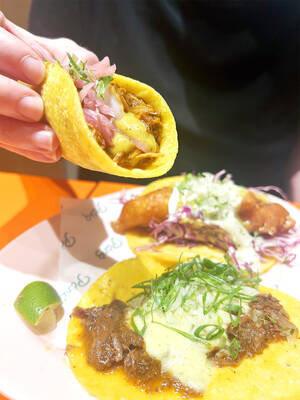
This year’s Michelin Gourmand Bib sported 16 new entries in the 126-strong Taiwan directory. The fight for the best braised pork rice and the crispiest scallion pancake painstakingly continued, but what stood out in the lineup this year? Pang Taqueria (胖塔可利亞); Taiwan’s first Michelin-recommended Mexican restaurant. Chef Charles Chen (陳治宇) is a self-confessed Americophile, earning his chef whites at a fine-dining Latin-American fusion restaurant. But what makes this Xinyi (信義) spot stand head and shoulders above Taipei’s existing Mexican offerings? The authenticity. The produce. The care. AUTHENTIC EATS In my time on the island, I have caved too many times to

In a stark demonstration of how award-winning breakthroughs can come from the most unlikely directions, researchers have won an Ig Nobel prize for discovering that mammals can breathe through their anuses. After a series of tests on mice, rats and pigs, Japanese scientists found the animals absorb oxygen delivered through the rectum, work that underpins a clinical trial to see whether the procedure can treat respiratory failure. The team is among 10 recognized in this year’s Ig Nobel awards (see below for more), the irreverent accolades given for achievements that “first make people laugh, and then make them think.” They are not


 RSS
RSS