

Mi Cocina is the latest venture by Rainbow Lin (林虹惠), who wants to offer a more upscale alternative to her long-running Western eatery on Shida Road (師大路), Grandma Nitti’s.
Whatever one may think of Grandma Nitti’s, which has both die-hard fans and detractors, Mi Cocina will feel like a refreshing and welcome change to a neighborhood filled with burger joints and cheap cafes, although this looks to be changing with the recent crackdown on businesses in the Shida area.
Located on Xinhai Road (辛亥路) near Dingzhou Road (汀州路), the restaurant lives up to its Chinese name, “New York Bistro”(紐約小館), for both the decor — simple and stylish — as well as the menu, which is mostly American dishes inspired by French country cooking. It’s basically comfort food, but a bit healthier and a little fancier.
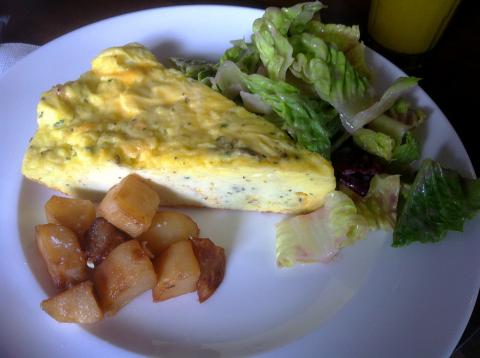
Photo: David Chen, Taipei Times
Another reason that Mi Cocina is worth a visit is its chef, 31-year-old Lisa Nolasco, a New York City native who is responsible for the restaurant’s homemade goodness, and whom patrons will spot working in the open-air kitchen.
On a lunch visit, don’t hesitate to try the roasted pork panini (NT$250). The stringy, tender pork is melt-in-your-mouth delicious, with generous amounts sandwiched between two slices of freshly baked focaccia. Swiss Cheese and a creamy but not-too-full-on sauce made with garlic and jalapeno round out this near-perfect sandwich. Mine could have stayed in the grill half a minute longer (one small portion in the middle was cold), and the side of fries were a tad undercooked and not quite golden enough — but these are minor shortcomings given how tasty the sandwich was.
A return visit with friends for dinner left me more impressed. The menu choices are simple: steak, chicken, fish, rice or pasta, and everything our party of three ordered was well-received. The pan-roasted chicken breast (NT$350) was surprisingly tender. (Nolasco says her trick is simply to cook the chicken on the bone and not to overcook it.) It comes topped with assorted roast vegetables strewn on top and creamy mashed potatoes.
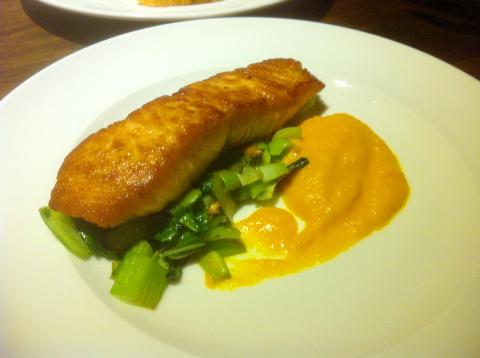
Photo: David Chen, Taipei Times
As much as I liked the chicken, I couldn’t help but envy one of my dining companions for her dinner of pan-seared risotto cakes (NT$280). Though on paper the recipe for this dish is simply what you do with leftover risotto, Mi Cocina does this vegetarian-friendly item right. The risotto is shaped into two small patties and pan-fried on both sides to a golden brown. Nolasco says she was inspired to add this item to the menu after having a local breakfast staple, radish cake (蘿蔔糕). The similarity is apparent in texture — it’s crispy on the outside and soft on the inside. But flavor-wise, it’s a couple of steps ahead of radish cake, with a rich, buttery flavor. It also comes with roasted vegetables on the side.
My other dining companion enjoyed the pan-seared salmon (NT$300), which was cooked just right, judging from the few bites I had. She wasn’t impressed with the accompanying stir-fried bok choy as it seemed a little too commonplace and not quite the right match for salmon, but was impressed with the carrot-ginger puree, which looked gorgeous and had a nice zing.
On Saturday and Sundays, Mi Cocina has a brunch special for NT$300 that includes fresh juice, coffee and a main entree. Choices include lox and bagel, roasted pork panini, French toast and frittata. We had the latter, but were left underwhelmed because it was a little overcooked and, for a quiche-like dish, it felt a bit short on the cheese and vegetable filling.
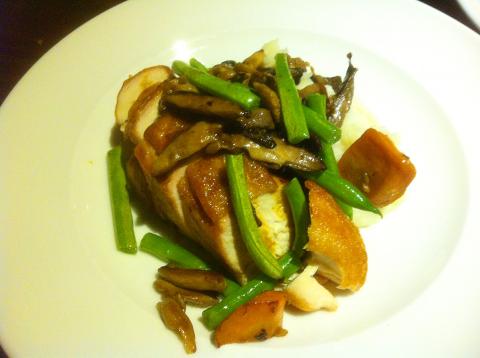
Photo: David Chen, Taipei Times
Your mileage may vary, though, as Nolasco and Lin continue to tinker with the menu and recipes. Since my last visit, there are already new additions to the menu, of which the zucchini lasagna (NT$280) sounds the most enticing. It’s made with pesto, oven-roasted tomatoes and homemade ricotta cheese. Nolasco says the dish is suited to Buddhist vegetarians that abstain from garlic and onions. Another new item that sounds good is the “pan-seared herb-crusted pork tenderloin” (NT$380), which comes with taro root puree and apple and bacon chutney on the side.
The desserts will be familiar to regulars at Lin’s other cafe, My Sweetie Pie, which supplies Mi Cocina’s cakes and pies. Prices average around NT$100 per slice. Mi Cocina’s vibe will also feel familiar — like My Sweetie Pie and Grandma Nitti’s, the restaurant has an outdoor patio — albeit tiny — well-suited for gazing at passersby while having a cup of coffee or glass of beer.
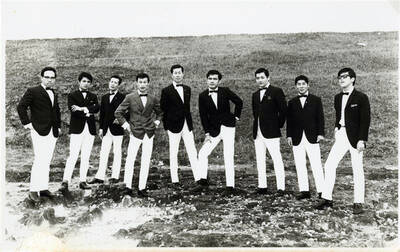
Sept. 28 to Oct. 4 Opening in 1971, Singapore’s Wisma Theatre (海燕歌劇院) was entirely modeled after Taiwanese live variety shows, combining singing, dancing and drama. Even its performers were recruited from Taiwan. The formula was an instant hit, selling out on the third night with the crowd fighting outside for tickets. Among its key figures was 31-year-old Chi Li-nan (紀利男), an acclaimed saxophonist and band leader who had entered Taiwan’s live entertainment scene at age 19 with zero musical training. Chi wasn’t even supposed to be there. He had accompanied his girlfriend, pop singer Shang Kuan Ping (上官萍), to negotiations with Wisma’s agent.
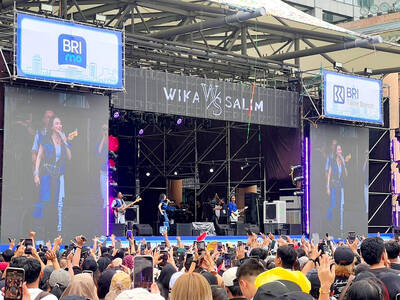
Apetition on the Web site of the National Development Council (NDC) arguing that non-citizens receiving National Health Insurance (NHI) should make up payments from their birth to their current age has reached 5,000 signatures last week, the threshold requiring a response. The comments under the petition are predictably odious, proving once again that the Venn diagram of racism and idiocy is a perfect circle. Also last week, the Ministry of the Interior proudly announced that the 400th “high-level professional” was approved for citizenship on Aug. 26. Four hundred carefully selected dual citizens! At that rate, sometime around the year 2600, Taiwan
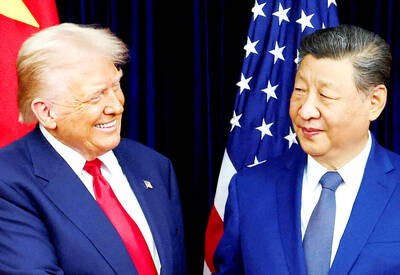
The tussle between the Chinese Nationalist Party (KMT) and its pro-People’s Republic of China (PRC) allies and fellow travelers, and the pro-Taiwan side in politics is in part a struggle over defining the nation’s agency in international spaces. What kind of agency does Taiwan have? The United Daily News (UDN) recently reported that former National Security Council secretary-general and longtime KMT stalwart Su Chi (蘇起), popularizer of the fake “1992 consensus,” contended that the US was both unable and unwilling to protect Taiwan. He also asserted that the threat from the PRC was rising and that the future depended on the
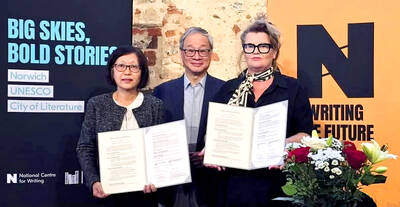
Serving as interpreter during Culture Minister Li Yuan’s (李遠) visit to Britain offered an unusual view of cultural diplomacy — not as ceremony, but as a series of conversations capable of becoming lasting relationships. During four intensive days, from Sept. 6 to Sept. 9, the delegation moved between museums, arts centers, universities and literary organizations. The program ranged from urban planning and museum access to translation, illustration and contemporary dance. Yet one question connected these encounters: How can an initial meeting become a relationship that lasts? Li described himself as “greedy” about the possibilities. The word was characteristically humorous, but the ambition


 RSS
RSS