


Sioux and Assiniboine tribe members wailed a welcome song last month as around 60 bison from Yellowstone National Park stormed onto a prairie pasture that had not felt a bison’s hoof for almost 140 years.
That historic homecoming came just 11 days after 71 pureblood bison, descended from one of Montana’s last wild herds, were released nearby onto a swath of untilled grassland owned by a charity with a vision of building a haven for prairie wildlife. Some hunters and conservationists are now calling for bison to be reintroduced to a 404,686-hectare wildlife refuge spanning this remote region.
“Populations of all native Montana wildlife have been allowed to rebound except bison; it’s time to take care of them like they once took care of us,” said Robert Magnan, 58, director of the Fort Peck Indian Reservation’s Fish and Game Department, who will oversee the transplanted Yellowstone bison program.
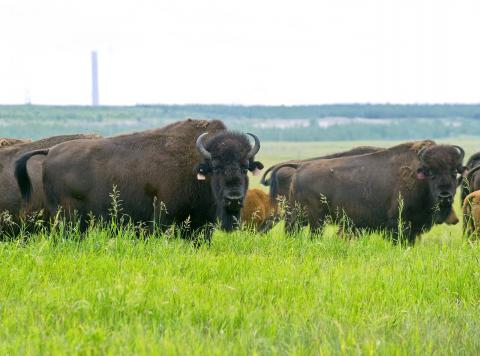
Photo: Bloomberg
But with several groups navigating a complex and contentious path to return bison to these plains, agribusiness is fighting back. Many farmers and ranchers fear that bison, particularly those from Yellowstone, might be mismanaged and damage private property, and worry that they would compete for grass with their own herds.
“Bison are a romantic notion, but they don’t belong today,” said Curt McCann, 46, a Chinook rancher who this month drove four hours to a public meeting in Jordan to speak against bison reintroduction.
When the explorer Meriwether Lewis followed the Missouri River through this region in 1805, he came across bison herds he described as “innumerable.” Just eight decades later, a young Theodore Roosevelt noted that all that remained were “countless” bleached skulls covering the Montana badlands.
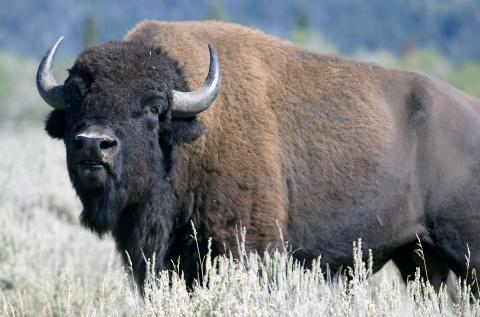
Photo : Bloomberg
Scientists estimate that tens of millions of bison once roamed America, but by 1902 there were only 23 known survivors in the wild, all hiding from poachers in a remote Yellowstone valley. For decades, attempts to transplant bison from the rebounding Yellowstone herd were thwarted, despite requests from tribes to steward some of the animals.
“I call them my brothers and sisters because they are a genetic link to the same ones my ancestors hunted,” said Tote Gray Hawk, 54, a Sioux, who has brought the Fort Peck bison hay and water each day since their arrival. Their meat, lower in cholesterol than beef, will feed elderly tribe members and their skulls will be used in traditional sun dance ceremonies, he said.
The last hunt for indigenous bison on the Fort Peck reservation happened in 1873. In the 1880s, hundreds of tribal members starved to death on the barren land. Around them homesteaders from Europe began wresting an agricultural living from this windswept expanse of rolling amber in northeast Montana. Most of the neighboring farmers and ranchers today are descendants of those pioneers, and they safeguard their traditions with generational grit.
“Bison is a big issue that could really impact our livelihood,” said Brett Dailey, 52, who ranches near Jordan.
Today there are 3 million cattle in Montana and agribusiness is the state’s biggest industry, but not a single bison roams free. A 2011 survey commissioned by the National Wildlife Federation showed that a majority of state residents support reintroducing huntable bison to the vast Charles M. Russell National Wildlife Refuge, similar to a Utah herd created in 1941 from the last few bison allowed out of Yellowstone.
“Within this sea of agriculture there is room for small islands of conservation,” said Sean Gerrity, president of the American Prairie Reserve, the charity that brought the group of genetically pure bison back to a pasture just north of the refuge.
The arrival of Yellowstone bison was welcome news around the troubled Fort Peck Reservation. When the first calf was born Sunday, a rust-colored baby bull, tribal flags still hung at half staff for a teenage boy who had committed suicide days earlier. Rates of poverty, unemployment, disease and addiction hover stubbornly above national averages here.
Census data shows that around northeast Montana, a prairie expanse almost the size of Indiana, most county populations peaked in the early 1900s and have since dropped by almost half.
The region’s fastest growing economic engine, oil production, is proving a mixed blessing. In 2010 the Environmental Protection Agency reported that toxic chemicals from nearby drilling contaminated drinking water supplies for Poplar, a reservation town of around 3,000. This year a schoolteacher from Sidney, near the North Dakota border, was kidnapped during her morning jog and murdered. The suspects are two Colorado roughnecks.
“These bison represent healing,” said Iris Greybull, 62, of Poplar.
The bison debate has dredged up old tensions between tribes and their neighbors. Before Greybull, a Sioux, spoke in favor of the animals last fall at a fractious meeting in Glasgow, dozens of farmers and ranchers walked out in protest.
She and other tribal members say they see an ugly double standard in the fact that there are more than 130 private bison ranches in the state, including one belonging to the mogul Ted Turner housing dozens of controversial Yellowstone bison, and yet only the Fort Peck herd has been visited by protesters.
But some say the bison on the ranches do not pose the threat that the wild ones do.
“Unless they have the German wall and a moat with a bunch of crocodiles and piranhas, they’re not going to contain those woolly tanks,” said state Senator John Brenden of nearby Scobey, who has long done battle on the bison issue in the state Legislature.
Around a century ago some Yellowstone bison contracted disease from domestic livestock and in recent decades thousands have been slaughtered in an effort to protect ranchers’ herds. At the direction of Governor Brian Schweitzer of Montana, a few of these bison were quarantined for years and certified healthy. Some may soon go to the Fort Belknap Indian Reservation, about 274km west of Fort Peck, pending the outcome of a lawsuit filed by opponents.
“I took a lot of arrows for this, but it was the right thing to do,” Schweitzer said. “If you want to get into a fistfight in Montana, go into a bar and share your opinion about bison or wolves.”

Sept.16 to Sept. 22 The “anti-communist train” with then-president Chiang Kai-shek’s (蔣介石) face plastered on the engine puffed along the “sugar railway” (糖業鐵路) in May 1955, drawing enthusiastic crowds at 103 stops covering nearly 1,200km. An estimated 1.58 million spectators were treated to propaganda films, plays and received free sugar products. By this time, the state-run Taiwan Sugar Corporation (台糖, Taisugar) had managed to connect the previously separate east-west lines established by Japanese-era sugar factories, allowing the anti-communist train to travel easily from Taichung to Pingtung’s Donggang Township (東港). Last Sunday’s feature (Taiwan in Time: The sugar express) covered the inauguration of the

The corruption cases surrounding former Taipei Mayor and Taiwan People’s Party (TPP) head Ko Wen-je (柯文哲) are just one item in the endless cycle of noise and fuss obscuring Taiwan’s deep and urgent structural and social problems. Even the case itself, as James Baron observed in an excellent piece at the Diplomat last week, is only one manifestation of the greater problem of deep-rooted corruption in land development. Last week the government announced a program to permit 25,000 foreign university students, primarily from the Philippines, Indonesia and Malaysia, to work in Taiwan after graduation for 2-4 years. That number is a

This year’s Michelin Gourmand Bib sported 16 new entries in the 126-strong Taiwan directory. The fight for the best braised pork rice and the crispiest scallion pancake painstakingly continued, but what stood out in the lineup this year? Pang Taqueria (胖塔可利亞); Taiwan’s first Michelin-recommended Mexican restaurant. Chef Charles Chen (陳治宇) is a self-confessed Americophile, earning his chef whites at a fine-dining Latin-American fusion restaurant. But what makes this Xinyi (信義) spot stand head and shoulders above Taipei’s existing Mexican offerings? The authenticity. The produce. The care. AUTHENTIC EATS In my time on the island, I have caved too many times to

In a stark demonstration of how award-winning breakthroughs can come from the most unlikely directions, researchers have won an Ig Nobel prize for discovering that mammals can breathe through their anuses. After a series of tests on mice, rats and pigs, Japanese scientists found the animals absorb oxygen delivered through the rectum, work that underpins a clinical trial to see whether the procedure can treat respiratory failure. The team is among 10 recognized in this year’s Ig Nobel awards (see below for more), the irreverent accolades given for achievements that “first make people laugh, and then make them think.” They are not


 RSS
RSS