


Legendary Amazons (楊門女將之軍令如山)
Frankie Chan (陳勳奇) is probably best known as the composer of the scores of Chungking Express (重慶森林) and Ashes of Time (東邪西毒), but as director of Legendary Amazons, he is not doing himself any favors. The inappropriateness of the English title alone suggests that the film is not really intended to go much beyond the Chinese-speaking world, and the presence of people like Cecilia Cheung (張柏芝) pretending, without any tongue-in-cheek, to be hardened combat veterans of vicious desert campaigns, really just stretches credibility too far. There are some decent big battle set pieces, but the film does not go beyond the historical romances that have been coming out of Hong Kong for decades.
Magic to Win (開心魔法)
From Wilson Yip (葉偉信), director of the solid Ip Man (葉問) martial arts films, Magic to Win shows a lighter side to the director. Unfortunately, it also seems to highlight other less desirable qualities, including a slap-dash approach to narrative coherence and a propensity to cherry-pick ideas from recent Hollywood productions. His new film, with its mixture of the mundane and the supernatural, both equally unbelievable, requires a huge suspension of disbelief if you are to go along for the ride. If you do, the film is filled with energy and high spirits, and perfectly enjoyable, though it fails to achieve the innocent good humor of the Happy Ghost (開心鬼) franchise of the 1980s, which it is clearly trying to emulate. Forgettable entertainment, but with enough familiar faces, including Louis Koo (古天樂) and model-turned-actress Karena Ng (吳千語), to command some attention.
The Source (La source des femmes)
A film that tries to combine sexual comedy with social issues fails to do justice to either in a story that is all cliche and lazy exoticism. The story revolves around the women from a small village in North Africa banding together against their husbands in an attempt to get the men to help in the dangerous and burdensome task of fetching water from the spring. Led by Leila (Leila Bekhti), a young wife from a less conservative part of the country, the women decide to withhold all sexual favors until the men chip in with the domestic work, enduring both physical and psychological abuse for their efforts. The characters are all one dimensional, and director Radu Mihaileanu squanders a talented cast in a tale in which he works through a catalog of standard scenarios toward a predictable end.
Touching Home
Coming to the scene on the wake of the high-profile Moneyball, Touching Home, a based-on-real-life against-the-odds inspirational tale from the world of baseball, fails to distinguish itself. Released in 2008, it is also more than a little shopworn, and despite a solid performance by Ed Harris as an alcoholic father making amends with his twin sons by helping them pursue their dreams to make it in professional baseball, the story is all just a bit too formulaic to make an impression.

Taiwan’s overtaking of South Korea in GDP per capita is not a temporary anomaly, but the result of deeper structural problems in the South Korean economy says Chang Young-chul, the former CEO of Korea Asset Management Corp. Chang says that while it reflects Taiwan’s own gains, it also highlights weakening growth momentum in South Korea. As design and foundry capabilities become more important in the AI era, Seoul risks losing competitiveness if it relies too heavily on memory chips. IMF forecasts showing Taiwan widening its lead over South Korea have fueled debate in Seoul over memory chip dependence, industrial policy and
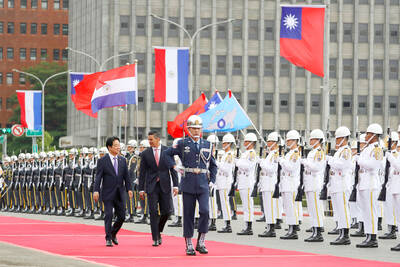
“China wants to unify with Taiwan at the lowest possible cost, and it currently believes that unification will become easier and less costly as time passes,” wrote Amanda Hsiao (蕭嫣然) and Bonnie Glaser in Foreign Affairs (“Why China Waits”) this month, describing how the People’s Republic of China (PRC) is playing the long game in its quest to seize Taiwan. This has been a favorite claim of many writers over the years, easy to argue because it is so trite. Very obviously, if the PRC isn’t attacking Taiwan, it is waiting. But for what? Hsiao and Glaser’s main point is trivial,
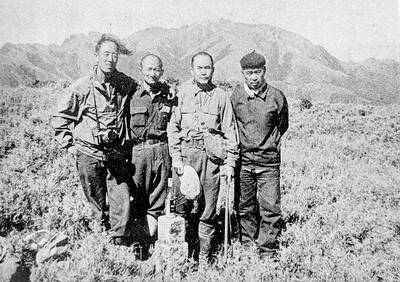
May 18 to May 24 Gathered on Yangtou Mountain (羊頭山) on Dec. 5, 1972, Taiwan’s hiking enthusiasts formally declared the formation of the “100 Peaks Club” (百岳俱樂部) and unveiled the final list of mountains. Famed mountaineer Lin Wen-an (林文安) led this effort for the Chinese Alpine Association (中華山岳協會). Working with other experienced climbers, he chose 100 peaks above 10,000 feet (3,048m) that featured triangulation points and varied in difficulty and character. The list sparked an alpine hiking craze, inspiring many to take up mountaineering and competing to “conquer” the summits. A common misconception is that the 100 Peaks represent Taiwan’s 100 tallest

And so, in the wake of US President Donald Trump’s trip to the People’s Republic of China (PRC), all the experts on the Strait of Hormuz suddenly became experts on US-China-Taiwan relations. The Internet has certainly expanded human knowledge. Lots of these sudden experts made noise this week about Trump’s words after the meeting with PRC dictator Xi Jin-ping (習近平). Trump is going to sell out Taiwan! Longtime Taiwan commentator J. Michael Cole summed the situation up neatly in the Guardian: “We need to keep in mind that he has a tendency to say many things — sometimes contradicting himself within


 RSS
RSS