


At around 10am one day earlier this week, a dazed and haggard man in surprisingly clean blue convict’s fatigues walked out of Insein jail on the outskirts of Myanmar’s capital, Rangoon. Tang Naing Oo had been in prison — held for the most part in a cell measuring 9m by 15m that he shared with 110 other inmates — for 14 months. He had originally been sentenced to three years in jail, back in September 2010, for distributing pictures of Aung San Suu Kyi, the famous pro-democracy campaigner and Nobel laureate, on a Rangoon pavement. Now, he was walking past the noodle sellers, the watermelon hawker, a crowd of waiting passengers at the ramshackle bus stop, to a form of freedom.
Tang Naing Oo had learned he was to be released only a few hours earlier. When he woke in the fetid cell at 5am, he saw “hope” on the faces of his fellow inmates, he says. His release came the day before national celebrations commemorating the independence of Burma (later renamed Myanmar) from Britain 64 years ago, and some kind of amnesty had long been expected from the government. However, the hopes of most inmates in Insein, and the vast network of other prisons and interrogation camps around the country, were disappointed. Of the between 600 and 2,000 political prisoners estimated to be in detention, only a couple of dozen were released. None were senior figures.
“If the government are serious, they will release all the other detainees,” Tang Naing Oo says, slumped against the grubby wall of a nearby shop-cum-home-cum-cafe. “This is just for getting more interest from the international community. It is not real change.”
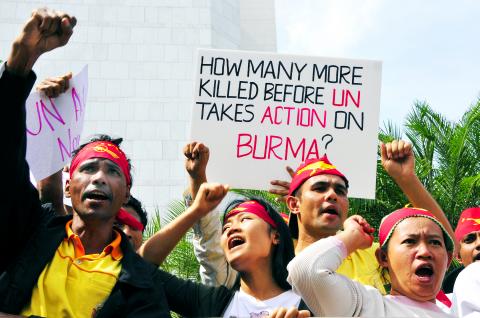
Photo: Bloomberg
The international community arrived in Myanmar on Thursday in the shape of William Hague, the British foreign secretary. He is the first UK official of such seniority to come to the country since the army took over in 1962. Last month, US Secretary of State Hillary Clinton, the first US secretary of state to visit for a similar period, flew in and Hague is following her exact itinerary. He arrived in Naypyidaw, the new capital hacked at huge expense out of swamps and scrub in the center of the country, where he met Thein Sein, the retired general who was named president and head of the new, nominally civilian government last year by the dictator Than Shwe, following the latter’s supposed retirement from public life. Hague then flew to Rangoon, the bustling city on the Irrawaddy delta, where he met representatives of civil society and ethnic minorities before having a private dinner with Aung San Suu Kyi.
The visit, British officials in Rangoon say, has been prompted by the reforms recently made by Myanmar’s rulers and the desire of British Prime Minister David Cameron’s government to encourage further progress on the path to democracy, stability and prosperity. Even 18 months ago such an ambition would have been laughable. Successive military regimes have won deserved reputations for brutality, corruption and human rights abuses.
Myanmar has been repeatedly shaken by uprisings, most recently in 2007. One of the world’s longest running civil wars has pitted ethnic groups against the national army, creating a vast refugee crisis and reports of forced labor as well as systematic rape and torture. The nation is, despite considerable resources and a prize strategic position on the Indian Ocean seaboard, one of the poorest in the world. A clique clustered around the top generals and their relatives lives in great luxury, while only one in 10 villages has electricity. The government response to the catastrophic Cyclone Nargis in 2008 was a toxic mixture of cynical disregard for human suffering, secrecy and incompetence. Aung Sang Suu Kyi, who assumed the leadership of a popular pro-democracy revolt in 1988, has spent most of the subsequent 23 years in prison or under house arrest.
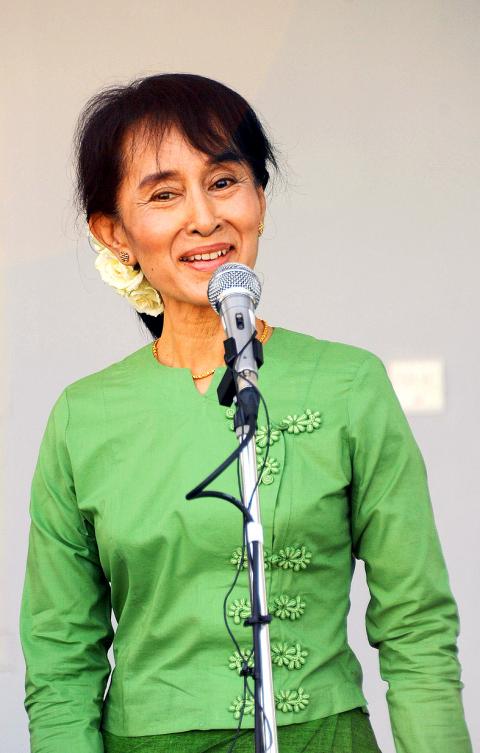
Photo: AFP
Things started to change in March 2010 with the appointment of the civilian government. Few analysts can say exactly why the notorious Than Shwe decided on this move. Some argue that the motivation was purely economic, as only improved relations with the West will allow Myanmar to join the ranks of the Asian tiger economies. Others point to a resentment at China’s growing role in the country. Nay Zin Latt, the political adviser to the president, says that the decision was simply the result of a realization that “for capitalism and the free market to flourish, democracy was necessary.”
“We need Western investment, technical knowledge, the art of management. If the country doesn’t grow economically then there will be big problems, big unrest. The people with Mercedes cars won’t be able to drive them around the streets!” Latt explained.
Aung San Suu Kyi, or the “Lady” as she is known locally, was released from house arrest in November 2010 and elections that she and her party, the National League for Democracy, boycotted, were held the same month. These were deeply flawed but many were surprised that they were held at all. The release of Aung San Suu Kyi, who won the Nobel Peace Prize in 1991 after the regime canceled elections that her party had won, was seen as extraordinary.
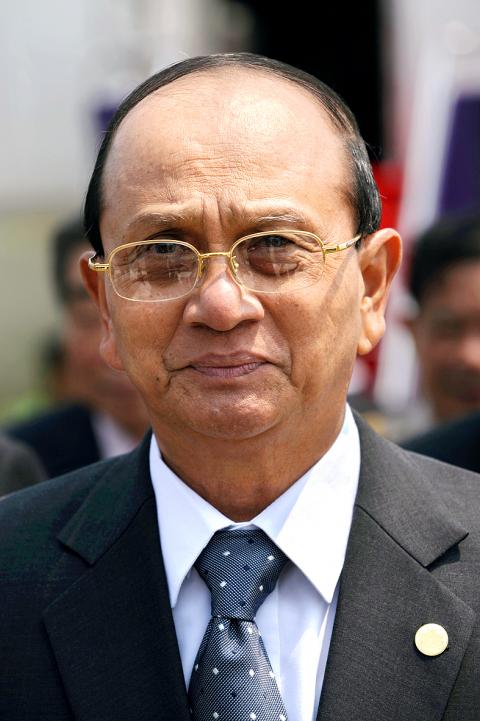
Photo: Bloomberg
Since then there have been other reforms. Many, such as new labor laws or legislation allowing protests, have had little practical effect on the ground. Others have had more impact. A handful of foreign journalists have been allowed in, surveillance of democratic activists is marginally lighter and work on a very unpopular Chinese-funded dam project, which would have generated huge amounts of cash for the regime while displacing tens of thousands of locals, has been suspended.
Local journalists have tracked the reforms through the degree of censorship to which they are subjected. “Before, printing any image of Aung San Suu Kyi was unthinkable. Then we could use pictures of her on the inside pages no bigger than 5 inches by 7 inches. Then suddenly we could put them on the front page,” said Thi Ha Saw, editor of the Myanma Dana magazine.
It is not just the press. As all visiting reporters have remarked, there are posters of the Lady now on sale on street corners and her picture on mobile phones, walls and cars. The latest development is that Aung San Suu Kyi herself will lead her party in contesting by-elections in the late spring. This is a risky and controversial decision that risks fracturing the fragile unity of the democratic campaigners in Myanmar. It will almost certainly result in the National League for Democracy entering parliament in some numbers — even if they will still be heavily outnumbered by soldiers in the assembly.
The government is considerably more enthusiastic about the prospect of the Lady in parliament than many of her supporters. “We need an opposition here. We need a strong National League for Democracy. The reforms will continue. Sometimes they will go slowly. Sometimes quickly. But they will continue. This is democratization and that is the mission of the government,” says Latt, the presidential adviser.
This then is the process Hague has come to reinforce. If his visit is largely welcomed by pro-democracy campaigners — and Aung San Suu Kyi was sounded out first, as she was before Clinton’s trip — others are more wary. There are many in the country who are concerned that the very adulation lavished on Aung San Suu Kyi, particularly in the West, could be something of a trap. These people know to what extent the Lady incarnates Myanmar’s struggle for democracy for the international community, especially with a biopic about her on release, and they see her cult status as a potential danger. The worry is that the sight of their leader taking a seat in the country’s parliament will be taken to mean that the problems in the country have been solved.
Normal relations will be established — not least because Myanmar is an important element in the ongoing effort to roll back Chinese influence in the region. Trade will follow the flag. The current US and EU sanctions on Myanmar will be lifted and businesses will begin to move in to exploit an untapped market and a country with fantastic natural resources. As long as Aung San Suu Kyi remains in parliament, the argument goes, the authorities will have the fig leaf they need.
Shyan Saran, a former Indian foreign secretary and ambassador to Myanmar, puts it bluntly: “Aung San Suu Kyi is the regime’s passport to legitimacy in the international community.”
Yuza Maw Htoon, a Rangoon-based activist, politician and head of an NGO who stood as an independent in the 2010 elections, is more delicate. “The international community gives recognition only to the Lady and that makes the government happy,” she says. “There is a need for other interlocutors too, both for the authorities here and for our friends overseas.”
Even within the senior ranks of the National League for Democracy, there are those who fear that the focus on their leader could backfire.
U Win Tin, 82, is one of the founders of the party. He remembers the dark days of the Japanese occupation of Myanmar during World War II, as well as the freedom struggle against the British. He is deeply skeptical of the government’s desire for “democratization” and concerned that the West might let itself be deceived.
Speaking in the crowded, untidy offices of the party, he said he could “not accept this so-called change” on the part of the government. “I cannot trust it. There are still two motorbikes from military intelligence outside my home, like there have been for decades. There are still many friends in prison,” he says. “If the West put the whole focus on [Aung San Suu Kyi] that could be very misleading. We trust in her and her intuition, but this is all happening very quickly.”
Another common fear, voiced by U Win Tin, is that strategic considerations will blind the international community to the problems that continue in Myanmar. “I have lived through periods when there was a real struggle in the region between the West and its enemies. There was the Cold War, when Laos, Vietnam and Cambodia were under communist rule and anyone who was the communist’s enemy was the West’s friend. Now I am concerned that Burma will become a pawn in the effort against the Chinese,” he says.
Aung San Suu Kyi appeared this week at the National League for Democracy headquarters for the celebration of the country’s independence. Looking tired and drawn, she called for further efforts on the road to freedom. She smiled very little, though she stood patiently to be photographed with group after group of party workers and spoke briefly with the half dozen low-level foreign diplomats who were present. Songs were sung about the political prisoners still in jail, but the Lady did not mention them directly in her short speech. This disappointed some. Others spoke of “necessary compromises.”
U Win Tin had a message for the British foreign secretary. “Hague should keep in mind that, yes, we have found a light in the tunnel here in Burma,” he says. “But we are still in the tunnel. Maybe we can reach the light, maybe we can make it brighter, maybe we can even leave the tunnel. But we don’t know yet. And meanwhile, we are still in the dark.”
Ajay Verma, a consultant gastroenterologist at Kettering general hospital in Northamptonshire, says our gut is a “complex machine.” “It is constantly providing us with the nutrition we need, initially to grow and develop, and then for us to survive, thrive and repair from injury and illness.” How can we keep it functioning well? Put simply: “Make sure what you put into it is balanced, and that you clear out its waste products adequately,” Verma says. “In a general gastroenterology clinic, the most common conditions we see are irritable bowel syndrome (IBS), gastroesophageal reflux disease, inflammatory bowel disease and constipation,” says Nisha
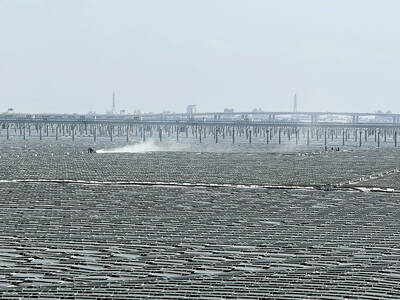
The arithmetic is straightforward and uncomfortable. By the end of 2025, Taiwan had committed itself to a 50-30-20 electricity mix — half natural gas, 30 per cent coal, 20 per cent renewables. The Ministry of Economic Affairs’s (MOEA) own monthly energy reports tell a different story. Natural gas reached 47.8 per cent of generation last year. Coal stood at 35.4 per cent, comfortably above its target ceiling. Renewables came in at 13.1 per cent, well short of the 20 per cent Taipei had pledged a decade earlier. Installed renewable capacity reached roughly half of the 12 gigawatts (GW) the government

Last week US President Donald Trump was asked by a reporter whether he would speak on the phone to the President of Taiwan. “l’ll speak to him. I speak to everybody. We have that situation very well in hand,” Trump said. This marked the second time in a couple of weeks he had said he would talk to the President of Taiwan. In 2016 he famously took a call from then-president Tsai Ing-wen (蔡英文), when he was president-elect. Despite warnings that the apocalypse was nigh because of a phone call, the world quickly forgot about the conversation between two democratically-elected presidents.
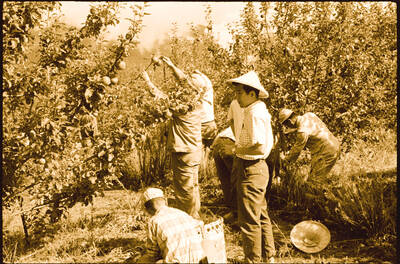
May 25 to May 31 Few believed that apples could be cultivated on a commercial scale in Taiwan’s high mountains. When horticulturalist Cheng Chao-hsiung (程兆熊) first proposed the idea in 1955, both American and Taiwanese colleagues dismissed it as implausible, arguing that temperate fruit could not be reliably grown on a subtropical island, especially on rugged terrain. However, it was this terrain in the Central Mountain Range where many Chinese Civil War veterans were resettled in the late 1950s. With limited job prospects and no family in Taiwan, they were placed on cooperative farms aimed toward self-sufficiency. Some say the conditions


 RSS
RSS