


J ay Chou (周杰倫), the king of Mando-pop, has denied rumors that he was planning to wed (or had already eloped with) teenage model Hannah Quinlivan (昆凌).
The 32-year-old star told reporters that he has no plans to marry until he is at least 35 — but that he hopes to get hitched soon after he hits that birthday.
“I don’t want to have a big generation gap with my kids,” Chou told the media. In an uncharacteristic display of restraint, reporters refrained from asking about the generation gap between him and the 18-year-old Quinlivan.
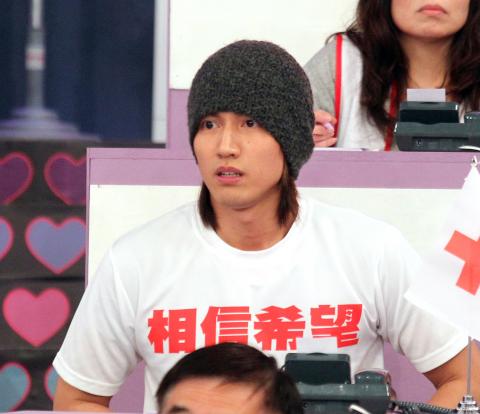
Photo: Taipei Times
While Chou refused to confirm speculation that he plans to make Quinlivan what local media calls his “J-wife” (J-嫂), or that they are even dating, he said that he does not consider marriage a “taboo subject” and assured the press that once he does tie the knot, he’ll let everyone know. Despite rumors that Chou and Quinlivan had registered for a marriage license in Europe or Japan, Chou insisted that he would only get hitched in Taiwan.
As was to be expected, Chou’s denial fueled yet more media interest. The China Times (中國時報) reported that Quinlivan is saving her first time for Chou — the first time she is seen in a wedding dress, that is. Quinlivan is reportedly refusing all bridal gown modeling offers, no matter how lucrative.
In other showbiz news, an online poll by Yahoo asking participants which celebrities had worked the hardest to parlay their romantic connections into fame named Quinlivan and Vivian Dawson, the boyfriend of former Chou flame Jolin Tsai (蔡依林), as its “winners.”
Other semi-celebs who scored high in the poll include Barbie Hsu’s (徐熙媛 aka Big S) husband Wang Xiaofei (汪小菲) and Taiwanese model Sonia Sui’s (隋棠) boyfriend Yao Yuan-hao (姚元浩).
Like Chou and Quinlivan, Taiwanese supermodel Lin Chi-ling (林志玲) and her rumored
ex-boyfriend actor and F4 member Jerry Yan (言承旭) are also facing intense scrutiny by the press. As Pop Stop readers will recall, Lin sent gossip reporters into a tizzy when she recently admitted that there was someone she “liked” and quickly denied rumors that the target of her affection is Scott Chiu (邱士楷), the son of a toilet magnate.
Media scrutiny moved on to Yan, who was spotted visiting Lin in the hospital after she broke six ribs during a horse riding accident in 2005 while filming in Dalian, China.
Last week, Yan returned to Dalian to pick up an award, but reporters were much more interested in his rumored reunion with his alleged former flame. Yan admitted that during his first visit to Dalian six years ago, he had been preoccupied with Lin’s well-being and seeing her in the hospital. But he refused to confirm the romance, saying instead that he is content as long as Lin, who is currently shooting a movie in Hangzhou, is happy.
One celebrity couple that is eager to celebrate their marriage publicly is Selina Jen (任家萱) of pop group S.H.E and her lawyer fiance Richard Chang (張承中). Their nuptials next week will occur close to the first anniversary of an accident that left Jen severely burned.
Jen has already had skin transplants over more than half her body and continues to face a series of operations. Media reports have said that her wounds are so sensitive that she can’t share a bed with Chang, but the two are optimistic that they will eventually be able to have children.
Their marriage was originally scheduled to take place on April 1, but the ceremony was delayed after Jen’s accident. The two are now happily making up for lost time. Jen has been putting up blog posts of a new set of engagement portraits taken during her recuperation, including one of her looking happy and healthy in a wedding dress.
It seems every few days one bumps into one of those “real man” comments in which Taiwan is urged to “face reality” or similar, and “make a deal,” with the speaker implying that soon it will be too late. “Deal” advocates always present themselves as having a superior grip on reality, and the manly ability to make the “hard choice.” Their testosterone-laden language often echoes that of Taiwan sellout advocates. Note that such commentary always specifies a process (“make a deal, work with, make progress”), never the end state of what occupation by a violent authoritarian colonialist state will entail. In

There are shadowy cabals plotting to sell out Taiwan to be annexed by China, by invasion if necessary. Fortunately, they are buffoons. In 2019, former Bamboo Union gangster and founder of the China Unification Promotion Party (CUPP), Chang An-le (張安樂, colorfully known as “White Wolf”), led a protest at the Legislative Yuan against comments made by then-premier Su Tseng-chang (蘇貞昌) that in the event of an attack by China, he would never surrender, but would protect the nation by fighting to the end, even if he only had a broom. Chang had party members bring a wooden casket that they

Taiwan’s English education system is being pulled apart by three opposing forces. Bilingual Nation 2030 pulls students toward English and global communication. Artificial Intelligence (AI) readiness pulls them toward digital judgment, verification and AI-mediated work. But Taiwan’s old exam culture pulls them back toward memorization, grammar drills, timed reading and correct answers. If the education system keeps using old exams to define success, it risks producing graduates who are neither genuinely bilingual nor genuinely AI-ready, but trained for tasks machines can already perform. The first force is Bilingual Nation 2030. Launched in 2018, the policy aimed to “help Taiwan’s workforce connect

June 1 to June 7 "If all Taiwanese were as afraid of dying as you, then what would happen?” Physician Shih Chiang-nan (施江南) reportedly said this to his wife Chen Chiao-tung (陳焦桐) after she urged him to stop intervening on behalf of Taiwanese soldiers stranded overseas after serving in the Japanese Army during World War II. Shih had clashed with high-ranking officials over the issue, engaged in several heated arguments with Taiwan governor-general Chen Yi (陳儀) and allegedly shouted at general Ko Yuan-fen (柯遠芬), chief of staff of the Taiwan Garrison Command, over


 RSS
RSS