


Dance lovers have a wealth of programs to choose from this weekend, ranging from the very classic — in fact ancient — to the very contemporary.
The National Theater complex is playing host to two of the productions, with Neo-Classic Dance Company (新古典舞團) in the main theater and the Sun-Shier Dance Theatre (三 十 舞蹈劇場) up in the Experimental Theater. Meanwhile, in Guandu at Taipei National University of the Arts, Meimage Dance (玫舞擊) has taken over the Dance Hall for its show in the 2011 Kuandu Arts Festival (關渡藝術節).
Starting with the oldest company, and the oldest works, Liu Feng-shueh’s (劉鳳學) Neo-Classic troupe is performing the kind of dance that has made them both famous: meticulously researched reconstructions of Tang Dynasty (618 to 907) music and dance. The result of almost six decades of research conducted by Liu, the company’s founder and artistic director, The Joy of Drinking a Toast (傾盃樂) will also be the 86-year-old’s swan song to the Tang era. She announced in August that this production would be the last in the series, though she will continue to choreograph more modern works for the company.
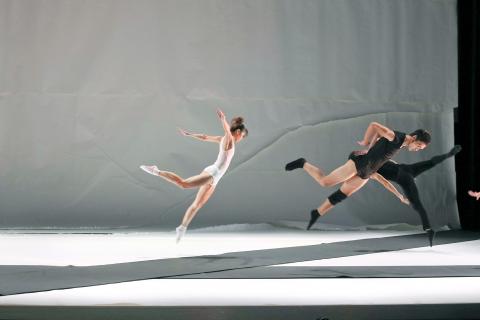
Photo Courtesy of Meimage Dance
The show includes one new work, from which the program takes its title, and extracts of four of Liu’s previous pieces: The Singing of Spring Orioles (春鶯囀), Pa Tou (拔頭), Whirl Around (團亂旋) and Liquid Amber (蘇合香).
The 40-minute The Joy of Drinking a Toast is based on three chapters of dance notations and score that Liu found, all that remains of a piece she believes was first performed in 627. Liu used her knowledge of Tang culture to flesh out the work. Pa Tou stands out from the other snippets of earlier works in its use of face masks, rather than just painted faces.
The entire show runs 80 minutes, with no intermission, and there is a pre-show introduction to the production that starts 30 minutes before show time in the theater’s main lobby.
At 14 years, San-Shier is the second-oldest troupe performing this weekend, though still relatively young compared with Liu’s company. Co-founder and choreographer Chang Hsiu-ping’s (張秀萍) latest work, titled Proclaiming of Skin Surface (膚演宣言), examines the texture of human skin and its other attributes. Not exactly a subject that lends itself to dance, one might think, but Chang has built a reputation for unconventional and feminist-oriented topics — like last year’s Too Much Vinegar (黑醋加太多), which delved into accidents and absurdist tragedy.
Tonight’s show at the Experimental Theater is sold out, but there are still tickets left for matinees today and tomorrow.
At just a year old, Meimage Dance may be one of the youngest dance troupes in Taiwan, but founder and choreographer Ho Hsiao-mei (何曉玫) is no babe in the woods, having years of experience choreographing for Taipei Crossover Dance Company (台北越界舞團), as well as pieces for her students at Taipei National University of the Arts.
I was impressed by her Beyond the Pale (紙境) when she showed a sample as a work in progress at the Quanta Hall in Taoyuan County’s Hwa Ya Science Park (華亞科技園區) in August. A stark white paper backdrop and big rolls of black paper served as both a stage for the dancers and an interactive prop as they pulled and tore seams in the paper and ripped it up over the course of the dance, stripping it away just as Ho’s choreography is stripped and spare, with no wasted movements.
The dancers switch back and forth from white suits to black outfits while the score changes from high-speed train sounds to spoken word (English-language poetry) to Mozart to who-knows-what. There was also a touch of the late German post-modern choreographer Pina Bausch to the piece, with the dancers playing with a microphone and breathing or shouting into it.
It will be interesting to see what changes Ho has made to the piece in the past two months.
Given the disparity in styles, dance fans will be able to pick and choose based on their own preferences — and what their wallets will allow.
Performance Notes
WHAT: Neo-Classic Dance Company’s The Joy of Drinking a Toast (傾盃樂)
WHEN: Tonight at 7:30pm, tomorrow at 2:30pm
WHERE: National Theater, 21-1 Zhongshan S Rd, Taipei City (台北市中山南路21-1號)
ADMISSION: NT$800 to NT$1,500; available through NTCH ticketing or online at www.artsticket.com.tw or 7-Eleven ibon kiosks
WHAT: Sun-Shier Dance Theatre’s Proclaiming of Skin Surface (膚演宣言)
WHEN: Tonight at 7:30pm (sold out), this afternoon and Sunday at 2:30pm
WHERE: Experimental Theater (國家戲劇院實驗劇場), 21-1 Zhongshan S Rd, Taipei City (台北市中山南路21-1號)
ADMISSION: NT$500; available through NTCH ticketing or online at www.artsticket.com.tw or 7-Eleven ibon kiosks
WHAT: Meimage Dance’s Beyond the Pale (紙境)
WHEN: Today at 2:30pm and 7:30pm
WHERE: Taipei National University of the Arts Dance Hall (國立臺北藝術大學展演藝術中心舞蹈廳), 1 Xueyuan Rd, Taipei City (台北市學園路1號)
ADMISSION: NT$600 and 800; available through NTCH ticketing or online at www.artsticket.com.tw or 7-Eleven ibon kiosks
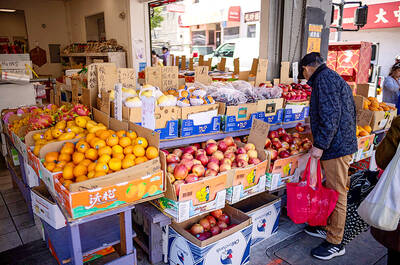
Ajay Verma, a consultant gastroenterologist at Kettering general hospital in Northamptonshire, says our gut is a “complex machine.” “It is constantly providing us with the nutrition we need, initially to grow and develop, and then for us to survive, thrive and repair from injury and illness.” How can we keep it functioning well? Put simply: “Make sure what you put into it is balanced, and that you clear out its waste products adequately,” Verma says. “In a general gastroenterology clinic, the most common conditions we see are irritable bowel syndrome (IBS), gastroesophageal reflux disease, inflammatory bowel disease and constipation,” says Nisha
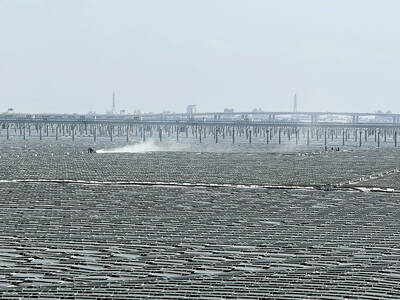
The arithmetic is straightforward and uncomfortable. By the end of 2025, Taiwan had committed itself to a 50-30-20 electricity mix — half natural gas, 30 per cent coal, 20 per cent renewables. The Ministry of Economic Affairs’s (MOEA) own monthly energy reports tell a different story. Natural gas reached 47.8 per cent of generation last year. Coal stood at 35.4 per cent, comfortably above its target ceiling. Renewables came in at 13.1 per cent, well short of the 20 per cent Taipei had pledged a decade earlier. Installed renewable capacity reached roughly half of the 12 gigawatts (GW) the government

Last week US President Donald Trump was asked by a reporter whether he would speak on the phone to the President of Taiwan. “l’ll speak to him. I speak to everybody. We have that situation very well in hand,” Trump said. This marked the second time in a couple of weeks he had said he would talk to the President of Taiwan. In 2016 he famously took a call from then-president Tsai Ing-wen (蔡英文), when he was president-elect. Despite warnings that the apocalypse was nigh because of a phone call, the world quickly forgot about the conversation between two democratically-elected presidents.

Taiwan’s drone exports are taking off, fuelled by the war in Ukraine, as Taiwanese companies seek a stake in the fast-growing global market for unmanned aerial vehicles (UAV). Low-cost drones used for reconnaissance and strikes are in high demand as governments around the world boost defense spending in the face of intensifying conflicts. A relative new player in the increasingly competitive industry, Taiwan’s pitch is to be an “Asian hub” for the production of UAVs and components free of Chinese materials, or “non-red.” That means its UAVs can be up to three times more expensive than their Chinese competitors, like the world’s biggest


 RSS
RSS