


Steve Ilardi is slim and enthusiastic, with intense eyes. The clinical psychologist is 7,000km from me, in Kansas, and we are chatting about his new book via Skype, the online videophone service. “I’ve spent a lot of time pondering Skype,” he says. “On the one hand it provides a degree of social connectedness. On the other, you’re still essentially by yourself.” But, he concludes, “a large part of the human cortex is devoted to the processing of visual information, so I guess Skype is less alienating than voice calls.”
Social connectedness is important to Ilardi. In The Depression Cure, he argues that the brain mistakenly interprets the pain of depression as an infection. Thinking that isolation is needed, it sends messages to the sufferer to “crawl into a hole and wait for it all to go away.” This can be disastrous because what depressed people really need is the opposite: more human contact.
Which is why social connectedness forms one-sixth of his “lifestyle based” cure for depression. The other five elements are meaningful activity (to prevent “ruminating” on negative thoughts); regular exercise; a diet rich in omega-3 fatty acids; daily exposure to sunlight; and good-quality, restorative sleep.
The program has one glaring omission: anti-depressant medication. Because according to Ilardi, the drugs simply don’t work. “Meds have only around a 50 percent success rate,” he says. “Moreover, of the people who do improve, half experience a relapse. This lowers the recovery rate to only 25 percent. To make matters worse, the side effects often include emotional numbing, sexual dysfunction and weight gain.”
As a respected clinical psychologist and university professor, Ilardi’s views are hard to dismiss. A research team at his workplace, the University of Kansas, has been testing his system — known as TLC (Therapeutic Lifestyle Change) — in clinical trials. The preliminary results show, he says, that every patient who put the full program into practice got better.
Ilardi is convinced that the medical profession’s readiness to prescribe anti-depression medication is obscuring an important debate. Up to 20 percent of the UK population will have clinical depression at some point, he says — twice as many as 30 years ago. Where has this depression epidemic come from?
The answer, he suggests, lies in our lifestyle. “Our standard of living is better now than ever before, but technological progress comes with a dark underbelly. Human beings were not designed for this poorly nourished, sedentary, indoor, sleep-deprived, socially isolated, frenzied pace of life. So depression continues its relentless march.”
Our environment may have evolved rapidly but our physical evolution hasn’t kept up. “Our genome hasn’t moved on since 12,000 years ago, when everyone on the planet were hunter-gatherers,” he says. “Biologically, we still have Stone Age bodies. And when Stone Age body meets modern environment, the health consequences can be disastrous.”
To counteract this Ilardi focuses on the aspects of a primitive lifestyle that militate against depression. “Hunter-gatherer tribes still exist today in some parts of the world,” he says, “and their level of depression is almost zero. The reasons? They’re too busy to sit around brooding. They get lots of physical activity and sunlight. Their diet is rich in omega-3, their level of social connection is extraordinary, and they regularly have as much as 10 hours of sleep.” Ten hours? “We need eight. At the moment we average 6.7.”
So we should all burn our possessions and head out into the forest? “Of course not,” Iladi shudders. “That would be like a lifelong camping trip with 30 close relatives for company. Nobody would recommend that.”
Instead we can adapt our modern lifestyle to match our genome by harnessing modern technology, such as fish oil supplements to increase our intake of omega-3. All well and good. But I can’t escape the feeling that the six-step program seems like common sense. Isn’t it obvious that more sleep, exercise and social connectedness are good for you?
“The devil is in the detail,” replies Ilardi. “People need to know how much sunlight is most effective, and at which time of day. And taking supplements, for example, is a complex business. You need anti-oxidants to ensure that the fish oil is effective, as well as a multivitamin. Without someone spelling it out, most people would never do it.” Ilardi practices the program himself. He’s never been depressed, he tells me, but it increases his sense of well-being and reduces his absentmindedness (his college nickname was “Spaced”).
It all makes sense, but will I try it myself? I don’t suffer from depression, but well-being sounds nice. I’m not so sure about the fish oil, but I might just give it a go.




Taiwan’s English education system is being pulled apart by three opposing forces. Bilingual Nation 2030 pulls students toward English and global communication. Artificial Intelligence (AI) readiness pulls them toward digital judgment, verification and AI-mediated work. But Taiwan’s old exam culture pulls them back toward memorization, grammar drills, timed reading and correct answers. If the education system keeps using old exams to define success, it risks producing graduates who are neither genuinely bilingual nor genuinely AI-ready, but trained for tasks machines can already perform. The first force is Bilingual Nation 2030. Launched in 2018, the policy aimed to “help Taiwan’s workforce connect

“Taiwan’s Opposition Leader Comes to US With a Message Straight Out of Beijing” read a May 31 headline in the Wall Street Journal. Top US administration officials and members of Congress almost certainly read the WSJ, and if there was a bullet point takeaway that people in Washington should absorb ahead of Chinese Nationalist Party (KMT) Chair Cheng Li-wun’s (鄭麗文) arrival in DC on June 9, that headline is it. The last few columns have discussed this very topic, and the timing is not coincidental. While those top officials likely do not read the Taipei Times, judging by the number

With weighty, anxiety-inducing geopolitical topics dominating the headlines, checking in on the wild and weird state of local politics can take some of the edge off. This November’s elections will determine who will be in charge of fixing potholes in your neighborhood, not the potholes in Taiwan’s complicated geopolitical space. Recently, after an online interview with a Taipei-based journalist, I commented that Taipei journalists never go further than the MRT can take them. He laughed and agreed. Naturally, the Taipei mayoral race is eating up much of the press attention. TAIPEI CITY Democratic Progressive Party (DPP) candidate Puma Shen (沈伯洋) has
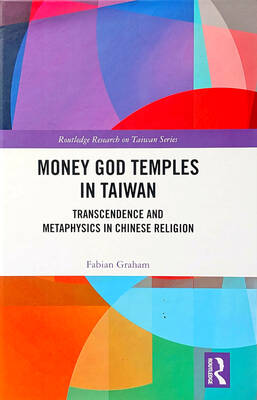
As someone who normally steers clear of books with “transcendence” or “metaphysics” in their subtitles, this reviewer — a casual observer of local belief systems since the 1990s — found Fabian Graham’s Money God Temples in Taiwan a challenging read. Those who’ve only dipped their toes into temple culture will likely need to parse several sections with special care if they’re to keep up with the author, a British ethnographic researcher whose previous books have investigated religious practices among ethnic Chinese in Southeast Asia. This scholarly volume examines a facet of Taiwan’s religious landscape that didn’t exist a century ago, and


 RSS
RSS