


The annual list of the world’s 50 best restaurants was unveiled in London on Monday night, containing a new No 1. The publication of the list is one of the biggest events in the food world’s calendar.
The talk of the night was that the title of world’s best restaurant has finally been wrenched from the grip of El Bulli in Spain, with Denmark’s Noma, a relative newcomer, being acclaimed as the globe’s greatest dining experience. Rene Redzepi’s groundbreaking restaurant in Copenhagen, which serves only food from the Nordic region, was propelled into the top spot thanks to a dedication to regional products fashioned into startling creations such as “vintage potato and whey,” and “lovage and prastost.”
Some big-name chefs in London, however, again failed to make the top flight, with Gordon Ramsay — arguably Britain’s most successful culinary export — absent from the list, having dropped out of the top 100 last year. Despite all of the publicity from his TV shows in the UK and US, and more than 20 restaurants in four continents, Ramsay failed to regain his place among the top chefs, where he last appeared in 2008, in 13th place.
Traditional rivals for the top two spots, El Bulli on the Costa Brava and the Fat Duck, of Bray, Berkshire, moved down to second and third respectively to make way for Noma, after what has been a turbulent year for both restaurants.
Ferran Adria of El Bulli, celebrated as the world’s leading molecular gastronome, announced in January that his experimental restaurant is to close for two years, while Blumenthal was forced to temporarily close the Fat Duck in February last year when around 400 diners got food poisoning.
Speaking ahead of the awards, on the prospect of dropping further down the list, Blumenthal admitted that the restaurant’s closure could influence its ranking. “Us chefs are incredibly competitive so no one would be a human being if they weren’t disappointed by slipping down a place or two or three,” he said.
Praising Noma, he added: “No one thinks of Denmark as being one of Europe’s gastronomic leaders and what Rene has done in that country makes it even more remarkable.”
Noma’s breakthrough — decided by an 806-strong panel of chefs, restaurateurs, food writers and restaurant critics from around the world — caps a remarkable rise. The restaurant leapt from obscurity to third place in 2008 while Redzepi won the chefs’ chef award in the same year, hitting back at critics who he said had called the restaurant “the stinking whale.”
Richard Vines, restaurant critic at Bloomberg, said the Danish chef’s victory was deserved. “[Redzepi] is doing something really different, heading a movement that is trying to rediscover Nordic cuisine. It is genuinely creative and unique.”
He added: “Many people are trying to use seasonal and local food but Noma has taken it to the next level. They are rediscovering traditional ingredients while using modern techniques to create the dishes.”
Noma uses only food from Sweden, Norway, Iceland, Denmark (including Greenland and the Faroe Isles) and Finland, and employs a network of foragers to find wild herbs and source unusual seafood. In an interview with Jay Rayner, the Observer food critic, he argued that the strict framework had unleashed his creativity. “A tight frame sets you free. It forces you to be imaginative,” he said.


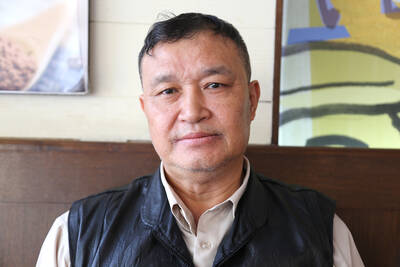
Taiwan has next to no political engagement in Myanmar, either with the ruling military junta nor the dozens of armed groups who’ve in the last five years taken over around two-thirds of the nation’s territory in a sprawling, patchwork civil war. But early last month, the leader of one relatively minor Burmese revolutionary faction, General Nerdah Bomya, who is also an alleged war criminal, made a low key visit to Taipei, where he met with a member of President William Lai’s (賴清德) staff, a retired Taiwanese military official and several academics. “I feel like Taiwan is a good example of

March 2 to March 8 Gunfire rang out along the shore of the frontline island of Lieyu (烈嶼) on a foggy afternoon on March 7, 1987. By the time it was over, about 20 unarmed Vietnamese refugees — men, women, elderly and children — were dead. They were hastily buried, followed by decades of silence. Months later, opposition politicians and journalists tried to uncover what had happened, but conflicting accounts only deepened the confusion. One version suggested that government troops had mistakenly killed their own operatives attempting to return home from Vietnam. The military maintained that the
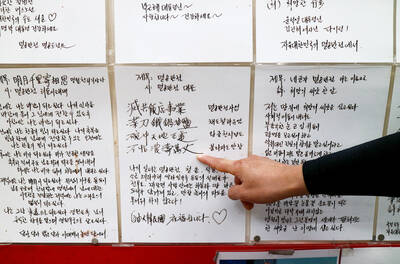
“M yeolgong jajangmyeon (anti-communism zhajiangmian, 滅共炸醬麵), let’s all shout together — myeolgong!” a chef at a Chinese restaurant in Dongtan, located about 35km south of Seoul, South Korea, calls out before serving a bowl of Korean-style zhajiangmian —black bean noodles. Diners repeat the phrase before tucking in. This political-themed restaurant, named Myeolgong Banjeom (滅共飯館, “anti-communism restaurant”), is operated by a single person and does not take reservations; therefore long queues form regularly outside, and most customers appear sympathetic to its political theme. Photos of conservative public figures hang on the walls, alongside political slogans and poems written in Chinese characters; South
Taipei Mayor Chiang Wan-an (蔣萬安) announced last week a city policy to get businesses to reduce working hours to seven hours per day for employees with children 12 and under at home. The city promised to subsidize 80 percent of the employees’ wage loss. Taipei can do this, since the Celestial Dragon Kingdom (天龍國), as it is sardonically known to the denizens of Taiwan’s less fortunate regions, has an outsize grip on the government budget. Like most subsidies, this will likely have little effect on Taiwan’s catastrophic birth rates, though it may be a relief to the shrinking number of


 RSS
RSS