


Jay Chou (周杰倫) and model Lin Chi-ling (林志玲) have finally fulfilled every pap’s dream by appearing in public as a couple — or have they? Next Magazine reported that the two went on a date to a hot pot restaurant in Taipei’s East District (東區) — but our sister newspaper, the Liberty Times, says the outing was a ploy to energize lackluster ticket sales of the duo’s flick The Treasure Hunter (刺陵).
The super-hotties were spotted late at night last week. In an alleged attempt to throw off reporters, Chou swapped his BMW for a Ford borrowed from lyricist Vincent Fang (方文山) before driving into Lin’s apartment complex. Despite his attempts at subterfuge (or perhaps because of), photogs quickly surrounded the two — Next Magazine published grainy photos of Chou and Lin in and out of the Ford as they arrived at the restaurant on Civil Boulevard (市民大道).
Oddly enough, for a pair trying to avoid publicity, the two had gathered not only a contingent of celeb friends, including Devon Song (彈頭) of pop group Nan Quan Mama (南拳媽媽) and Jackie Chan’s (成龍) son Jaycee Fong (房祖名), but also what appeared to be Chou’s entire entourage.
“It’s like he called in a naval escort (護航),” Next Magazine tartly noted.
Chou and Lin’s inability to keep their “secret love affair” a secret may indeed be a scheme to raise ticket sales of Treasure Hunter. The epic is rumored to have cost NT$500 million to produce, but has made only NT$6,270,000 at the box office since opening two weeks ago, according to the Liberty Times. Even a limited edition souvenir book autographed by the two actors and filled with glossy photos of them in character has found few takers. There were 600 volumes issued, but as of the beginning of this week, 264 books were still lingering in stores, despite Chou’s status as one of the sexiest men in Asia and Lin’s as “Taiwan’s most beautiful woman.”
Only time will tell if the Chou-Lin matchup will increase interest in Treasure Hunter, but one thing’s for sure: Chou sure does like that hot pot restaurant on Civil Boulevard. Next Magazine noted that it was his favorite meeting spot during his on-and-off relationship with pop superstar Jolin Tsai (蔡依林). “Only the face beside him has changed, from Tsai to [talk show host] Patty Hou (侯佩岑) to Lin,” the gossip rag wrote.
On the opposite side of the coin, actor Mark Chao (趙又廷) was not only probably a lot less eager to talk to reporters, but also tired of promoting his latest film, Monga (艋舺). Chao was hit with a cold after a rigorous round of publicity events and recording for the flick’s sound track. Apple Daily spotted the actor heading into a clinic on Minquan East Road (民權東路) known for its clientele of celebrities. A brave reporter got close enough to the germ-laden heartthrob to ascertain that he sounded nasal behind his facemask and that his “electrifying eyes” looked spiritless. Chao burst into a coughing fit as soon as he opened his mouth to answer a question, before managing to choke out, redundantly, “I have to wear a mask, this cold is really bad.” When asked if he had H1N1, Chao replied, “No way! I don’t have a fever!” before launching into a hacking fit once again.
Taiwanese songstress Elva Hsiao (蕭亞軒) had weightier things on her mind last Monday as she and her younger brother bade good-bye to their mother, who passed away after a battle with cancer. Apple Daily reported on the memorial service in exacting detail, thanks to information provided by Hsiao’s management company. The funeral cost NT$150,000, mourners were surrounded by 6,600 white roses, NT$180 million worth of paper money was burned, along with paper versions of two maids and a Louis Vuitton handbag, and donations were to be made to the Formosa Cancer Foundation (台灣癌症基金會), Dharma Drum Mountain (法鼓山) and Tzu Chi (慈濟). Hsiao’s former flame, Jacky Chu (祝釩剛), was in attendance. Chu reportedly let down Hsiao and her mother 10 years ago when he was unable to commit to Hsiao. Apple Daily reported that he showed up at the funeral to pay his respects to mother Hsiao and promise to take care of Elva “as a friend.” Other famous mourners included socialite and model Aimee Sun (孫芸芸), actress Terri Kwan (關穎), and Fong, who went to the funeral a few days after hanging out with Chou and Lin at the hot pot restaurant.

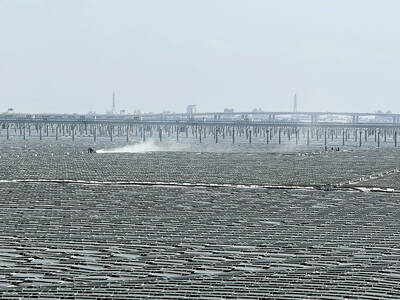
The arithmetic is straightforward and uncomfortable. By the end of 2025, Taiwan had committed itself to a 50-30-20 electricity mix — half natural gas, 30 per cent coal, 20 per cent renewables. The Ministry of Economic Affairs’s (MOEA) own monthly energy reports tell a different story. Natural gas reached 47.8 per cent of generation last year. Coal stood at 35.4 per cent, comfortably above its target ceiling. Renewables came in at 13.1 per cent, well short of the 20 per cent Taipei had pledged a decade earlier. Installed renewable capacity reached roughly half of the 12 gigawatts (GW) the government
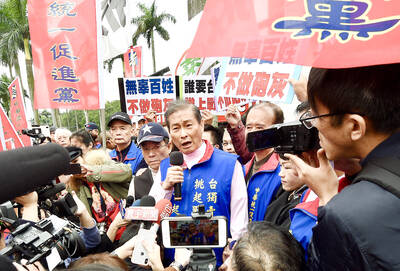
There are shadowy cabals plotting to sell out Taiwan to be annexed by China, by invasion if necessary. Fortunately, they are buffoons. In 2019, former Bamboo Union gangster and founder of the China Unification Promotion Party (CUPP), Chang An-le (張安樂, colorfully known as “White Wolf”), led a protest at the Legislative Yuan against comments made by then-premier Su Tseng-chang (蘇貞昌) that in the event of an attack by China, he would never surrender, but would protect the nation by fighting to the end, even if he only had a broom. Chang had party members bring a wooden casket that they
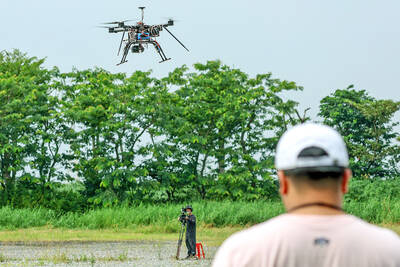
Taiwan’s drone exports are taking off, fuelled by the war in Ukraine, as Taiwanese companies seek a stake in the fast-growing global market for unmanned aerial vehicles (UAV). Low-cost drones used for reconnaissance and strikes are in high demand as governments around the world boost defense spending in the face of intensifying conflicts. A relative new player in the increasingly competitive industry, Taiwan’s pitch is to be an “Asian hub” for the production of UAVs and components free of Chinese materials, or “non-red.” That means its UAVs can be up to three times more expensive than their Chinese competitors, like the world’s biggest

It seems every few days one bumps into one of those “real man” comments in which Taiwan is urged to “face reality” or similar, and “make a deal,” with the speaker implying that soon it will be too late. “Deal” advocates always present themselves as having a superior grip on reality, and the manly ability to make the “hard choice.” Their testosterone-laden language often echoes that of Taiwan sellout advocates. Note that such commentary always specifies a process (“make a deal, work with, make progress”), never the end state of what occupation by a violent authoritarian colonialist state will entail. In


 RSS
RSS