


The National Theater’s curtain came down on Friday night — seemingly slower than usual, as befitting a Legend Lin Dance Theatre (無垢舞蹈劇場) performance — and you could feel the audience collectively exhale the long breath they had been holding before bursting into frenzied applause.
Song of Pensive Beholding (Chants de la Destinee, 觀), which had its world premiere on Friday night, is the final part of the trilogy Lin Lee-chen (林麗珍) began almost 15 years ago with Mirrors de Vie (醮). Like Mirrors and the second part of the trilogy, Hymne aux Fleurs Qui Passent (花神祭春芽), Lin created a mystical, magical portal for Song that transports the audience, even as it creates strong links to our own world.
As the audience enters the theater, the stage curtain was up and a primitive altar — of polished driftwood and dried sheaves of corn or rice and water — was placed on the raised floor of the orchestra pit. Flickering candles lit the side wings of the stage.
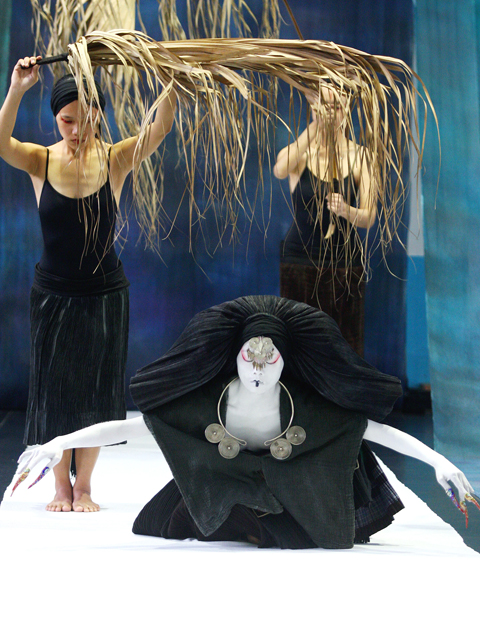
PHOTO COURTESY OF LEGEND LIN DANCE THEATRE
The Song opens with childish giggles, as two little boys and a woman enter from one of the doors off to the side of the stage and walk to the altar for a ritual water blessing. As the boys scamper off, the two ceremonial drummers take their places on either side of the stage. With the sound of a gong, the altar is slowly lowered into the orchestra pit (all too audibly, unfortunately, it sounded like some gears need oil) and the performance commences.
In the beginning, most of the stage is dark, the only light coming from single spots up in the batons, making the stage look cavernous — think Notre Dame or any medieval cathedral.
Two women start to move slowly from either side of drapes in the back to the front of stage, walking half bent, holding two dried sheaves in front of them, lifting one foot, dragging the big toe along the floor until it is a footstep ahead, then placing the full foot down and lifting the other foot. More women enter, some, like the first representing the god of Crops, others the God of Water. Two men, clad in bodypaint, loincloths and painted faces, advance half-crouched, holding lit candles before them — they represent the God of Fire.
Then the figure of a woman — the White Bird — with a striking black cloth headdress, white bodypaint and a big black skirt with Hmong or Miao designs makes her first appearance.
A large part of the eight-part Song is taken up with these slow, meditative walks, criss-crossing the stage, first vertically and later horizontally, with the dancers moving so slowly that they often appear not to be moving at all. The dancers’ half-crouched or shoulders-hunched positions look painful — the secret I’m told, is the hips. Lin believes all the power should be centered in the hips, with everything else relaxed, even if, like White Bird, you do a slow backbend from a kneeling position, arms outstretched until the hands reach the floor and then slowly swivel the body.
The slow pace underscores the meditative core of Lin’s work. Time passes imperceptibly. Nothing happens and yet the world changes before our eyes.
The meditative feeling is enhanced by the score, with large segments of chanting taken from two albums: Dhyana Aman: Meditation of No Mind and Naked Spirits. The beautiful voice of Hsu Ching-wen (�?E) comes in about halfway through the program, as the voice of the “Primordial Soul,” singing in a made-up language, accompanied by Wu Chung-hsien (吳宗憲) on the flute.
In the program notes, Lin said watching eagles over the harbor in her hometown of Keelung inspired her. She said Song tells the story of “a mysterious river, a mysterious eagle race and a mysterious realm where time and space did not yet exist. The two brothers that led the eagle race vowed to protect this stunningly beautiful land forever as it was. One day, however, the vows were broken and the land encountered Change.” The bird motif is illustrated through the long cloisonne fingernail covers the main characters wear as well as the long pheasant feathers in the topknots of the two brothers, Yaki and Samo.
The change comes to the land when Yaki has an encounter, both sexual and metaphysical, with White Bird. This triggers an encounter between the two brothers. The clash, however, is internalized, all coiled muscles, as the two men face each other and make their stand, driving their long staffs along the floor with so much intensity you would think that long gouges would be left. They grimace, they groan, they shriek at each other — they just never actually touch. The younger brother is finally forced to withdraw, but it is the victor who appears vanquished. He collapses, crying as he gulps for air, before slowly rising and starting the long walk to the back of the stage.
As he moves back, the women/temple maidens reappear, crossing the stage horizontally this time, with the sheaves of grain and three long strips of cloth, and then the gods of fire appear. One by one, the entire cast makes their appearance on stage, half-turning to face the audience as the altar rises out of the pit and the curtain falls, cutting the audience off from the company’s otherworldly vision.
Lin’s production team — lighting by Cheng Fu-chang (鄭富長), staging by Cheng Wang (張忘), costumes by Tim Yip (葉錦添) — created a stunning production that seamlessly enhanced her unique vision without distracting from it. Let’s just hope it doesn’t take another nine years for the 59-year Lin to create a new full-length production.
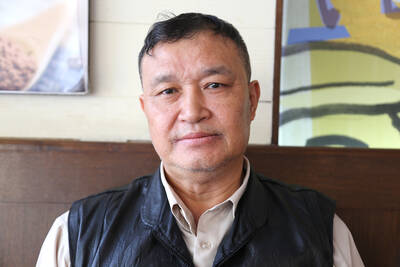
Taiwan has next to no political engagement in Myanmar, either with the ruling military junta nor the dozens of armed groups who’ve in the last five years taken over around two-thirds of the nation’s territory in a sprawling, patchwork civil war. But early last month, the leader of one relatively minor Burmese revolutionary faction, General Nerdah Bomya, who is also an alleged war criminal, made a low key visit to Taipei, where he met with a member of President William Lai’s (賴清德) staff, a retired Taiwanese military official and several academics. “I feel like Taiwan is a good example of
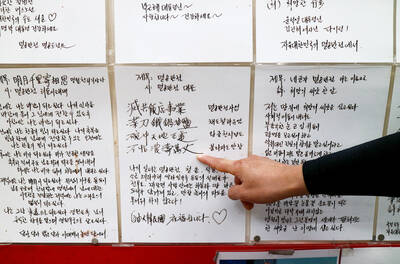
“M yeolgong jajangmyeon (anti-communism zhajiangmian, 滅共炸醬麵), let’s all shout together — myeolgong!” a chef at a Chinese restaurant in Dongtan, located about 35km south of Seoul, South Korea, calls out before serving a bowl of Korean-style zhajiangmian —black bean noodles. Diners repeat the phrase before tucking in. This political-themed restaurant, named Myeolgong Banjeom (滅共飯館, “anti-communism restaurant”), is operated by a single person and does not take reservations; therefore long queues form regularly outside, and most customers appear sympathetic to its political theme. Photos of conservative public figures hang on the walls, alongside political slogans and poems written in Chinese characters; South

Institutions signalling a fresh beginning and new spirit often adopt new slogans, symbols and marketing materials, and the Chinese Nationalist Party (KMT) is no exception. Cheng Li-wun (鄭麗文), soon after taking office as KMT chair, released a new slogan that plays on the party’s acronym: “Kind Mindfulness Team.” The party recently released a graphic prominently featuring the red, white and blue of the flag with a Chinese slogan “establishing peace, blessings and fortune marching forth” (締造和平,幸福前行). One part of the graphic also features two hands in blue and white grasping olive branches in a stylized shape of Taiwan. Bonus points for
Taipei Mayor Chiang Wan-an (蔣萬安) announced last week a city policy to get businesses to reduce working hours to seven hours per day for employees with children 12 and under at home. The city promised to subsidize 80 percent of the employees’ wage loss. Taipei can do this, since the Celestial Dragon Kingdom (天龍國), as it is sardonically known to the denizens of Taiwan’s less fortunate regions, has an outsize grip on the government budget. Like most subsidies, this will likely have little effect on Taiwan’s catastrophic birth rates, though it may be a relief to the shrinking number of


 RSS
RSS