


By now, most high school dress codes have just about done away with the guesswork.
Girls: no midriff-baring blouses, stiletto heels, miniskirts.
Boys: no sagging pants, muscle shirts.
But do the math.
“Rules” + “teenager” = “challenges.”
If the skirt is an acceptable length, can a boy wear it?
Can a girl attend her prom in a tuxedo?
In recent years, a growing number of teenagers have been dressing to articulate — or confound — gender identity and sexual orientation. Certainly they have been confounding school officials, whose responses have ranged from indifference to applause to bans.
Last week, a cross-dressing Houston senior was sent home because his wig violated the school’s dress-code rule that a boy’s hair may not be “longer than the bottom of a regular shirt collar.” Last month, officials at a high school in Cobb County, Georgia, sent home a boy who favored wigs, make-up and skinny jeans. In August, a Mississippi student’s senior portrait was barred from her yearbook because she had posed in a tuxedo.
Other schools are more accepting of unconventional gender expression. In September, a freshman girl at Rincon High School in Tucson who identifies as male was nominated for homecoming prince. Last May, a gay male student at a Los Angeles high school was crowned prom queen.
Dress-code conflicts often reflect a generational divide, with students coming of age in a culture that is more accepting of ambiguity and difference than that of the adults who make the rules.
“This generation is really challenging the gender norms we grew up with,” said Diane Ehrensaft, an Oakland psychologist who writes about gender. “A lot of youths say they won’t be bound by boys having to wear this or girls wearing that. For them, gender is a creative playing field.” Adults, she added, “become the gender police through dress codes.”
Dress is always code, particularly for teenagers eager to telegraph evolving identities. Each year, schools hope to quell disruption by prohibiting the latest styles that signify a gang affiliation, a sexual act or drug use.
But when officials want to discipline a student whose wardrobe expresses sexual orientation or gender variance, they must consider anti-discrimination policies, mental health factors, community standards and classroom distractions.
And safety is a critical concern. In February last year, Lawrence King, an eighth-grader from Oxnard, California, who occasionally wore high-heeled boots and makeup, was shot to death in class by another student.
Although dress code disputes are largely anecdotal, popping up in the news when a lawsuit threat emerges, educators and psychologists say that more schools will have to address them in the near future. There are 4,118 gay-straight alliance clubs in high schools across the US, which raise awareness of such issues. Gender-boundary questions are even bubbling up in elementary schools, with parents seeking to pave the way for their children, in blogs like acceptingdad.com and labelsareforjars.wordpress.com.
At minimum, more students are trying on their curiosity for size. Typically during “Mix ‘n’ Match Day,” at Ramapo High School in Spring Valley, New York, students might wear polka dots with stripes, said Diane Schneider, a teacher who is a co-chairwoman of the Hudson Valley chapter of the Gay, Lesbian and Straight Education Network. But this year, she said, “about 50 kids came as cross-dressers.”
All this is too much for some educators, who say high school should not be a public stage to work out private identity issues. School, they say, is a rigorous academic and social training ground for the world of adults and employment.
“It’s hard enough to get kids to concentrate on an algorithm — even without Jimmy sitting there in lipstick and fake eyelashes,” said Kay Hymowitz, a senior fellow at the Manhattan Institute.
Because schools are communal, she wrote in an e-mail message, “self-expression will always have to be at least partially limited, just as it is in the workplace.” Principals need leeway in determining how students present themselves, she added. “You can understand why a lot of principals get fed up with these sorts of fights and just decide on school uniforms.”
At Wesson Attendance Center, a Mississippi public school, just that sort of fight erupted over senior portraits. Last summer, during her photo session, Ceara Sturgis, 17, dutifully tried on the traditional black drape, the open-necked robe that reveals the collarbone, a hint of bare shoulder.
“It was terrible!” said Sturgis, an honors student, band president and soccer goalie, who has been openly gay since 10th grade. “If you put a boy in a drape, that’s me! I have big shoulders and ooh, it didn’t look like me! I said, ‘I can’t do this!’ So my mom said, ‘Try on the tux.’ And that looked normal.”
Shortly thereafter, students were informed that girls had to wear drapes for yearbook portraits; boys, tuxedos.
The Mississippi chapter of the American Civil Liberties Union wrote to the school. Rickey Clopton, superintendent of Copiah County schools, did not return phone calls. Last month he released a statement affirming that the school’s decision was “based upon sound educational policy and legal precedent.”
Last month, Veronica Rodriguez, Sturgis’ mother, paid for a full-page ad in the yearbook that is to include a photograph of her daughter in a tuxedo.
Dress-code challenges like these have been cropping up for years. Earlier this year, when prodded by lawyers, schools in Jackson, Mississippi, and Lebanon, Indiana, reversed policies and allowed girls to wear tuxedos.
But generally, courts give local administrators great latitude. In Marion County, Florida, students must dress “in keeping with their gender.” Last spring, when a boy came to school wearing high-heeled boots, a stuffed bra, and a V-neck T-shirt, he was sent home to change.
“He was cross-dressing and it caused a disruption in the normal instructional day,” said Kevin Christian, a district spokesman. “That’s the whole point behind the dress code.”
In some districts, administrators seek to define the line between classroom distraction and the student’s need for self-expression. A few years ago, when Alan Storm was assistant superintendent at Sunnyside Unified School District in Tucson, he oversaw legal and disciplinary matters.
Principals would ask him about dress-code gender cases: “They’d say, ‘Johnny just showed up in a cut-off top! Should I suspend the kid or make him change his clothes?’” Storm recalled. “And I’d say, ‘Is there a bare midriff?’ ‘No.’ ‘Then it doesn’t violate your dress code. You have no right to make the kid change his clothes. But it’s your absolute policy to keep the kid safe.’”
Storm, now superintendent of a technological program for high school students throughout Pima County, Arizona, helped draft anti-discrimination policies that protect gender expression and sexual orientation, since adopted by some Tucson districts.
Such policies have become woven into the social fabric of Rincon High School, said Brenda Kazen, a school counselor: “Gender expression is very fluid here.” Some boys have worn makeup and pink frilly scarves; girls wear big T-shirts, long basketball shorts — and look like male gang members, she said. Moreover, the student population includes immigrants from more than three dozen countries. “Our kids are just used to seeing different things and they’re OK with it,” Kazen said.
Yet acceptance is hardly unilateral among teenagers, much less adults.
“There are other places where there are real safety issues,” said Barbara Risman, a sociologist at the University of Illinois who studies adolescent gender identity. “Most boys still very much feel the need to repress whole parts of themselves to avoid peer harassment.”
Last fall, Stephen Russell, a professor at the University of Arizona who studies gay, lesbian and transgender youth, conducted a survey of about 1,200 California high school students. When asked why those perceived as not as “masculine” or “feminine” as others were harassed, a leading reason students gave was “manner of dress.”
Often a student’s clothes, intended as a fashion statement, can be misread as a billboard about sexuality. In recent years, “emo” style has moved from punk fringe almost to pop mainstream, with boys wearing heavy eyeliner, body-hugging T-shirts and floppy hair dyed black, to emulate singers like Adam Lambert and Pete Wentz.
“The emo kids get a lot of grief,” said Marty Hulsey, a guidance counselor in Lee County, Alabama. “Even teachers say things and I had to stop it. One child came to me who was an emo kid and said he was accused of being gay, but that he had a girlfriend.” Hulsey said he affirmed the boy’s right to wear the clothes that expressed his taste.
When a principal asks a boy to leave his handbag at home, is the request an attempt to protect a student from harassment or harassment itself?
Dress codes should be enforced consistently, with measures also taken against straight students who dress provocatively, said Diane Levin, a professor at Wheelock College in Boston who writes about the sexualization of young children.
But whether or not a principal bans gender-blurring clothing, she said, the student cannot be abandoned. Why has the student chosen to dress this way? “Is the student sensation-seeking?” Levin asked. “Can the school keep the student safe?”
Some guidance counselors say that while safety concerns can not be dismissed, high school administrators shouldn’t presume that such students will be targeted by peers.
Jeff Grace, faculty adviser for a gay-straight alliance club at an inner-city high school in Columbus, Ohio, said he has seen student perceptions change over the past decade.
One student, Grace recounted, born male and named Jack, has long, straight hair and prefers to be referred to with a female pronoun. Jack is careful not to violate the dress code. She favors tops that are tapered but not revealing, flats, lip gloss.
“One day I heard a student say, ‘Man, there was a girl in the guy’s restroom, standing up using the urinal! What’s up with that?’” Grace recalled.
Bathrooms can be dangerous for transgender students. But the other student replied off-handedly, “That wasn’t a girl. That’s just Jack.”
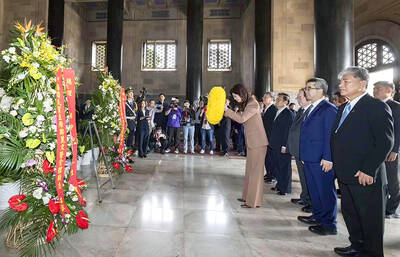
The problem with Marx’s famous remark that history repeats itself, first as tragedy, the second time as farce, is that the first time is usually farce as well. This week Chinese Nationalist Party (KMT) Chair Cheng Li-wun (鄭麗文) made a pilgrimage to the People’s Republic of China (PRC) “to confer, converse and otherwise hob-nob” with Chinese Communist Party (CCP) officials. The visit was an instant international media hit, with major media reporting almost entirely shorn of context. “Taiwan’s main opposition leader landed in China Tuesday for a rare visit aimed at cross-strait ‘peace’”, crowed Agence-France Presse (AFP) from Shanghai. Rare!

What is the importance within the Chinese Nationalist Party (KMT) of the meeting between Xi Jinping (習近平), the leader Chinese Communist Party (CCP), and Cheng Li-wun (鄭麗文), the leader of the KMT? Local media is an excellent guide to determine how important — or unimportant — a news event is to the public. Taiwan has a vast online media ecosystem, and if a news item is gaining traction among readers, editors shift resources in near real time to boost coverage to meet the demand and drive up traffic. Cheng’s China trip is among the top headlines, but by no means
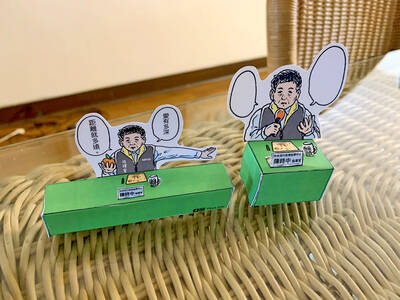
Sunflower movement superstar Lin Fei-fan (林飛帆) once quipped that the Democratic Progressive Party (DPP) could nominate a watermelon to run for Tainan mayor and win. Conversely, the DPP could run a living saint for mayor in Taipei and still lose. In 2022, the DPP ran with the closest thing to a living saint they could find: former Minister of Health and Welfare Chen Shih-chung (陳時中). During the pandemic, his polling was astronomically high, with the approval of his performance reaching as high as 91 percent in one TVBS poll. He was such a phenomenon that people printed out pop-up cartoon

A recent report from the Environmental Management Administration of the Ministry of Environment highlights a perennial problem: illegal dumping of construction waste. In Taoyuan’s Yangmei District (楊梅) and Hsinchu’s Longtan District (龍潭) criminals leased 10,000 square meters of farmland, saying they were going to engage in horticulture. They then accepted between 40,000 and 50,000 cubic meters of construction waste from sites in northern Taiwan, charging less than the going rate for disposal, and dumped the waste concrete, tile, metal and glass onto the leased land. Taoyuan District prosecutors charged 33 individuals from seven companies with numerous violations of the law. This


 RSS
RSS