


The territory covered by a “cultural guide” can be both vast and devious. There are subtleties to navigate, generalizations to make, and, to be sure, a lot of space to cover. Amy Liu gallivants through this tricky terrain with gusto. Taiwan A to Z, The Essential Cultural Guide is at once a dictionary, menu, sociology text, travel guide, history, brochure and easy read. Mostly, it’s the inside scoop in manageable doses, alphabetized, too.
Make no mistake, Liu writes about her beloved island through a rose-tinted pane — not that this makes her accounts any less appetizing; she knows the way to the heart is through the stomach. F is for “Friendly Taiwanese,” a gimmicky chapter that may be difficult to digest (more on that later), but also for “Fruit Paradise,” a mouthwatering compilation ranging from wax apples to star fruits.
Liu’s guide entices readers with the best of Taiwanese cuisine, from pearl milk tea (珍珠奶茶) to fantuan (飯糰), or sticky glutinous rice rolls, to eight different varieties of dumplings. As for xiao chi (小吃), or snacks, Liu guides visitors to the homes of signature dishes: Hualien for mochi (麻糬), Keelung for tempura, Shenkeng for stinky tofu. To eat Taiwanese fare, Liu offers a chapter on using the country’s utensil of choice, though it may be difficult to translate the painstaking directions into actual skill with chopsticks.
Equally tricky to grasp may be mannerisms intuitive for native Taiwanese, but Liu treats these more subtle aspects of culture with good humor. “I” is for “Indirect Communication — How Taiwanese express themselves.” “The Taiwanese value indirect communication and they don’t spell out everything,” Liu writes, before translating a few phrases. “Yes,” for example, frequently means “I hear you” and is more popular than the only reluctantly uttered “no.”
The “Etiquette” chapter is perhaps the guide’s most practical. Caveats against impaling a bowl of rice with chopsticks (only done at funerals) or proffering business cards with only one hand are valuable tidbits. Some rules stem from common sense — don’t pick up food then put it back in the dish — but others — do not use chopsticks to spear food and don’t write on someone’s business card (it represents their face) — could be a newcomer’s saving grace.
Other must-reads fall under P, for “People of Taiwan,” which gives a broad overview of the island’s history and demographics, or under B, for “Betel Nut Beauties,” Taiwan’s notorious hawkers of the chewable nut popular for its tobacco-like buzz, as well as of revealing marketing strategies. Handy details are scattered here and there. Ganbei (乾杯), for example, means “bottoms up” and should be uttered with the generous toasting inevitable at formal business dinners.
If the guide does not shy from generalization, it also isn’t burdened by the need to dissect all its claims. It must be said, however, that characterizations such as, “ABCs by and large are well-educated, energetic, adventurous, and independent,” are startling, to say the least. It might be better to encounter “Friendly Taiwanese” in person, rather than in words stating, “Indeed the general impression … is that the Taiwanese are, among other things, friendly, polite, hard-working, kind, passionate, easy-going, reliable, open, and flexible.”
Liu’s social studies are her most ambitious. For the most part, it boils down to “Westerners value individualism, while Taiwanese respect group-orientation.” In “Identity, ‘I’ or ‘We’ — it all starts from the nursery.” Liu describes the difference between Taiwanese parents, who sleep in the same room or even bed as their children (sometimes at the price of the father’s exile to another room) versus Western families, who often have their babies sleep alone starting on the first day in order to instill independence.
She writes of Western culture, “The ‘self-identity’ — (I, me, my) and the need to stand out from the crowd and be different is considered desirable” and contrasts this with Taiwanese who “identify closely with the group … All aspects of personal and professional life, including relationships, are connected and intertwined for everyone who is considered part of the group. The desires of the ‘self’ cannot be separated from the wishes of the group and the family.” At the same time, Liu explains, “Taiwanese people are group-oriented … however, they are generally not good at teamwork,” attributing this to a culture of fierce competition that extends into offices and classrooms alike, thus the unusually high number of university degrees and PhDs found on the island.
Liu writes that her inspiration stems from seeing both her brother’s child raised in Taiwan as well as her sister’s children brought up in the US. She herself is, in her own terms, a “Returning Taiwanese,” having emigrated to the US from Taipei when she was 13. It’s perhaps these double-sided perspectives that lend the book the familiarity of an insider and its accessibility to those who are not.
Liu’s guide aptly compiles the lessons newcomers might otherwise learn over a period of time, through observation and conversations. It’s less draining than an academic paper and more reliable than a tourist’s brochure, and it’s accompanied by glossy, full-page color photos. Of course, cultural guides tend to be rendered out of date as quickly as iPod models, but for the time being, Liu’s guide will help readers with their first steps in Taiwan.

Sept.16 to Sept. 22 The “anti-communist train” with then-president Chiang Kai-shek’s (蔣介石) face plastered on the engine puffed along the “sugar railway” (糖業鐵路) in May 1955, drawing enthusiastic crowds at 103 stops covering nearly 1,200km. An estimated 1.58 million spectators were treated to propaganda films, plays and received free sugar products. By this time, the state-run Taiwan Sugar Corporation (台糖, Taisugar) had managed to connect the previously separate east-west lines established by Japanese-era sugar factories, allowing the anti-communist train to travel easily from Taichung to Pingtung’s Donggang Township (東港). Last Sunday’s feature (Taiwan in Time: The sugar express) covered the inauguration of the

The corruption cases surrounding former Taipei Mayor and Taiwan People’s Party (TPP) head Ko Wen-je (柯文哲) are just one item in the endless cycle of noise and fuss obscuring Taiwan’s deep and urgent structural and social problems. Even the case itself, as James Baron observed in an excellent piece at the Diplomat last week, is only one manifestation of the greater problem of deep-rooted corruption in land development. Last week the government announced a program to permit 25,000 foreign university students, primarily from the Philippines, Indonesia and Malaysia, to work in Taiwan after graduation for 2-4 years. That number is a
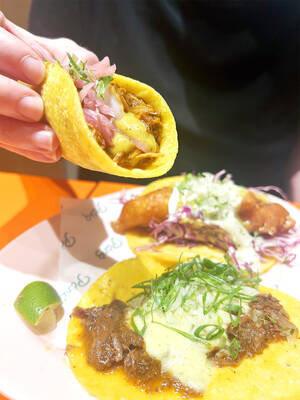
This year’s Michelin Gourmand Bib sported 16 new entries in the 126-strong Taiwan directory. The fight for the best braised pork rice and the crispiest scallion pancake painstakingly continued, but what stood out in the lineup this year? Pang Taqueria (胖塔可利亞); Taiwan’s first Michelin-recommended Mexican restaurant. Chef Charles Chen (陳治宇) is a self-confessed Americophile, earning his chef whites at a fine-dining Latin-American fusion restaurant. But what makes this Xinyi (信義) spot stand head and shoulders above Taipei’s existing Mexican offerings? The authenticity. The produce. The care. AUTHENTIC EATS In my time on the island, I have caved too many times to

In a stark demonstration of how award-winning breakthroughs can come from the most unlikely directions, researchers have won an Ig Nobel prize for discovering that mammals can breathe through their anuses. After a series of tests on mice, rats and pigs, Japanese scientists found the animals absorb oxygen delivered through the rectum, work that underpins a clinical trial to see whether the procedure can treat respiratory failure. The team is among 10 recognized in this year’s Ig Nobel awards (see below for more), the irreverent accolades given for achievements that “first make people laugh, and then make them think.” They are not


 RSS
RSS