


Appearing in a suggestive advertisement for an online game in which your breasts are shown swaying as you ride an undulating exercise machine can put a wannabe on the fast track to superstardom. That, at least, has been the case for “big-breasted bodacious baby face” (童顏巨乳) Yaoyao (瑤瑤), real name Kuo Shu-yao (郭書瑤), who last week was spotted having a business dinner with representatives from Yoshimoto Kogyo, a major Japanese entertainment conglomerate.
Yaoyao’s record company Seed Music (種子音樂) — yes, her debut album is slated to hit record stores next month — said there is indeed a plan for the sex kitten to become a pop star in Japan in the manner of Vivian Hsu (徐若瑄).
Seed Music appears to be on to something. Given the warm reception Yaoyao has received among Taiwan’s zhainan (宅男) community, it is not a stretch to imagine the 19-year-old winning the hearts of Japanese otaku as well.
Meanwhile, former superstar Joey Wang (王祖賢) was in the news again this week after it was reported that the 42-year-old recluse has become a Buddhist nun.
Wang rose to fame after starring in 1987 blockbuster A Chinese Ghost Story (倩女幽魂) and enjoyed a notable career throughout the 1990s. She retired in 2002 and has led a low-profile life in Canada ever since, where she is said to have donned the habit last month.
Gossip observers think Wang’s sudden ability to “see through the vanity of the secular world” (看破紅塵) has something to do with her two failed relationships. One was a 16-year-long romance with musician Chi Chin (齊秦), the other an extramarital affair with Hong Kong entertainment mogul Peter Lam (林建岳).
One of the few openly gay celebrities in Taiwan has aggravated members of the TV-watching public by referring to homosexuals as niang (娘), the Chinese equivalent of “sissy,” on a popular television show, reports the Liberty Times (the Taipei Times’ sister paper).
Over the past month or so Kevin Tsai (蔡康永) of Here Comes Kang and Xi (康熙來了), which he co-hosts with Little S (小S), has been using the word niang to address gay celebrities such as Kuo Hsin (郭鑫), Ti Chih-chieh (狄志杰) and Hsu Chien-kuo (許建國) when they appear on his show.
Viewers angered by his use of the term, which when used by a stranger is considered demeaning, posted angry comments on the Internet like the following: “The sissy host should think of himself before calling other people sissies.”
In other gay-related news, pop diva A-mei (阿妹), real name Chang Hui-mei (張惠妹), will introduce her new persona A-mit (阿密特) to gay fans at a party on July 18 at Riverside Live House (西門紅樓展演館) in Taipei. Unlike A-mei, A-mit is said to have a zero tolerance policy when it comes to saccharine ballads and KTV-friendly tunes. Those who have seen A-mit perform say the black-clad rocker screams, hisses and howls, but never croons.
To catch A-mit at Riverside, partygoers have to be biologically male or identified as male on their ID cards, and wear something “rainbowy.”
Professing concern that the star’s female fans will feel left out, A-mit’s record company, Gold Typhoon (金牌大風), promises a women-only A-mit party if the gay pa (gay趴) goes well.

The small platform at Duoliang Train Station in Taitung County’s Taimali Township (太麻里) served villagers from 1992 to 2006, but was eventually shut down due to lack of use. Just 10 years later, the abandoned train station had become widely known as the most beautiful station in Taiwan, and visitors were so frequent that the village had to start restricting traffic. Nowadays, Duoliang Village (多良) is known as a bit of a tourist trap, with a mandatory, albeit modest, admission fee of NT$10 giving access to a crowded lane of vendors with a mediocre view of the ocean and the trains
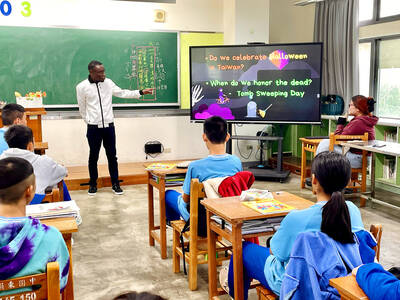
For many people, Bilingual Nation 2030 begins and ends in the classroom. Since the policy was launched in 2018, the debate has centered on students, teachers and the pressure placed on schools. Yet the policy was never solely about English education. The government’s official plan also calls for bilingualization in Taiwan’s government services, laws and regulations, and living environment. The goal is to make Taiwan more inclusive and accessible to international enterprises and talent and better prepared for global economic and trade conditions. After eight years, that grand vision is due for a pulse check. RULES THAT CAN BE READ For Harper Chen (陳虹宇), an adviser

Traditionally, indigenous people in Taiwan’s mountains practice swidden cultivation, or “slash and burn” agriculture, a practice common in human history. According to a 2016 research article in the International Journal of Environmental Sustainability, among the Atayal people, this began with a search for suitable forested slopeland. The trees are burnt for fertilizer and the land cleared of stones. The stones and wood are then piled up to make fences, while both dead and standing trees are retained on the plot. The fences are used to grow climbing crops like squash and beans. The plot itself supports farming for three years.

President William Lai (賴清德) on Nov. 25 last year announced in a Washington Post op-ed that “my government will introduce a historic US$40 billion supplementary defense budget, an investment that underscores our commitment to defending Taiwan’s democracy.” Lai promised “significant new arms acquisitions from the United States” and to “invest in cutting-edge technologies and expand Taiwan’s defense industrial base,” to “bolster deterrence by inserting greater costs and uncertainties into Beijing’s decision-making on the use of force.” Announcing it in the Washington Post was a strategic gamble, both geopolitically and domestically, with Taiwan’s international credibility at stake. But Lai’s message was exactly


 RSS
RSS