


With the opening of the Chinese opera classic The Palace of Eternal Youth (長生殿) at the National Palace Museum (國立故宮博物院文會堂) on Wednesday, the institution’s director, Chou Kung-shin (周功鑫), brings to fruition her vision of expanding the museum’s cultural relevance and broadening its appeal.
The production takes to the stage every Wednesday for the next 12 weeks and will have English-language side-titles, which widens its accessibility.
In late 2007, the museum’s Vienna Art Festival (維也納藝術季), which featured a series of concerts related to its Splendor of the Baroque and Beyond: Great Hapsburg Collectors exhibition, was well received.
The current project, titled New Melody From the National Palace Museum (故宮新韻), is a longer term undertaking that features Chinese operatic productions tailored to complement the museum’s exhibits.
What makes the New Melody project particularly exciting is the very high caliber of the two groups that have so far agreed to take part.
The Palace of Eternal Youth is a 90-minute production specially created by the Lanting Kun Opera Company (蘭庭崑劇團) starring Wen Yuhang (溫宇航).
After The Palace’s run, Beijing opera star Li Baochun (李寶春) will take the stage with his highly-acclaimed interpretation of The Monkey King Makes Havoc in Heaven (孫悟空大鬧天宮).
When planning to introduce performance art to the museum, Chou said there was a strong consensus on the need for a connection between the artistic productions and the museum’s exhibitions.
In the case of The Palace of Eternal Youth, part of the opera’s story is presented in the Tang Dynasty painting Emperor Ming-huang’s Flight to Szechwan (明皇幸蜀圖), one of the institution’s great treasures.
“Visual arts express a single moment. In a good work, this moment can hint at the past, express the present, and suggest the future. Performance art is extended through time and can tell a story from beginning to end. By putting these two things together, we are using an artifact to enrich our production, while the performance can enrich [our understanding] of the artifact,” said Wang Chih-ping (王志萍), Lanting Kun Opera Company’s director.
Lanting won acclaim for combining the rigorous discipline of traditional opera with contemporary presentation styles. In condensing a 50-act opera that could take anything up to two days to perform into a 90-minute production required ingenuity, but Wang believes that despite the short stage time, both a narrative structure and the original’s highlights have been preserved.
The Palace of Eternal Youth tells the story of the Tang Dynasty emperor Ming-huang (唐明皇) and his infatuation with the Lady Yang (楊貴妃), which nearly brought his rule to an inglorious end.
The painting that is paired with the opera portrays the emperor fleeing before rebel armies. Ultimately he saves himself and his dynasty by sacrificing the object of his love to the blood lust of his enemies.
The production of The Palace focuses on what Wang believes is the most moving section of the opera, which starts with the emperor pledging his exclusive affection to Lady Yang, and ends with his flight and the latter’s death.
Wang, an art historian by training, said that she chose Emperor Ming-huang’s Flight to Szechwan as her point of departure because of its value as an historical artifact, its acknowledged artistic merit, and its close association with one of the best-known romances in Chinese literature.
Other images, such as designs taken from Tang Dynasty bronze mirrors, of which the museum has a huge collection, have also been incorporated into the production’s stage design. Lanting created new costumes for the production, which Wang said reference Tang Dynasty-style garments, but do not transgress the limits imposed by operatic convention.
In recent years, many Chinese opera companies have worked to create their own productions of the generally long and discursive classic operas of yore, with a preference for a running time of around three hours.
Wang said the company settled on a 90-minute format out of consideration for the type of audience that the New Melody series would likely attract.
“Our audience this time is different from your regular theater-goer. They are museum-goers. They will probably be taking in the show as part of a museum visit,” she said. Wang added that event organizers in Hong Kong had expressed interest in Lanting’s condensed version.
Wang’s production will be the first time that the museum’s auditorium has been used for a full operatic production. This has been made possible by the donation of high-definition screens and projection equipment from Delta Electronics (台達電子), which allow the use of multimedia effects to highlight portions of Emperor Ming-huang’s Flight to Szechwan at different points in the performance, and the inclusion of easy-to-read side titles in both English and Chinese.
Wang said that staging the production in a facility that had primarily been designed as a lecture hall posed considerable problems, but the small size of the venue (around 200 seats) should allow a more intimate appreciation of the performers than is possible in all but the very best seats of a venue such as the National Theater.
The museum will hold a series of lectures on Tang Dynasty painting and kun opera ranging from a discussion of the portrayal of Tang Dynasty serving women in art by National Palace Museum researcher Tsai Hsiao-fen (蔡玫芬, July 17) to a talk on the different types of male roles in kun opera given by Wen (July 24), who plays the emperor in the opera.

Sept.16 to Sept. 22 The “anti-communist train” with then-president Chiang Kai-shek’s (蔣介石) face plastered on the engine puffed along the “sugar railway” (糖業鐵路) in May 1955, drawing enthusiastic crowds at 103 stops covering nearly 1,200km. An estimated 1.58 million spectators were treated to propaganda films, plays and received free sugar products. By this time, the state-run Taiwan Sugar Corporation (台糖, Taisugar) had managed to connect the previously separate east-west lines established by Japanese-era sugar factories, allowing the anti-communist train to travel easily from Taichung to Pingtung’s Donggang Township (東港). Last Sunday’s feature (Taiwan in Time: The sugar express) covered the inauguration of the

The corruption cases surrounding former Taipei Mayor and Taiwan People’s Party (TPP) head Ko Wen-je (柯文哲) are just one item in the endless cycle of noise and fuss obscuring Taiwan’s deep and urgent structural and social problems. Even the case itself, as James Baron observed in an excellent piece at the Diplomat last week, is only one manifestation of the greater problem of deep-rooted corruption in land development. Last week the government announced a program to permit 25,000 foreign university students, primarily from the Philippines, Indonesia and Malaysia, to work in Taiwan after graduation for 2-4 years. That number is a
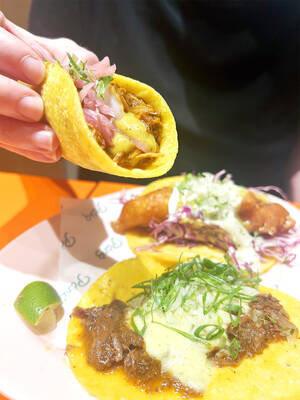
This year’s Michelin Gourmand Bib sported 16 new entries in the 126-strong Taiwan directory. The fight for the best braised pork rice and the crispiest scallion pancake painstakingly continued, but what stood out in the lineup this year? Pang Taqueria (胖塔可利亞); Taiwan’s first Michelin-recommended Mexican restaurant. Chef Charles Chen (陳治宇) is a self-confessed Americophile, earning his chef whites at a fine-dining Latin-American fusion restaurant. But what makes this Xinyi (信義) spot stand head and shoulders above Taipei’s existing Mexican offerings? The authenticity. The produce. The care. AUTHENTIC EATS In my time on the island, I have caved too many times to

In the aftermath of the 2020 general elections the Chinese Nationalist Party (KMT) was demoralized. The Democratic Progressive Party (DPP) had crushed them in a second landslide in a row, with their presidential candidate Tsai Ing-wen (蔡英文) winning more votes than any in Taiwan’s history. The KMT did pick up three legislative seats, but the DPP retained an outright majority. To take responsibility for that catastrophic loss, as is customary, party chairman Wu Den-yih (吳敦義) resigned. This would mark the end of an era of how the party operated and the beginning of a new effort at reform, first under


 RSS
RSS