


looks as though television actor Yao Yuan-hao (姚元浩) is not paying off the right people. The Apple Daily reported that Yao, the boyfriend of model Sonia Sui (隋棠), planned to hold a surfing competition for youngsters in Ilan last weekend but was shocked when 30 or so tattooed men dressed in black showed up with surfboards and a heavy dose of attitude.
The report said that on the morning of the competition, Yao received an anonymous phone call telling him to cancel the competition. Or else.
Clearly not one to cave in to threats, Yao simply called on local police to remove the pesky gangsters, who intentionally stood in front of the judges so as to obstruct their view. But the coppers said they couldn’t do anything because it was a public beach. Miffed, Yao had no choice but to cancel the competition.
Perhaps Yao didn’t read a report in last year’s Next Magazine that speculated Sui worked in a hostess bar for a few days to pay off her mother’s debts. Pop Stop wonders if there is a connection.
And speaking of celebs paying off debts, Yuki Hsu (徐懷鈺) went off to perform in China in April to help pay down the mortgage on her family’s home as well as to revive her declining career.
But the 31-year-old singer got more than she bargained for at Very 88 (非常88), a pub in Hangzhou (杭州) with a hostess club atmosphere. Feeling somewhat uncomfortable with the ogling eyes and the wink-wink, nudge-nudge expressions of those present, she quickly finished her set and headed back to Taiwan, according to a report in Next.
Now, ordinarily, this might compel a person to look closer at her contract before signing. But not Hsu. At the beginning of this month she was back in China, and this time it was rumored that she wasn’t even told where she would be performing.
Upon arriving at the “gig,” she was ushered into a private room containing a handful of inebriated businessmen and a few hostesses.
Pop Stop was pondering Hsu’s run of bad luck, both in terms of singing and advances made on her by Chinese men, until we saw her tasteless Bad Girl video on YouTube. It features a skimpily clad Hsu gyrating around a stage with half naked men. It’s not surprising that drunken businessmen in China might expect Hsu to put on a show for them.
“It wasn’t my fault.” These were the words spoken by Zhang Ziyi (章子怡) in reference to the lurid photographs taken of her and Israeli fiancee Aviv “Vivi” Nevo earlier this year at a beach resort in St Barts.
Zhang made the comments while attending the Cannes Film Festival, where she was a judge. “I didn’t do anything harmful,” she said, a fact that seems to be backed up by her continued popularity. Yahoo Kimo released statistics for the most hits per person between January and April and Zhang came out on top.
In other wedding news, plastic surgeon and alleged lothario Li Jin-liang (李進良) is finally tying the knot with Hu Ying-chen (胡盈禎), the daughter of entertainer Hu Gua (胡瓜).
The announcement served as a perfect excuse for Next to exhume some of his old skeletons.
The magazine’s sense of timing is impeccable. Nothing appeals more to short attention spans and puts gossip into a shallower perspective than a few lines (accompanied by a photograph or graphic) detailing the shenanigans of Taiwan’s glitterati.
Readers of Pop Stop will recall Li’s escapades last year when he entertained two friends and three hostesses at a Taipei hotel. Or, before that, when he was accused of sexual harassment by a Japanese porn star. Oddly, neither of these episodes made the cut in this week’s edition of Next. What did was a night out last Christmas with a woman named Mao Mao (毛毛), and the suggestion of infidelity it implied.
According to an interview that Hu gave on a TV talk show on May 14, however, she questioned the veracity of that report because she was present with Li and Mao Mao.
On the same show, she cheekily thanked the gossip rag for running all these stories about them because it’s free advertising for Li’s plastic surgery clinic. It also helps her to keep an eye on her husband, she said.
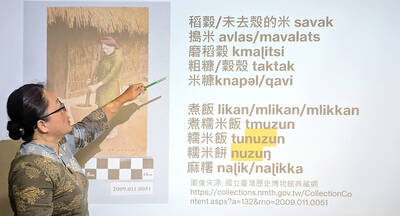
Jan. 26 to Feb. 1 Nearly 90 years after it was last recorded, the Basay language was taught in a classroom for the first time in September last year. Over the following three months, students learned its sounds along with the customs and folktales of the Ketagalan people, who once spoke it across northern Taiwan. Although each Ketagalan settlement had its own language, Basay functioned as a common trade language. By the late 19th century, it had largely fallen out of daily use as speakers shifted to Hoklo (commonly known as Taiwanese), surviving only in fragments remembered by the elderly. In

William Liu (劉家君) moved to Kaohsiung from Nantou to live with his boyfriend Reg Hong (洪嘉佑). “In Nantou, people do not support gay rights at all and never even talk about it. Living here made me optimistic and made me realize how much I can express myself,” Liu tells the Taipei Times. Hong and his friend Cony Hsieh (謝昀希) are both active in several LGBT groups and organizations in Kaohsiung. They were among the people behind the city’s 16th Pride event in November last year, which gathered over 35,000 people. Along with others, they clearly see Kaohsiung as the nexus of LGBT rights.
Dissident artist Ai Weiwei’s (艾未未) famous return to the People’s Republic of China (PRC) has been overshadowed by the astonishing news of the latest arrests of senior military figures for “corruption,” but it is an interesting piece of news in its own right, though more for what Ai does not understand than for what he does. Ai simply lacks the reflective understanding that the loneliness and isolation he imagines are “European” are simply the joys of life as an expat. That goes both ways: “I love Taiwan!” say many still wet-behind-the-ears expats here, not realizing what they love is being an

In the American west, “it is said, water flows upwards towards money,” wrote Marc Reisner in one of the most compelling books on public policy ever written, Cadillac Desert. As Americans failed to overcome the West’s water scarcity with hard work and private capital, the Federal government came to the rescue. As Reisner describes: “the American West quietly became the first and most durable example of the modern welfare state.” In Taiwan, the money toward which water flows upwards is the high tech industry, particularly the chip powerhouse Taiwan Semiconductor Manufacturing Co (TSMC, 台積電). Typically articles on TSMC’s water demand


 RSS
RSS