


Many Taiwanese artists undergo a remarkable aesthetic shift after studying or traveling in the US or Europe. The principles of Chinese art in which they were originally trained, however, often prove to be implacable.
Painter Chu Teh-chun (朱德群) moved to France in the early 1950s where he was influenced by Nicolas de Stael’s abstract geometric strips of impasto color. Chu combined Stael’s style with calligraphy. Lee Tsai-chien (李再鈐) traveled to Europe in the 1970s to study Chinese sculpture, but returned to Taiwan with notes for a book on ancient Greek art (which he later published) and a mind full of the teachings of Plato, which inspired his monumental sculptures.
The Age of Writing Poems and Indulging in Wine — Calligraphy and Paintings by Chiang I-han (詩酒年華—姜一涵書畫展), currently on display at the National Museum of History, shows
that Chiang I-han (姜一涵), 83, belongs in this artistic milieu. In his work, modernism meets Chinese calligraphy and landscape painting.
Chiang’s early paintings closely adhere to the latter tradition, in which trees, mountains and enclosed compounds are rendered in great detail and serve as emblems of self-cultivation and nature’s perfection. But Chiang’s interest in calligraphy and ink painting was as much academic as it was artistic.
Han researched Chinese art at Kansas State and Princeton universities in the early 1970s.
A retrospective of Piet Mondrian’s work that Chiang saw at the Guggenheim Museum in 1973 was a turning point for the artist. Mondrian’s paintings were an aesthetic revelation for Chiang. The bold primary colors and geometrical shapes contrasted with the detailed and literary Chinese ink paintings he had studied and created up to that point.
“I went [to the Guggenheim] to look at his paintings every day for two weeks,” Chiang said in an interview with the Taipei Times. “I wanted to approach the paintings directly without the intermediary of essays or teachers.”
He went on to study Western modernists for the decade that he lived and worked in the US.
Chiang said he viewed the work of impressionist masters such as Gauguin and Cezanne and later the surrealist forms of Joan Miro as a means of broadening the scope of his art, free of contextual interference.
Akin to Chu’s landscapes, Chiang employs the thick, black brushstrokes that characterise calligraphy. But whereas Chu broadened his palette (and canvas size), Chiang retained a degree of Mondrian-inspired simplicity, of form and color. It is a style that Chiang’s friends have suggested resembles the work of children. Looking at the controlled brushstrokes of the pictures currently on display, however, reveals an artist in complete control of his medium.
Green on Green (疊翠) is an abstract landscape with broad, black brushstrokes that are tinged at the edges with beams of gray wash, interspersed here and there with dapples of vermilion, acid green and brown. The violence of the brushstrokes is startling and differs significantly from the meditative landscapes found in Chiang’s earlier work.
Rhythms of Mountains and Sunset (夕陽山外山) is a serene expressionist study of nature. The orange-red sun in the top-right corner shines on charcoal-colored mountains, with the snow-capped peak of one reflecting the sunshine. Blotches of green-brown paint, presumably signifying leaves, are sprinkled across the lower part of the canvas, suggesting the presence of a light breeze. It is a landscape reduced to its most elementary colors and outlines.
It is a pity that the museum doesn’t exhibit any of Chiang’s earlier paintings — particularly the traditional Chinese landscape Seclusion in the Mountain (山居, 1970), the impressionist Rhythm of Mountains (山韻, 1989) and the expressionist Red River (紅河, 2006) — as doing so would have provided viewers with a clearer understanding of Chiang’s development. The exhibit does, however, manage to broaden its scope with several books written by Chiang and a documentary of his life as an artist. Reviewing these sources does much to reveal an artist working across two traditions while transcending both.

Last week, Viola Zhou published a marvelous deep dive into the culture clash between Taiwanese boss mentality and American labor practices at the Taiwan Semiconductor (TSMC) plant in Arizona in Rest of World. “The American engineers complained of rigid, counterproductive hierarchies at the company,” while the Taiwanese said American workers aren’t dedicated. The article is a delight, but what it is depicting is the clash between a work culture that offers employee autonomy and at least nods at work-life balance, and one that runs on hierarchical discipline enforced by chickenshit. And it runs on chickenshit because chickenshit is a cultural
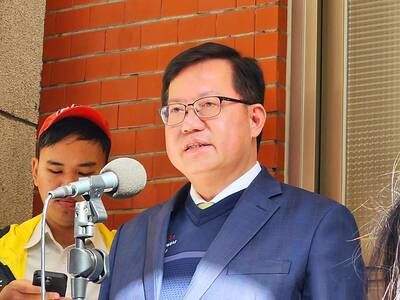
By far the most jarring of the new appointments for the incoming administration is that of Tseng Wen-tsan (鄭文燦) to head the Straits Exchange Foundation (SEF). That is a huge demotion for one of the most powerful figures in the Democratic Progressive Party (DPP). Tseng has one of the most impressive resumes in the party. He was very active during the Wild Lily Movement and his generation is now the one taking power. He has served in many of the requisite government, party and elected positions to build out a solid political profile. Elected as mayor of Taoyuan as part of the
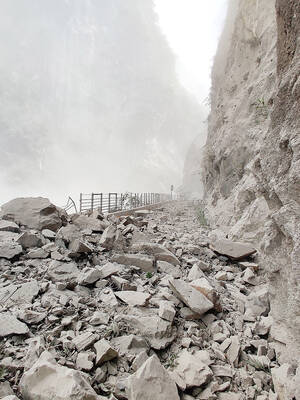
Moritz Mieg, 22, lay face down in the rubble, the ground shaking violently beneath him. Boulders crashed down around him, some stones hitting his back. “I just hoped that it would be one big hit and over, because I did not want to be hit nearly to death and then have to slowly die,” the student from Germany tells Taipei Times. MORNING WALK Early on April 3, Mieg set out on a scenic hike through Taroko Gorge in Hualien County (花蓮). It was a fine day for it. Little did he know that the complex intersection of tectonic plates Taiwan sits

When picturing Tainan, what typically comes to mind is charming alleyways, Japanese architecture and world-class cuisine. But look beyond the fray, through stained glass windows and sliding bookcases, and there exists a thriving speakeasy subculture, where innovative mixologists ply their trade, serving exquisite concoctions and unique flavor profiles to rival any city in Taiwan. Speakeasies hail from the prohibition era of 1920s America. When alcohol was outlawed, people took their business to hidden establishments; requiring patrons to use hushed tones — speak easy — to conceal their illegal activities. Nowadays legal, speakeasy bars are simply hidden bars, often found behind bookcases


 RSS
RSS