


On the second day of the Shanghai International Art Fair in September 2007, the event’s organizer confronted staff of Taiwan’s Galerie Grand Siecle (新苑藝術) about two works by Yao Jui-chung (姚瑞中).
“They said, ‘We were told your booth has something inappropriate that violates the rules of the show. If you don’t remove it immediately, you’ll have to close your booth,’” says Sophie Tseng (曾其瑢), the gallery’s coordinator of international affairs.
Taiwanese (2004) showed a red figure — presumably a symbol of communist China — having sex with an anthropomorphic green Formosan dog. The English word “Taiwanese” was juxtaposed with the quasi-homophonous Chinese characters tawannisi (他玩你死, “He fucks you to death”). The other problematic work, Chinese (2004), depicted the same red figure in what looks like a panel from a kung-fu comic book, with chuainisi (踹你死, “kick you to death”) written above “Chinese” in a speech bubble. The pieces were taken down.
Despite talk of Beijing’s growing tolerance of “controversial” artwork, themes dealing with animosity between Taiwan and China remain taboo. While Chinese painters like Wang Guangyi (王廣義) and Yue Minjun (岳敏君) have capitalized on the West’s fascination with the Cultural Revolution and the Tiananmen Square Massacre, both Chinese and foreign artists quickly learn that to show in China you have to play by Chinese Communist Party (CCP) rules.
China’s international exposure and economic power often leave Taiwanese artists facing the same quandary that burdens politicians, businesspeople and voters. Like many Taiwanese, the response of local artists to Beijing’s stubborn hegemony runs the gamut from indifference to indignance and pragmaticism to confusion.
Twenty-eight-year-old Taiwanese artist Ya-chu Kang (康雅筑) — a friend of mine — showed her work at a fiber arts exhibition at Suzhou Art and Design Technology Institute two years ago without incident. When I learned her pieces were displayed in the “domestic” section of the exhibit, Kang said that although she considers herself Taiwanese and not Chinese, she hadn’t thought much about the implications of being labeled “domestic” in China. She’s annoyed by recent developments such as President Ma Ying-jeou (馬英九) saying that CCP officials needn’t call him “president” and his referring to Taiwan as an “area” rather than a country, but for the most part she’d rather not think about politics.
“It makes me feel sick,” she says. “If I open the paper and there’s an article about cross-strait politics, I won’t read it. It’s boring.”
Though Kang’s work rarely touches on political themes, even artists like 39-year-old Yao, who has built a career around politically oriented art, sometimes participate in shows as “Chinese” artists. Echoing Taiwanese businesspeople and athletes, these artists argue that terms like “domestic,” “Taiwan, China” and “Chinese Taipei” are irrelevant to their work.
But off the record, many artists rankle at the labels China forces on them. While chatting after an interview last year, one of Taiwan’s most successful painters proudly told me he once refused to show in China because of just such an appellation. When I requested details to include in this article, the previously effusive artist didn’t reply.
Taichung-based painter Huang Chin-ho (黃進河) has no such qualms. With trains roaring by his converted warehouse studio and Taiwanese classics pealing from an old cassette player, Huang zestily described what it means to be a Taiwanese artist.
“Most Taiwanese artists ignore politics and say art is independent of everything else. But I think politics is a part of reality. Art and politics are both about life … If you don’t understand politics, you don’t understand art.”
Huang’s paintings celebrate Taiwan’s folk culture with a pride and power unequaled by any artist I’ve seen. Although some of the 53-year-old’s brushwork may appear rudimentary, his ideas about Taiwanese identity aren’t.
After majoring in history in the 1970s, Huang continued his education on his own and cites Shih Ming’s (史明) A History of Taiwan for the Past 400 Years (台灣人四百年史) as particularly influential. He acknowledges China’s historical importance to Taiwan but unflinchingly rejects any attempt to label him “Chinese.” Of the five artists interviewed for this article, Huang is the only one who has categorically refused to show in Communist China, comparing his decision to Pablo Picasso’s refusal to show Guernica in Francoist Spain.
“I can’t accept China’s attitude toward us, so I’m just not going to show there. That’s my right,” he says with a laugh that acknowledges both how easily the decision comes to him and how easily other artists ignore the issue. “I don’t look down on Taiwanese artists who show in China, but what I can’t stand is artists who don’t recognize they’re from Taiwan.”
Huang says that 10 years ago Chinese curator Gao Minglu (高名潞) visited him while in Taiwan recruiting artists for Insideout: New Chinese Artists, a show at New York’s prestigious PS1 Contemporary Art Museum that included Chinese art stars including Cai Guoqiang (蔡國強) and the above-mentioned Wang. Huang says he got along well with Gao and the two discussed classical Chinese literature.
Later he received a call from Gao asking him to join the exhibition.
“I told him directly: ‘The show uses the term Chinese. You’ve called the wrong person.’” Huang says.
Gao objected, saying that the exhibition’s Chinese name used huaren (華人, “a person of Chinese descent”) rather than zhongguoren (中國人, “a person from China”).
“So I asked him,” Huang says, “if this word huaren existed in English. It doesn’t. I told him I’d refuse as long as the English translation of huaren is ‘Chinese.’ That was pretty much the end of the phone call.”
While Huang’s idealism has made him something of a hero locally, his life and art are so intertwined with politics that current events can leave him paralyzed. When I interviewed him last September we sat next to an incomplete work he’d been commissioned to paint in 1995. Huang said he hadn’t really painted for almost a year. He tries to calm himself by practicing tai chi, but it’s obvious that the country’s frequent political shifts unnerve him.
“Lots of things have happened,” he says. “It started with the legislative elections. The Chinese Nationalist Party [KMT] won. Then this year Ma Ying-jeou won [the presidency]. We’re all very sad, so I haven’t been able to work.”
In Huang’s more parochial moments, he hints that waishengren (外省人, people who fled to Taiwan after the KMT’s loss in the Chinese Civil War and their descendants) are unable to fully appreciate the land his ancestors have called home for centuries. At other times, his anti-KMT vitriol seems more a lament that some of the country’s most recent colonizers have yet to adopt Taiwan as their home.
The works of Taipei-based artist Mei Dean-E (梅丁衍) address many of the cross-strait issues that Huang and all politically conscious Taiwanese face. But where Huang presents an uncompromising position on Taiwan’s status with regard to China, Mei challenges viewers to think for themselves.
The Map of Republic of China (2003, 中華民國全圖) shows a cartographically accurate map of Asia, but without China. While downplaying China’s role in Taiwan’s history is convenient for some independence-minded pundits, the piece highlights the incongruity of a China-free interpretation of Taiwan’s history and present situation.
When it comes to exhibiting in China, Mei is a realist. Museums can make placards reading “China, Taiwan” or “domestic,” he says, but they can’t change his pieces.
“The content of my work is more trouble than China wants, but if they select my work, I will agree [to show there].”
And he does. Fifteen years ago Mei’s work was included in a group show in Shanghai. The 54-year-old chuckles at how his jigsaw puzzle image that combined portraits of Mao Zedong (毛澤東) and Sun Yat-sen (孫中山) was not only left out of the exhibition, but was carefully cut from catalogs distributed there.
Even outside China there are problems. When Mei’s work was to be shown at France’s Lyon Biennial in 2000, Chinese officials contacted the director, Jean-Hubert Martin, and asked him not to show a piece by Mei that depicted Chiang Kai-shek (蔣介石). Martin refused and the exhibition went on as planned.
In 2007, Mei showed a piece in Beijing based on a photograph of Taiwanese serving in Japan’s army during World War II.
“Chinese people, they hate Japanese. When they saw a Taiwanese artist showing Taiwanese soldiers wearing Japanese uniforms, they were so upset, angry,” Mei says. “When I explained [the image] to a young reporter, she ran away.”
Mei is familiar with such reactions. After his mandatory military service in the 1970s, he was asked to tell his KMT commanders what he thought about the experience. He did and was promptly detained for an additional two months pending investigation into his possibly subversive ideas, and only freed after repeated appeals from his family.
Thirty years later, Mei still voices his opinions directly, and he’s very willing to share them with people in China — if Beijing allows them to listen.
It shouldn’t be surprising that many artists who grew up during Taiwan’s Martial Law Era tend to be more interested in cross-strait politics than younger generations accustomed to civil liberties that didn’t exist a couple decades ago.
One exception is 27-year-old Hsieh Mu-chi (謝牧岐). Though much of his work is formally oriented — he is a talented painter — Hsieh is interested in politics and says it constitutes an important part of his identity and art.
When Hsieh was a teen, his father started listening to underground radio and took part in anti-KMT political activities held by groups like the Taiwan Independence Party (建國黨). Curious about his father’s interest in politics and influenced by Taiwanese writer Wu Cho-liu’s (吳濁流) The Asian Orphan (亞細亞的孤兒), in which the main character goes insane trying to come to grips with the Japanese, Chinese and Taiwanese aspects of his identity, Hsieh says he later started thinking: “Who am I?”
“I wanted my work Good to Have You Here [2007, 有你真好] to come from a Taiwanese angle,” he says. “The country is sandwiched between China and Japan and the geographical and cultural connections have influenced Taiwan’s appearance today.”
Hsieh’s painting includes stylized versions of Chinese and Japanese flags with what appears to be an empty flagpole between. Still, the work seems more about color and space than politics, and it didn’t stir controversy when shown in Shanghai in 2007.
While interviewing Hsieh in his Bali Township (八里鄉), Taipei County studio, he came off understandably confused about cross-strait politics and complained that Taiwanese media coverage was often too one-sided.
Hsieh talked about attending a demonstration against Chinese envoy Chen Yunlin’s (陳雲林) visit in November, saying that he mostly went for the spectacle and that he was turned off by what he felt was the Democratic Progressive Party trying to take advantage of the event.
When I tried to corner him on whether he would show in China as a “Chinese artist” or an artist from “Taiwan, China,” he skirted the question, mentioning a story the Liberty Times (the Taipei Times’ sister paper) covered last year about an advertisement by Taipei’s Asia Art Center (亞洲藝術中心) that listed 19 Taiwanese artists as being from “Taiwan, China.” The gallery caught hell for it, with one artist writing on his blog: “Here’s my middle finger: Fuck this show and fuck this gallery.”
Hsieh said that when he heard about the Asia Art Center story, he thought about making a work and labeling it with his name and a series of politically charged descriptions of his country like “Taiwan, China,” “Taiwan, Republic of China,” and the most controversial of them all: “The Republic of Taiwan” (台灣共和國). He never made the work.
One of the most interesting remarks from the interview came from a staff member of Aki Gallery (也趣畫廊), which represents Hsieh.
“The position of artists and galleries is different,” said Jocelyn Li (李悅芝), who accompanied me to Hsieh’s studio. “For galleries, we want to do business and make our commission, so we really want to get into the Chinese market. But for artists, the work is more important ... They can say, ‘OK, I’m not going to show.’”
But can they? Making a living as an artist can be challenging and as with galleries, there’s a strong temptation to go where the money is.
About a week after my interview with Hsieh I sent him an e-mail, hoping to get solid answers to some of the questions I felt he’d avoided. He responded straightforwardly, but what struck me was the honesty shown in an aside.
“To tell the truth,” Hsieh wrote, “I’m still trying to figure out things for myself ... That’s why my answers were unsure and hesitant.”

Sept.16 to Sept. 22 The “anti-communist train” with then-president Chiang Kai-shek’s (蔣介石) face plastered on the engine puffed along the “sugar railway” (糖業鐵路) in May 1955, drawing enthusiastic crowds at 103 stops covering nearly 1,200km. An estimated 1.58 million spectators were treated to propaganda films, plays and received free sugar products. By this time, the state-run Taiwan Sugar Corporation (台糖, Taisugar) had managed to connect the previously separate east-west lines established by Japanese-era sugar factories, allowing the anti-communist train to travel easily from Taichung to Pingtung’s Donggang Township (東港). Last Sunday’s feature (Taiwan in Time: The sugar express) covered the inauguration of the

The corruption cases surrounding former Taipei Mayor and Taiwan People’s Party (TPP) head Ko Wen-je (柯文哲) are just one item in the endless cycle of noise and fuss obscuring Taiwan’s deep and urgent structural and social problems. Even the case itself, as James Baron observed in an excellent piece at the Diplomat last week, is only one manifestation of the greater problem of deep-rooted corruption in land development. Last week the government announced a program to permit 25,000 foreign university students, primarily from the Philippines, Indonesia and Malaysia, to work in Taiwan after graduation for 2-4 years. That number is a
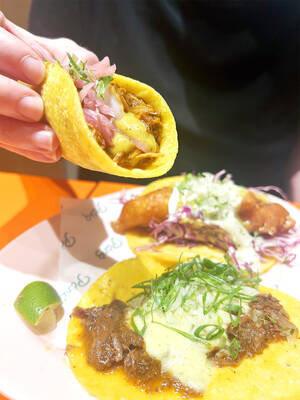
This year’s Michelin Gourmand Bib sported 16 new entries in the 126-strong Taiwan directory. The fight for the best braised pork rice and the crispiest scallion pancake painstakingly continued, but what stood out in the lineup this year? Pang Taqueria (胖塔可利亞); Taiwan’s first Michelin-recommended Mexican restaurant. Chef Charles Chen (陳治宇) is a self-confessed Americophile, earning his chef whites at a fine-dining Latin-American fusion restaurant. But what makes this Xinyi (信義) spot stand head and shoulders above Taipei’s existing Mexican offerings? The authenticity. The produce. The care. AUTHENTIC EATS In my time on the island, I have caved too many times to

Many Taiwanese have a favorable opinion of Japan, in part because Taiwan’s former colonial master is seen as having contributed a great deal to the development of local industries, transportation networks and institutions of education. Of course, the island’s people were never asked if they wanted to be ruled by Tokyo or participate in its modernization plans. From their arrival in 1895 until at least 1902, the Japanese faced widespread and violent antagonism. Things then calmed down, relatively speaking. Even so, between 1907 and 1916 there were eleven anti-Japanese revolts. A map in the National Museum of Taiwan History (國立臺灣歷史博物館)


 RSS
RSS