


VIEW THIS PAGE Even if you are accustomed to a hectic schedule, once you arrive on Green Island, the silence and slow pace of life will calm you and make you want to take your time, lingering by the rocks along the shore, enjoying the ocean breeze or taking photos atop the emerald hills.
There is much to see and even if you take your time, you can manage to see practically all of it because the island is so small.
Getting around the island— which is just 4km long and 3km wide — is easy so there is no need to figure out where to go or find public transport. The island is so tiny that you can drive around it on the 20km round-island road in about an hour. Golf carts can be rented for about NT$1,000 a day. Scooters and bicycles are also available.
But walking around the island is quite doable if you like taking your time, and it will allow you to enjoy the island’s main attractions at a leisurely pace.
You can start by walking from Nanliao Harbor (南寮漁港), where the ferry docks, north to Nanliao Village (南寮村) or Jhongliao Village (中寮村) where a row of mostly seafood restaurants give you a lot of options for lunch.
After eating, you can check out the Green Island Lighthouse (綠島燈塔) nearby. The 33m-high landmark was built after a US vessel ran aground on coral reef during a violent storm in 1937. Moved by local residents’ brave rescue attempts, the Americans paid for the construction of the lighthouse the following year.
If you keep walking along the main path, you’ll get to the old Green Island Prison (綠島監獄), which has been converted into
a museum.
While visiting a prison may not be on the top of your agenda during a vacation, this one is worth checking out to gain an insight into Taiwan’s history.
The seaside Green Island Human Rights Memorial Park (綠島人權紀念公園) erected outside the prison is dedicated to the hundreds of political prisoners once held here and elsewhere in Taiwan. Names of the prisoners are inscribed on the memorial’s walls, as well as words that poetically recount the sorrow of mothers of the detainees praying that their sons will survive.
Further along the road is the Sika Deer Ecological Park (綠島梅花鹿生態園區), a 23-hectare park that supposedly is aimed at educating people about the animal species native to Taiwan, but seems geared more towards commercial purposes. It has a KTV, a restaurant and a somewhat incongruous area for play warfare, complete with uniforms for rent and toy guns.
Sika deer are not native to Green Island but were brought there by locals for their antlers, which are infused in a locally made wine.
While they are not an endangered species, some local restaurants serve deer meat, and the deer’s population has also declined over the years, said Lin Su-ling (林紓琳), recreation section chief of the Tourism Bureau’s East Coast National Scenic Area Administration.
Continuing along the path, one will arrive at another point of attraction — Kuanyin Cave (觀音洞, Goddess of Mercy Cave) — where devout Buddhists still participate in blessing ceremonies. According to one local legend, the cave was discovered about 100 years ago when a fisherman lost at sea said he saw a strange light emanating from the hillside where the cave is located, which allowed him to safely reach shore.
Trying to find the source of light, local villagers later discovered the cave and the statue-like object inside — which is actually a 1m-tall stalagmite. The stalagmite is sometimes dressed in a deity’s cape and worshipped as a manifestation of the goddess, according to a Tourism Bureau magazine.
From here, walking south along the eastern side of the island will present visitors with views of some of the oddly shaped rocks, including Pekinese Dog (哈巴狗), and Sleeping Beauty (睡美人), which are near each other, as well as Confucius Rock (孔子岩) and Turkey Rock (火雞岩) further south. The Visitor Center near the airport has a map that identifies which rock is which.
Near the southeastern tip of the island, the Jhaorih (Morning Sun) Hot Spring (朝日溫泉) is another major tourist draw. Facing the rising sun in the east, it’s unique because it’s next to the sea and is one of only three saltwater hot springs in the world, the other two being in Japan and on a small island off the coast of Sicily.
Those who feel energetic and inspired by the easy and scenic walk along the coastal road can try the Across Mountain Ancient Trail (過山古道, 1.85km) and the Across Mountain Trail (過山步道, 1.84km), which offer hikers gorgeous views of the island and its surrounding ocean scenes. The trails were blazed by early inhabitants who used them to cross the island before vehicles were available and the round-island road was built.
Perhaps one thing Green Island lacks is preservation of its Aboriginal culture. Most Taiwanese would say there are no indigenous people on Green Island, in contrast to Orchid Island or other parts of the country.
But the island was home for thousands of years to various Aboriginal groups, including the Amei, before Han Chinese from Siao Liouciou Island (小琉球), off Pingtung County, migrated there in the 19th century.
Employees at the Visitors Center said the indigenous people fled due to conflicts with the Han Chinese and little remains of their history on the island.
The island had an Aboriginal name in the past — Sanasai, which means “a resting place.” Aborigines used to see Green Island as a stopping point on their trips to and from other parts of Taiwan, such as Orchid Island or Taiwan proper.
For the fun of it, try and ask if anyone you meet on Green Island knows the island’s original name. VIEW THIS PAGE

Sept.16 to Sept. 22 The “anti-communist train” with then-president Chiang Kai-shek’s (蔣介石) face plastered on the engine puffed along the “sugar railway” (糖業鐵路) in May 1955, drawing enthusiastic crowds at 103 stops covering nearly 1,200km. An estimated 1.58 million spectators were treated to propaganda films, plays and received free sugar products. By this time, the state-run Taiwan Sugar Corporation (台糖, Taisugar) had managed to connect the previously separate east-west lines established by Japanese-era sugar factories, allowing the anti-communist train to travel easily from Taichung to Pingtung’s Donggang Township (東港). Last Sunday’s feature (Taiwan in Time: The sugar express) covered the inauguration of the

The corruption cases surrounding former Taipei Mayor and Taiwan People’s Party (TPP) head Ko Wen-je (柯文哲) are just one item in the endless cycle of noise and fuss obscuring Taiwan’s deep and urgent structural and social problems. Even the case itself, as James Baron observed in an excellent piece at the Diplomat last week, is only one manifestation of the greater problem of deep-rooted corruption in land development. Last week the government announced a program to permit 25,000 foreign university students, primarily from the Philippines, Indonesia and Malaysia, to work in Taiwan after graduation for 2-4 years. That number is a
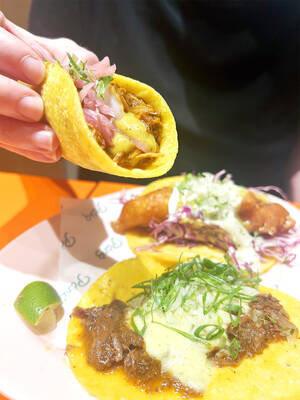
This year’s Michelin Gourmand Bib sported 16 new entries in the 126-strong Taiwan directory. The fight for the best braised pork rice and the crispiest scallion pancake painstakingly continued, but what stood out in the lineup this year? Pang Taqueria (胖塔可利亞); Taiwan’s first Michelin-recommended Mexican restaurant. Chef Charles Chen (陳治宇) is a self-confessed Americophile, earning his chef whites at a fine-dining Latin-American fusion restaurant. But what makes this Xinyi (信義) spot stand head and shoulders above Taipei’s existing Mexican offerings? The authenticity. The produce. The care. AUTHENTIC EATS In my time on the island, I have caved too many times to

In a stark demonstration of how award-winning breakthroughs can come from the most unlikely directions, researchers have won an Ig Nobel prize for discovering that mammals can breathe through their anuses. After a series of tests on mice, rats and pigs, Japanese scientists found the animals absorb oxygen delivered through the rectum, work that underpins a clinical trial to see whether the procedure can treat respiratory failure. The team is among 10 recognized in this year’s Ig Nobel awards (see below for more), the irreverent accolades given for achievements that “first make people laugh, and then make them think.” They are not


 RSS
RSS