


This huge novel, half a million Chinese characters long in the original, was a national sensation when it first surfaced in China three years ago, its two parts together selling over a million copies. Its fleshy sensationalism also appealed to Western critics who hailed Yu Hua (余華) as a profound satirist who’d peeled away the veneer of respectability that had concealed the realities of some of the most bizarre decades in all China’s history.
Brothers (Xiong Di, 弟兄) was first published in Chinese in two parts — with the second very much the longer — in Taipei in 2005 and 2006. This vigorous and racy English version is translated by Eileen Cheng-yin Chow (周成蔭) and Carlos Rojas, both American academics. Interestingly, the latter was one of the editors of Writing Taiwan, reviewed in the Taipei Times on Jan. 18, and the two have in addition edited Rethinking Chinese Popular Culture (Routledge, 2008) together.
This new translation was short-listed for the 2008 Man Asian Literary Prize, and the only response possible to its not winning is that the novel that did win must have been magnificent indeed.
The story involves two stepbrothers, the maverick Baldy Li (so-called because his mother told the barber to shave off all his hair as a child to save money) and the more philosophical Song Gang. Their shared passion for the beautiful Lin Hong snakes its way through the book.
Sexual detail is everywhere, but narrated in a brash, farcical way. Unprecedented orgasms, fake bust-enlarging creams, artificial hymens and silicone implants are strewn through the novel’s many pages.
Eating, too, features prominently, along with the sex and violence — all three directly physical things, and the opposite of the mental subtleties involved in aesthetic appreciation or metaphysical speculation, neither of which constitute Yu’s natural strengths.
This widely-ranging and ironic portrait of modern China evokes the very feel of the place, with its popular Korean TV soaps, Eternity bicycles, factory labor, Big White Rabbit candles, neon lights and raucous music, plus — for the successful — French wines, Italian furniture and a new white Mercedes.
The novel as a whole prompts the thought that China isn’t so much a socialist country busy embracing hyper-capitalism as a weird, perverse, more than half-crazed and wholly unique phenomenon. The “Chinese
characteristics” described by Deng Xiao-ping (鄧小平) include, for this author, the furthest reaches of sexual inventiveness and the most bizarre of plastic surgery techniques. Toilets, gold-plated or otherwise, feature prominently, as do hymen-reconstruction surgery (no imaginary procedure) and get-rich-quick schemes in the spirit of the modern Chinese enthusiasm for all aspects of capitalism. Confucian values of modesty, respect for elders and selfless integration into the social order couldn’t be further from the world described in this ribald, lurid, zany narrative.
Individual re-invention mirrors a national re-invention in which both a 5,000-year-old civilization and a shorter-lived Maoist construct are both ditched in favor of something more surreal, plastic and absurd. This is classic comic writing, where the grotesqueness found in real life is concentrated and intensified by a process of relentless accumulation to portray a world gone mad. And yet much of this gross fantasy is rooted in fact — there really was a Miss Artificial Beauty Contest in China for recipients of plastic surgery, for example. As for the Virgin Beauty Contest at the center of Part Two of the book, the reality it covers isn’t hard to imagine.
Much of the novel’s comedy springs from the portrait of a society of the newly rich who can’t quite shake off their peasant ways. And the essential style remains cartoon-like, as the names of the characters testify — Popsicle Wang, Success Liu, Victory Zhao, Yanker Yu, Scissors Guan, Writer Liu (who thinks up advertising phrases for his factory) and Poet Zhao (who’s only ever published four lines of verse in a mimeographed cultural center magazine).
Part One covers the boys’ youth during the Cultural Revolution. Baldy Li discovers his sex drive at the age of 8 and finds out about revolutionary Struggle Sessions at around the same age. This part of the story comes to a climax when the brothers’ father has his left elbow dislocated and his home looted before being casually murdered by Red Guards while attempting to buy a ticket to Shanghai. The bravery of his wife is strongly presented, but she doesn’t have much longer to live either.
A comic style would be inappropriate to such nightmares, so Yu veers instead into using the same kind of physical directness, only now to horrific rather than humorous effect.
The book as a whole raises memories of the English 18th
century where Fielding’s Tom Jones (also containing two boys brought up as brothers) and Smollett’s scabrous and racy novels featured sensational, picaresque adventures with frequent punch-ups set somewhere between country inns and fashionable spas. They may not have had characters falling into a cesspit in a public toilet while trying to catch glimpses of women’s buttocks, as here, but their aims and techniques were similar.
There’s now an established tradition in Chinese novel-writing of these garish, shocking, outrageous novels — Please Don’t Call Me Human (千萬別把我當人), by Wang Shuo, (王朔), and the many novels of Mo Yan (莫言) are some other examples. Initially stigmatized as “hooligan literature,” they today constitute part of the mainstream, and contrast with the sophisticated, urbane work of writers such as Wang Anyi (王安憶) and Dai Sijie (戴思杰), whose style perhaps derives from that of Eileen Chang (張愛玲).
Yu’s Chronicle of a Blood Merchant (許三觀賣血記), reviewed in the Taipei Times on Nov. 23, 2003, was very much in the same style as this new book. Brothers, though, is far more impressive. Indeed, it’s a major achievement by any standards. Already published in the US by Pantheon, it will appear from Picador Asia in April.

Sept.16 to Sept. 22 The “anti-communist train” with then-president Chiang Kai-shek’s (蔣介石) face plastered on the engine puffed along the “sugar railway” (糖業鐵路) in May 1955, drawing enthusiastic crowds at 103 stops covering nearly 1,200km. An estimated 1.58 million spectators were treated to propaganda films, plays and received free sugar products. By this time, the state-run Taiwan Sugar Corporation (台糖, Taisugar) had managed to connect the previously separate east-west lines established by Japanese-era sugar factories, allowing the anti-communist train to travel easily from Taichung to Pingtung’s Donggang Township (東港). Last Sunday’s feature (Taiwan in Time: The sugar express) covered the inauguration of the

The corruption cases surrounding former Taipei Mayor and Taiwan People’s Party (TPP) head Ko Wen-je (柯文哲) are just one item in the endless cycle of noise and fuss obscuring Taiwan’s deep and urgent structural and social problems. Even the case itself, as James Baron observed in an excellent piece at the Diplomat last week, is only one manifestation of the greater problem of deep-rooted corruption in land development. Last week the government announced a program to permit 25,000 foreign university students, primarily from the Philippines, Indonesia and Malaysia, to work in Taiwan after graduation for 2-4 years. That number is a
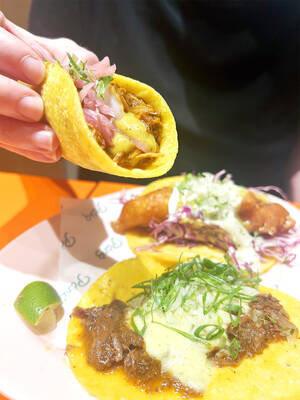
This year’s Michelin Gourmand Bib sported 16 new entries in the 126-strong Taiwan directory. The fight for the best braised pork rice and the crispiest scallion pancake painstakingly continued, but what stood out in the lineup this year? Pang Taqueria (胖塔可利亞); Taiwan’s first Michelin-recommended Mexican restaurant. Chef Charles Chen (陳治宇) is a self-confessed Americophile, earning his chef whites at a fine-dining Latin-American fusion restaurant. But what makes this Xinyi (信義) spot stand head and shoulders above Taipei’s existing Mexican offerings? The authenticity. The produce. The care. AUTHENTIC EATS In my time on the island, I have caved too many times to

In a stark demonstration of how award-winning breakthroughs can come from the most unlikely directions, researchers have won an Ig Nobel prize for discovering that mammals can breathe through their anuses. After a series of tests on mice, rats and pigs, Japanese scientists found the animals absorb oxygen delivered through the rectum, work that underpins a clinical trial to see whether the procedure can treat respiratory failure. The team is among 10 recognized in this year’s Ig Nobel awards (see below for more), the irreverent accolades given for achievements that “first make people laugh, and then make them think.” They are not


 RSS
RSS