


Theater in Taipei this year has achieved some notable heights and, unfortunately, some even more notable lows. The Jester (弄臣), a new Beijing opera production by Vivien Ku (辜懷群) and Li Baochun (李寶春) that had its world premiere at Novel Hall (新舞台) earlier this month, won accolades from audiences for its technical mastery and solid scriptwriting. Applause and bravos started only minutes into the first act of this adaptation of Verdi’s Rigoletto, a response that was in stark contrast to the ponderous silence and dutiful clapping that marked some recent fusion productions. People walked away at the end having been lifted up by the skill of the performance rather than being weighed down by its burden of innovation.
Far more traditional but equally successful was Six Legends of Lan Ting (蘭庭六記) by Lanting Kun Opera Troupe (蘭庭崑劇團), a relative newcomer to Taiwan’s traditional art scene, which played at Novel Hall in August. The main draw of this production was the outstanding performance by Wen Yuhang (溫宇航), who is best-known in the West for his starring role in the 19-hour 1999 Lincoln Center production of The Peony Pavilion (牡丹亭). It is performances like these that give substance to talk of a kun opera revival, especially as an international performance medium similar to Italian opera.
On the debit side of the ledger, productions such as National Taiwan College of Performing Arts’ (國立臺灣戲曲學院) The Plum Blossom Fan (桃花扇) became a byword for how badly the integration of Western and Chinese opera can turn out. The Western-style score performed by the Taipei Philharmonic Orchestra (台北愛樂管弦樂團) under the energetic direction of conductor Liao Hsiao-ling (廖曉玲) managed to constantly trip up performers, denying them the natural rhythms of Chinese opera.
One of 2008’s biggest productions was undoubtedly CKS Cultural Foundation’s flagship production of Mackay — The Black Bearded Bible Man (黑鬚馬偕) that premiered at the National Theater late last month. Unfortunately, despite a sterling performance by Thomas Maglioranza in the title role, and a splendid stage design by Lukas Hemleb, the flimsy script and flaccid pacing let the production down. Looked at in the context of the many experimental operas that have been produced in recent years, one can see that the money and the high level support for Mackay — The Black Bearded Bible Man has certainly paid off in the quality of the presentation. What is missing is a creative sensibility to direct these resources to make something more satisfying than a bald narrative of a worthy life.
Tainaner Ensemble’s (台南人劇團) K24 Chaos, a six-hour, six-act whodunit play within a play that incorporates Shakespeare’s Romeo and Juliet and employs a plotline similar to the television series Alias, opened to packed houses at the beginning of the year. It may seem strange to combine a love story using elements from a spy serial, but Tsai Po-chang’s (蔡柏璋) script made an admirable attempt and for the first two acts he pulled it off. Both staging and acting were tight and the story intricate and intriguing. But interest began to wane in the fourth act, or “episode,” as Tsai calls them, because the script tried to incorporate too many diverse plots into the story. Though the jokes and plot twists remained throughout, the production would have been better served if he had solved the mystery three hours earlier.
The Scholar and the Executioner (秀才與劊子手) demonstrated that playwright and theorist Huang Weiruo (黃維弱) is one of the top theater professionals working in the Chinese language today. The combination of theories found in Western theater and Beijing opera fused together in a theatrical spectacle that blended classical Chinese and modern themes easily digestible by a contemporary audience.
It has been a very good year for traditional arts, with a number of outstanding exhibitions hosted by the National Palace Museum. Most notable among these was the Stunning Decorative Porcelains From the Chienlung Reign (華麗彩瓷:乾隆洋彩特展), which opened in October and runs to August next year. As you might expect from ceramics devised especially for the admiration of one of the Qing Dynasty’s (1644-1911) most powerful and artistically sophisticated emperors, the exhibits absolutely overwhelm with their artistry and ornateness.
At the Taipei Fine Arts Museum (台北市立美術館), one of the most interesting exhibits was Form, Ideas, Essence, Rhythm: Contemporary East Asian Ink Painting (形•意•質•韻 ─ 東亞當代水墨創作邀請展). This show examined the relationship between modern ink painting and traditional Chinese aesthetics and the conceptual trends that are driving a new generation of artists. The 96 works on display, by artists from Taiwan, China, Japan and South Korea, dispel any idea that ink painting is a thing of the past. Works range from the hyper-kinetic manga imagery of Mise Natsunosuke’s My God — Tiananmen (My God — 天安門) to the ultra-minimalist calm of Yan Shanchun’s (嚴善錞) Searching for West Lake in My Dreams (西湖尋夢).
The Taipei Biennial also featured in a big way at TFAM this year, presenting many interesting works by young contemporary artists. This year the show, which opened in September, was curated by Manray Shu (徐文瑞) and Vasif Kortun, who extended the scope of the exhibition from the museum to include locations across the city.
The use of non-museum spaces, including projects based at the Beer Brewery on Jianguo North Road (建國啤酒廠), on the mega-digital screen at Taipei Arena (台北小巨蛋), in Taipei Art Park (中山美術公園) and at Zhongxiao Xinsheng MRT Station (捷運忠孝新生站), is an intentional effort to put art before people who might not otherwise visit a museum, and to comment on how digital media pushes artistic expression in our faces.
The National Museum of History (國立歷史博物館) and its curators should be commended for producing one of the year’s most outstanding exhibits. They should also be booed for mounting one of the worst.
From the arrangement of the paintings to the explanation of his works, the Chu Teh-chun 88 Retrospective (朱德群88回顧展) admirably revealed why Chu is regarded as one of Taiwan’s pre-eminent masters of abstract expressionism. The exhibit showed how the Western tradition of landscape painting and Chinese calligraphy informed Chu’s works in a manner that didn’t overburden the viewer. The explanations, which were concise and scattered throughout the gallery, provided necessary context for styles of art that are often impenetrable.
A Drop in the Ocean: Modern Contemporary Chinese Calligraphy and Painting Exhibition (滄海一粟—近現代書畫展), ought to have been an excellent opportunity to educate the public about the long and revered Chinese tradition of ink painting and calligraphy. What was presented instead was an exhibition of 300 works from as far back as the Tang Dynasty that was barely more edifying than wallpaper. Apart from a brief four-paragraph introduction, there were no explanations about the exhibit’s purpose. Although a title and artist for each work were given, there were no dates or clues as to why these works were deemed worthy of viewing. The curators of this exhibit, it seems, would have benefited from walking through the exhibit on Chu Teh-chun (朱德群) before mounting their own.

Sept.16 to Sept. 22 The “anti-communist train” with then-president Chiang Kai-shek’s (蔣介石) face plastered on the engine puffed along the “sugar railway” (糖業鐵路) in May 1955, drawing enthusiastic crowds at 103 stops covering nearly 1,200km. An estimated 1.58 million spectators were treated to propaganda films, plays and received free sugar products. By this time, the state-run Taiwan Sugar Corporation (台糖, Taisugar) had managed to connect the previously separate east-west lines established by Japanese-era sugar factories, allowing the anti-communist train to travel easily from Taichung to Pingtung’s Donggang Township (東港). Last Sunday’s feature (Taiwan in Time: The sugar express) covered the inauguration of the

The corruption cases surrounding former Taipei Mayor and Taiwan People’s Party (TPP) head Ko Wen-je (柯文哲) are just one item in the endless cycle of noise and fuss obscuring Taiwan’s deep and urgent structural and social problems. Even the case itself, as James Baron observed in an excellent piece at the Diplomat last week, is only one manifestation of the greater problem of deep-rooted corruption in land development. Last week the government announced a program to permit 25,000 foreign university students, primarily from the Philippines, Indonesia and Malaysia, to work in Taiwan after graduation for 2-4 years. That number is a
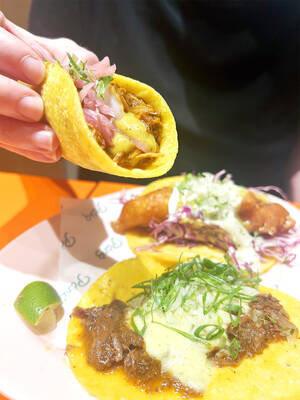
This year’s Michelin Gourmand Bib sported 16 new entries in the 126-strong Taiwan directory. The fight for the best braised pork rice and the crispiest scallion pancake painstakingly continued, but what stood out in the lineup this year? Pang Taqueria (胖塔可利亞); Taiwan’s first Michelin-recommended Mexican restaurant. Chef Charles Chen (陳治宇) is a self-confessed Americophile, earning his chef whites at a fine-dining Latin-American fusion restaurant. But what makes this Xinyi (信義) spot stand head and shoulders above Taipei’s existing Mexican offerings? The authenticity. The produce. The care. AUTHENTIC EATS In my time on the island, I have caved too many times to

In a stark demonstration of how award-winning breakthroughs can come from the most unlikely directions, researchers have won an Ig Nobel prize for discovering that mammals can breathe through their anuses. After a series of tests on mice, rats and pigs, Japanese scientists found the animals absorb oxygen delivered through the rectum, work that underpins a clinical trial to see whether the procedure can treat respiratory failure. The team is among 10 recognized in this year’s Ig Nobel awards (see below for more), the irreverent accolades given for achievements that “first make people laugh, and then make them think.” They are not


 RSS
RSS