


At Friday night’s concert in Taipei’s National Concert Hall the Austrian violinist Benjamin Schmid showed his understanding of the less-than-bravura role required of the soloist by Wieniawski’s Second Violin Concerto of 1862.
Most 19th-century Romantic-era concertos provided occasions when a soloist, deemed to represent some passionate force, lined up against an orchestra seen as standing for altogether more ordinary things. The preferred solo instrument was always the piano or the violin — cellos, clarinets and flutes weren’t considered capable of anything like such heroic possibilities, though Dvorak was to change that with what he came up with for the cello.
Wieniawski’s work isn’t shaped in this mould at all, though. The Polish virtuoso only wanted to pen something to display his own performing talents, as Mozart had done before him, and his best-known concerto isn’t an old warhorse like Beethoven’s or Tchaikovsky’s, but something more delicate, albeit intricate as well. It even could be argued to be better suited to listening to on headphones while working at the computer than heard in a large modern concert hall.
Schmid embodied this dedicated but unheroic role to perfection, and his solo encore was listened to with quiet attentiveness by the National Symphony Orchestra’s talented instrumentalists.
Mendelssohn is the Robert Louis Stevenson of classical music, though without ever having imagined a Mr Hyde. His symphonies, too, are “light,” and his Scottish Symphony that followed required no great change of gear. He was the well-mannered perfectionist. He wrote oratorios — religious declamations in key with mid 19th-century bourgeois sentiment — but no great shakes for most listeners these days. They could never do anything like predict or explain, let alone console for (but what could?) something like the looming First World War.
And the case against Mendelssohn can sometimes feel overwhelming. His works have tunes — but so what? They don’t combine towards some overwhelming question, as Beethoven’s insistently aspire to do. In place of weight he offers grace, and Friday’s rendering under Adrian Leaper didn’t so much stop the soul as entertain the wistful imagination (as Mendelssohn’s contemporaries would have put it).
Leaper actually proved a good guide here — if you watched him you saw a little into the interior of this elusive music, undemonstrative music. It isn’t the stuff that allows conductors to display flamboyant charisma, but it repays their care and attention, and this Leaper certainly gave it.

Last week, Viola Zhou published a marvelous deep dive into the culture clash between Taiwanese boss mentality and American labor practices at the Taiwan Semiconductor (TSMC) plant in Arizona in Rest of World. “The American engineers complained of rigid, counterproductive hierarchies at the company,” while the Taiwanese said American workers aren’t dedicated. The article is a delight, but what it is depicting is the clash between a work culture that offers employee autonomy and at least nods at work-life balance, and one that runs on hierarchical discipline enforced by chickenshit. And it runs on chickenshit because chickenshit is a cultural
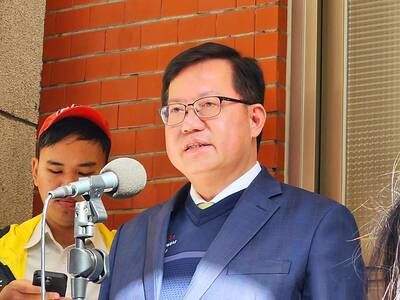
By far the most jarring of the new appointments for the incoming administration is that of Tseng Wen-tsan (鄭文燦) to head the Straits Exchange Foundation (SEF). That is a huge demotion for one of the most powerful figures in the Democratic Progressive Party (DPP). Tseng has one of the most impressive resumes in the party. He was very active during the Wild Lily Movement and his generation is now the one taking power. He has served in many of the requisite government, party and elected positions to build out a solid political profile. Elected as mayor of Taoyuan as part of the
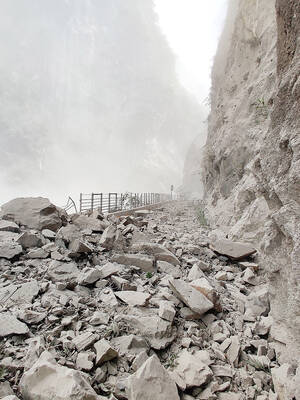
Moritz Mieg, 22, lay face down in the rubble, the ground shaking violently beneath him. Boulders crashed down around him, some stones hitting his back. “I just hoped that it would be one big hit and over, because I did not want to be hit nearly to death and then have to slowly die,” the student from Germany tells Taipei Times. MORNING WALK Early on April 3, Mieg set out on a scenic hike through Taroko Gorge in Hualien County (花蓮). It was a fine day for it. Little did he know that the complex intersection of tectonic plates Taiwan sits

When picturing Tainan, what typically comes to mind is charming alleyways, Japanese architecture and world-class cuisine. But look beyond the fray, through stained glass windows and sliding bookcases, and there exists a thriving speakeasy subculture, where innovative mixologists ply their trade, serving exquisite concoctions and unique flavor profiles to rival any city in Taiwan. Speakeasies hail from the prohibition era of 1920s America. When alcohol was outlawed, people took their business to hidden establishments; requiring patrons to use hushed tones — speak easy — to conceal their illegal activities. Nowadays legal, speakeasy bars are simply hidden bars, often found behind bookcases


 RSS
RSS