


The Taipei Biennial is the Taipei Fine Arts Museum’s (TFAM) big day out, a chance to showcase new contemporary art by both local and international artists. This year the show is being curated by Manray Shu (徐文瑞) and Vasif Kortun, who aim to extend the scope of the exhibition outward from the museum to include many different locations around the city.
The use of non-museum spaces, including projects based at the Beer Brewery on Jianguo North Road (建國啤酒廠), on the mega-digital screen at the Taipei Arena (台北小巨蛋), in Taipei Art Park (中山美術公園) and at the Zhongxiao Xinsheng MRT Station (捷運忠孝新生站), is an intentional effort to put art before people who might not otherwise visit a museum to see an exhibition, and to comment on the fact that digital media pushes artistic expression in our faces.
The conception of the show is described in the exhibition literature as originating from “a constellation of correlated themes that (are) all connected to neo-liberal capitalist globalization.”
According to curator Kortun, who has been the curator of two biennials in Istanbul, one of the most important features of the Taipei Biennial is to create a distributed network of artists from around the world. “It is not (linking) artists to a center, but (linking) artists to artists,” Kortun said. “It created a kind of horizontal network of a different kind of artistry.”
This horizontal and diversified model has been taken up in the structure of the exhibition itself, which although centering on the TFAM, is also making use of commercial spaces.
While some 47 international artists have been invited to participate, Kortun said an emphasis has been place on creating art works “for Taipei.” Kortun distanced himself from the idea of an art exhibition that was about keeping artists “in circulation,” emphasizing that the whole show was more similar in format to that of a forum in which artists discussed issues in a public fashion in the hope of making the general public (not just the museumgoing public), engage more actively with these issues.
One of the most interesting aspects of this exhibition for Taipei residents is the inclusion of Bbrother, one of the country’s most notorious graffiti artists.
Kortun pointed out that an artist like Bbrother (who wore a mask at the press conference and will not reveal his real name) does not need shows like the Biennial to bring this works to public notice. In an interview with the Taipei Times, Bbrother said he hoped that by creating works for a museum space, he might bring his work to the attention of a different public. “People come to museums with the expectation of finding meanings in the things they see,” he said. It is somewhat ironic that in a huge mural that will be a centerpiece of the exhibits at the TFAM, he is working at hiding many images within a camouflage design. “Creating a work like this gives me the chance to express more complete ideas than I am able to in works made on the street,” he said.
While the exhibition aims to bring art out into the streets, Bbrother is doing the opposite of bringing the street into the museum.
Other local artists include Wu Mali (吳瑪), whose work is a computer model titled Taipei Tomorrow as a Lake Again (2008), and includes a horticultural project outside the TFAM as well as Internet-accessible models of what could happen to Taipei as a result of global warming. This is associated with other global themes in the work Invisible City: Taipari York (隱形城市:台八里•約克) by Tsui Kuang-yu (崔廣宇) and video presentation Ventriloquists: Introductions (附身[聲]者:介紹) by Yu Cheng-ta (余政達), in which foreigners are given a Chinese script to repeat. In this latter work, the unintentional humor that this creates is highlighted with subtitles.
From Bbrother’s social activism to Yu’s YouTube-esque video prank, some insight is provided into the tensions between the local and the international. With many international artists bringing their own concerns to this new environment, where they have been encouraged to create works that use and reflect the city of Taipei, this should certainly generate plenty of food for thought.
EXHIBITION NOTES:
WHAT: 2008 Taipei Biennial
WHEN: Until Jan. 4, 2009
WHERE: Taipei Fine Arts Museum and other locations around the city. Details on the places and times of events can be found at www.taipeibiennial.org/index.aspx.
Information about associated activities can be found at the following locations:
* 2008 Taipei Biennial Feature: Dictionary of War (2008台北雙年展國際論壇:戰爭辭典) at www.dictionaryofwar.org
* Urban Nomad Film Program at the Taipei Biennial (城市遊牧影展) at urbannomadfilmfest.blogspot.com
* Taipei Drift: International Workshop for Art Academics 2008 (台北甩尾:2008國際藝術學院工作營) at taipeidrift.tnua.edu.tw

Sept.16 to Sept. 22 The “anti-communist train” with then-president Chiang Kai-shek’s (蔣介石) face plastered on the engine puffed along the “sugar railway” (糖業鐵路) in May 1955, drawing enthusiastic crowds at 103 stops covering nearly 1,200km. An estimated 1.58 million spectators were treated to propaganda films, plays and received free sugar products. By this time, the state-run Taiwan Sugar Corporation (台糖, Taisugar) had managed to connect the previously separate east-west lines established by Japanese-era sugar factories, allowing the anti-communist train to travel easily from Taichung to Pingtung’s Donggang Township (東港). Last Sunday’s feature (Taiwan in Time: The sugar express) covered the inauguration of the

The corruption cases surrounding former Taipei Mayor and Taiwan People’s Party (TPP) head Ko Wen-je (柯文哲) are just one item in the endless cycle of noise and fuss obscuring Taiwan’s deep and urgent structural and social problems. Even the case itself, as James Baron observed in an excellent piece at the Diplomat last week, is only one manifestation of the greater problem of deep-rooted corruption in land development. Last week the government announced a program to permit 25,000 foreign university students, primarily from the Philippines, Indonesia and Malaysia, to work in Taiwan after graduation for 2-4 years. That number is a
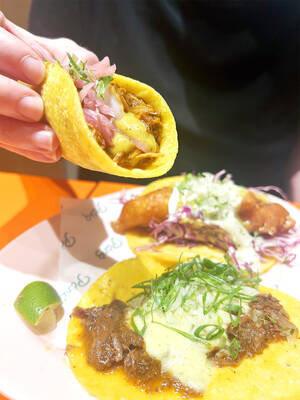
This year’s Michelin Gourmand Bib sported 16 new entries in the 126-strong Taiwan directory. The fight for the best braised pork rice and the crispiest scallion pancake painstakingly continued, but what stood out in the lineup this year? Pang Taqueria (胖塔可利亞); Taiwan’s first Michelin-recommended Mexican restaurant. Chef Charles Chen (陳治宇) is a self-confessed Americophile, earning his chef whites at a fine-dining Latin-American fusion restaurant. But what makes this Xinyi (信義) spot stand head and shoulders above Taipei’s existing Mexican offerings? The authenticity. The produce. The care. AUTHENTIC EATS In my time on the island, I have caved too many times to

In a stark demonstration of how award-winning breakthroughs can come from the most unlikely directions, researchers have won an Ig Nobel prize for discovering that mammals can breathe through their anuses. After a series of tests on mice, rats and pigs, Japanese scientists found the animals absorb oxygen delivered through the rectum, work that underpins a clinical trial to see whether the procedure can treat respiratory failure. The team is among 10 recognized in this year’s Ig Nobel awards (see below for more), the irreverent accolades given for achievements that “first make people laugh, and then make them think.” They are not


 RSS
RSS