


From hearing “is he yours?” asked to a white mother walking with her Asian child, to playground taunts of “slanted-eyes” and unfair assumptions about being good at math, nine Korean adoptees tell their stories of growing up in American, white families in Once They Hear My Name: Korean Adoptees and Their Journeys Toward Identity.
As children, the book’s featured adoptees, now ranging from age 25 to 53, said they did not need to look too hard to figure out they were different from others in their families. How they dealt with the differences — and the experiences these divisions produced while growing up — varied widely from person to person.
When Marilyn Lammert, an adoptive mother, traveled to South Korea to meet her son’s biological family in 1996, she met other American adoptees searching for their birth families along with some who had moved back to Korea to work or go to school.
As Lammert and Ellen Lee, a Korean-American friend who traveled with her, heard their stories, they sensed a common theme of longing for an identity and a strong desire to know more about their Korean roots. The visitors were amazed by the different paths that the adoptees took to get them to that point.
The two decided to interview Korean adoptees and collect life-experience stories that might help other adoptees through the struggle of being born into one race or culture but raised in another. Mary Anne Hess edited the taped interviews into the first-person accounts that make up the book.
The editors note that there are more than 100,000 Korean adoptees in the US. The oldest are now senior citizens and the youngest are still babies.
“They are part of the largest group of children ever adopted across racial, cultural and geographic lines,” according to the book. The oldest came home with US soldiers stationed in South Korea after the Korean War (1950-1953); the youngest are infants babies still coming over today.
The US Census Bureau reports that South Korea is still the largest single-source country of foreign-born adoptees under 18 years old, at about 48,000 children, according to the book. But China, Russia and Guatemala are the top home countries for adopted children now entering the US.
“As these children grow, they and their parents can look to the long-time experience of Korean adoptees for guidance in coming to grips with the difficult questions of identity formation in families that transcend racial and ethnic categorization,” the book says.
The adoptees’ stories share similar traits of being teased as children for being different — many grew up in rural areas or places without large Asian populations — and seeking a comfort level about being adopted. At the same time, there are remarkable differences.
Some adoptees’ parents went out of their way to teach their children about Korean culture, either through books, Korean food, special camps or trips to their home country. On the other hand, at least one adoptee “never had a bowl of rice.”
Some had adopted brothers or sisters while others had siblings who were the biological children of their parents, creating an entirely different complication. Some families talked openly about adoptions while others did not really discuss it. Some families stayed together while others were separated by divorce or death of a parent.
Beyond examining how the mere knowledge one is adopted (and of a different race) affects day-to-day life, the book also explores the adoptees’ decision of whether to seek out their birth families.
Two in the book, including Lammert’s son Adam Carlson, whose story makes up the first chapter, found their birth parents, while others have either come up empty or did not choose to begin an intense search.
While reading the stories, it is important to remember that those interviewed did not grow up in the age of the Internet, or adoption support groups, or having many of the resources available today. As everyone gets used to just clicking on their favorite Internet search engines, it is eye-opening to read about someone having to go to an actual South Korean orphanage to look up records.
Someone reading this book either thinking about adoption or parenting an adopted child of a different race may read between the lines as to what worked and what didn’t with the book’s nine adoptee contributors. But the overall lesson is that what works for one child may not work for another.
The title comes from one of the interviewed adoptees, Todd Knowlton. He said that once he got to college he would tell people he was adopted right away.
“I would always bring it up — even today — because, I mean, there’s no hiding,” said Knowlton, now 33 and a consultant in Bethesda, Maryland. “It doesn’t bother me, but once they hear my last name, people always ask uncomfortable questions.”
The book itself can be uncomfortable — and thought-provoking — particularly when reading about the outright discrimination or stereotypes that the adoptees endured on top of their struggles to fit into their own families. The stories help answer questions that would normally be too hard or perhaps too rude to ask.

Sept.16 to Sept. 22 The “anti-communist train” with then-president Chiang Kai-shek’s (蔣介石) face plastered on the engine puffed along the “sugar railway” (糖業鐵路) in May 1955, drawing enthusiastic crowds at 103 stops covering nearly 1,200km. An estimated 1.58 million spectators were treated to propaganda films, plays and received free sugar products. By this time, the state-run Taiwan Sugar Corporation (台糖, Taisugar) had managed to connect the previously separate east-west lines established by Japanese-era sugar factories, allowing the anti-communist train to travel easily from Taichung to Pingtung’s Donggang Township (東港). Last Sunday’s feature (Taiwan in Time: The sugar express) covered the inauguration of the

The corruption cases surrounding former Taipei Mayor and Taiwan People’s Party (TPP) head Ko Wen-je (柯文哲) are just one item in the endless cycle of noise and fuss obscuring Taiwan’s deep and urgent structural and social problems. Even the case itself, as James Baron observed in an excellent piece at the Diplomat last week, is only one manifestation of the greater problem of deep-rooted corruption in land development. Last week the government announced a program to permit 25,000 foreign university students, primarily from the Philippines, Indonesia and Malaysia, to work in Taiwan after graduation for 2-4 years. That number is a
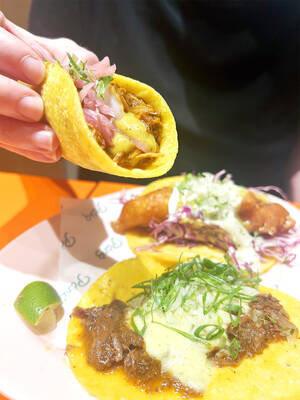
This year’s Michelin Gourmand Bib sported 16 new entries in the 126-strong Taiwan directory. The fight for the best braised pork rice and the crispiest scallion pancake painstakingly continued, but what stood out in the lineup this year? Pang Taqueria (胖塔可利亞); Taiwan’s first Michelin-recommended Mexican restaurant. Chef Charles Chen (陳治宇) is a self-confessed Americophile, earning his chef whites at a fine-dining Latin-American fusion restaurant. But what makes this Xinyi (信義) spot stand head and shoulders above Taipei’s existing Mexican offerings? The authenticity. The produce. The care. AUTHENTIC EATS In my time on the island, I have caved too many times to

In a stark demonstration of how award-winning breakthroughs can come from the most unlikely directions, researchers have won an Ig Nobel prize for discovering that mammals can breathe through their anuses. After a series of tests on mice, rats and pigs, Japanese scientists found the animals absorb oxygen delivered through the rectum, work that underpins a clinical trial to see whether the procedure can treat respiratory failure. The team is among 10 recognized in this year’s Ig Nobel awards (see below for more), the irreverent accolades given for achievements that “first make people laugh, and then make them think.” They are not


 RSS
RSS