


There are two kinds of people in the world: those who know what Under Armour is, and those who are just finding out.
John Mincarelli is one of the latter, having stumbled onto Under Armour last year in an upstate New York branch of Dick’s Sporting Goods.
Mincarelli, who teaches the dark art of fashion merchandising at the Fashion Institute of Technology, is a hard man to impress. And perusing the racks of Nike, Adidas and Columbia that day, looking for some new workout gear, nothing did. But then a display leapt out at him like some kind of marketing rhinoceros, which, since it features a colossally muscular mannequin modeled from a pro football player’s actual body, is roughly what Under Armour is designed to do.
“It totally grabbed my attention — just the name alone,” he said. “I thought, ‘This is brilliant.’ It implies all this power and protection and strength right off the bat.”
As any teenage boy could have told him, Under Armour is not new; it was founded in Baltimore in 1996 by Kevin Plank, a former college football player. But the brand hid in plain sight, like a purloined varsity letter, on the playing fields of team sports and the cameras of ESPN, where its discreet X-like logo (actually a U crossed with an A) and cartoonishly macho imagery made it all but invisible to the cold eye of fashion.
But anyone interested in a success story should look more closely at how Plank, 35, turned a pretty simple opening kickoff — a line of moisture-wicking compression garments designed to wear under sports uniforms, similar to those long worn by skiers and bicyclists — into one of the shrewdest plays in fashion history, not to mention one of the most provocative depictions of masculinity to emerge in the last decade.
In the last decade, as men have taken to vanity with a vengeance — fitness, grooming, wardrobe — they have made branding success stories out of Abercrombie and Fitch’s sexed-up jocks and Thom Browne’s billionaire nerds. Along the way, it seemed as if the old warhorse of machismo retained as much pop currency as all that castoff camouflage. (Didn’t the last Rambo kind of tank?)
But while the style attention focused on the crazy and colorful new underwear and skinny emo-boy clothes, Under Armour underwear and athletic wear stealthily infiltrated the closet and consciousness of the modern man’s man. Well known and much loved by military personnel, sports teams, weight lifters and, more and more, those who aspire to the above, Under Armour has not only redefined gym-pumped machismo for a new generation, it has put it on steroids.
“This is more about marketing than anything else,” said Marshal Cohen, the chief analyst for the NPD Group, which follows the apparel market. “It’s not a new product, it’s not new technology. They turned what was a niche market — they took the undergarment, your under-sports apparel — into something you actually wanted to wear.”
The result, he said, is that “they connect better with the consumer than any brand we’ve seen in a decade.”
Plank insists over and over that the brand is based on performance, a sentiment echoed by its fans, but he conceded that the Under Armour marketing campaigns have had very little to do with moisture wicking.
“Brands are effectively stories,” he said. “Our job is managing that.”
Now, one might think it reasonable that, with Batman breaking box-office records as if they were skyscraper windows, apparel made of superhero Lycra (actually, it’s a women’s lingerie material) should have struck a nerve. But Under Armour is made for (or at least marketed to) iron-man athletes, not the fantasy Iron Man of the movies. The company’s success — US$314 million in sales for the first half of 2008, a jump of nearly US$70 million over the first half of 2007, when the company went public — would be remarkable even if the economy were not pancake-flat.
And while the Under Armour marketing machine likes to evoke Plank’s rough and tumble football background, the company has been as cunning as a chess pro in cultivating its image and fan base. This is apparent in its testosterone-juiced Protect This House television ads featuring hugely built football players (like the fearsome-looking NFL veterans Eric Ogbogu or Ray Lewis) sweating, shouting and working up as if for battle.
Extreme as they are, they send a message of authenticity (one of Plank’s favorite words) and aggression to a select audience, unlike ads from sporting goods giants like Nike and Reebok aimed at more general audiences.
“I’m really struck by the concept of home protection in their ads,” said the cultural critic Susan Faludi, whose last two books, Stiffed and The Terror Dream, have addressed the perils of hype in, respectively, masculinity and the terrorist threat. Under Armour’s ads, she said, play into both, offering a fantasy of invulnerability. “In one, there’s this coach yelling at his team, ‘Nobody comes here and beats us, at our game, in our house.’ But I am looking at it through the lens of 9/11, at the anxiety and shame that, in fact, they did come here, and did not play our game and beat us in our house.”
A link to military brawn is no accident. Plank is proud of the line’s popularity with the US armed forces, a market he deliberately pursued. Instead of trying to penetrate the oversaturated underwear market with its familiar beefcake imagery, Under Armour created a line of tactical wear for military personnel.
“The best letter I ever got was from a SEAL serving in Iraq,” he said. “He said, ‘I just want to thank you — this stuff makes 120 degrees feel like 110.’”
Similarly, the company has carefully controlled distribution. For years it has largely restricted sales to sporting goods stores, military-base exchanges and sports-and military-oriented outlets. One of the largest and most inclusive sports-underwear sites was turned down by Under Armour when it sought to sell the line. The owner, who asked that he and his site remain anonymous in case negotiations started up again, was told by an Under Armour representative that its owner found his site “too homoerotic, too gay.”
Plank denied any knowledge of the snub, exclaiming: “What? No way!”
Whether or not this attitude was official policy, it has cemented the brand as aggressively heterosexual at a time when few other brands would care to be branded as such. So while Tom Ford may have made New England Patriots quarterback Tom Brady look debonair for this spring’s Superheroes gala at New York’s Metropolitan Museum of Art, Under Armour custom-made Jamie Foxx’s jockstrap for Any Given Sunday. Guess who got more yardage?
As Cohen pointed out, Abercrombie and Fitch gets more attention as the beloved of the hotties, but regular guys need brands to love, too.
“I just saw someone walking down the street in Las Vegas wearing a long-sleeve Under Armour shirt,” he said. “It was 100 degrees out, and I asked him why he was wearing it. He said, ‘I love it — it makes me feel like I just worked out.’ And — how do we say this? — this guy didn’t look like he had been lifting weights any time recently.”
The worked-out fantasy has also endeared it to a fan base most likely to carry it into the future as a major lifestyle brand: teenage boys.
“This is the brand for them,” Beth Boyle, the senior public relations manager for NPD, said of her two sons, ages 13 and 15. “Even if I say to them, ‘If we get the cheaper brand, you can have two,’ they say, ‘No, I’d rather have just one.’”
Teenage boys and their heroes may have made the brand what it is, but Under Armour is now thinking outside the gridiron. Women’s wear was introduced in 2005, and the company has sponsored women athletes and teams. Plank said he hopes the sector will be bigger than men’s wear, though it has yet to inspire the kind of loyalty that the men’s wear has.
The company’s first mainstream athletic shoe, a cross-trainer, was introduced two months ago (after being previewed in the company’s first Super Bowl ad) and has done well, selling roughly 500,000 pairs, according to Omar Saad, a retail analyst at Credit Suisse. He forecast that the brand would sell a million pairs by the end of the year. And this year the company opened its first two stores, in malls in Annapolis, Maryland, and Aurora, Illinois, a suburb of Chicago; and a third one opens this week, at a mall in Natick, Massachusetts, a suburb of Boston.
Suzanne Karkus, a veteran of Calvin Klein and Izod, was recently brought in to oversee apparel, much of which is either very tight or very baggy, and appeals to men who answer those descriptions as well. (A new intermediate “fitted” style is coming in spring 2009, she said, as are more up-to-date color selections.)
Only time will tell if the Under Armour formula can propel it to the size of Nike. Mincarelli, the Fashion Institute of Technology professor, is not sure. While he likes to wear Under Armour at the gym, he doesn’t feel the urge to wear it anywhere else.
“I’d love to see the brand images of Under Armour go head to head with Abercrombie,” he said, chuckling. “I think Under Armour would crush them. But you know, I’d rather own the shirt from Abercrombie.”

Sept.16 to Sept. 22 The “anti-communist train” with then-president Chiang Kai-shek’s (蔣介石) face plastered on the engine puffed along the “sugar railway” (糖業鐵路) in May 1955, drawing enthusiastic crowds at 103 stops covering nearly 1,200km. An estimated 1.58 million spectators were treated to propaganda films, plays and received free sugar products. By this time, the state-run Taiwan Sugar Corporation (台糖, Taisugar) had managed to connect the previously separate east-west lines established by Japanese-era sugar factories, allowing the anti-communist train to travel easily from Taichung to Pingtung’s Donggang Township (東港). Last Sunday’s feature (Taiwan in Time: The sugar express) covered the inauguration of the

The corruption cases surrounding former Taipei Mayor and Taiwan People’s Party (TPP) head Ko Wen-je (柯文哲) are just one item in the endless cycle of noise and fuss obscuring Taiwan’s deep and urgent structural and social problems. Even the case itself, as James Baron observed in an excellent piece at the Diplomat last week, is only one manifestation of the greater problem of deep-rooted corruption in land development. Last week the government announced a program to permit 25,000 foreign university students, primarily from the Philippines, Indonesia and Malaysia, to work in Taiwan after graduation for 2-4 years. That number is a
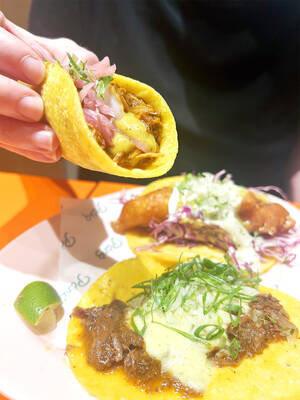
This year’s Michelin Gourmand Bib sported 16 new entries in the 126-strong Taiwan directory. The fight for the best braised pork rice and the crispiest scallion pancake painstakingly continued, but what stood out in the lineup this year? Pang Taqueria (胖塔可利亞); Taiwan’s first Michelin-recommended Mexican restaurant. Chef Charles Chen (陳治宇) is a self-confessed Americophile, earning his chef whites at a fine-dining Latin-American fusion restaurant. But what makes this Xinyi (信義) spot stand head and shoulders above Taipei’s existing Mexican offerings? The authenticity. The produce. The care. AUTHENTIC EATS In my time on the island, I have caved too many times to

In a stark demonstration of how award-winning breakthroughs can come from the most unlikely directions, researchers have won an Ig Nobel prize for discovering that mammals can breathe through their anuses. After a series of tests on mice, rats and pigs, Japanese scientists found the animals absorb oxygen delivered through the rectum, work that underpins a clinical trial to see whether the procedure can treat respiratory failure. The team is among 10 recognized in this year’s Ig Nobel awards (see below for more), the irreverent accolades given for achievements that “first make people laugh, and then make them think.” They are not


 RSS
RSS