


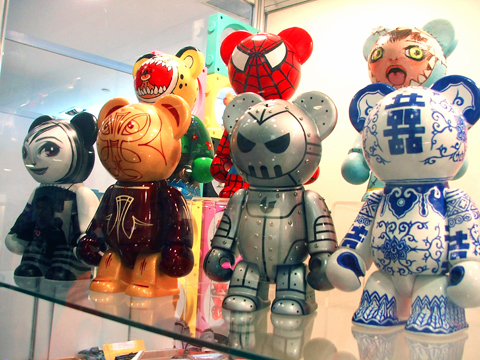
The scene at the Taipei Toy Festival's opening day on Thursday was as re nao as any of the city's most crowded night markets. Browsers with overstuffed shopping bags jostled for space in the narrow aisles between booths, and long queues formed in front of popular vendors. The stinky tofu at this particular festival, however, smells like fresh vinyl, and has a name - Smery Tofu - and a face.
This year marks the fifth time the Taipei Toy Festival brings together toy designers, distributors and fans. The festival runs until tomorrow in the spherical Mira Department Store at Core Pacific City Mall (京華城). Exhibitors hail from countries across the globe, while attendees vary from high school students to businessmen. No matter who they are, they all have one thing in common - an ability to revel in the wonder of toys that has survived past puberty.
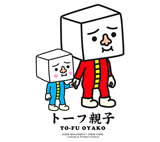
The Taipei Toy Festival is one of the most crucial events for toy designers in Asia, according to Koto Nishiyama, one of five members of the Japanese design team Devilrobots. The team is responsible for Tofu Oyako, the perpetually distressed-looking block-headed character that is one of the festival's mascots, as well as Smery Tofu, a variation of Tofu Oyako created as a tribute to one of Taiwan's most famous night market snacks.
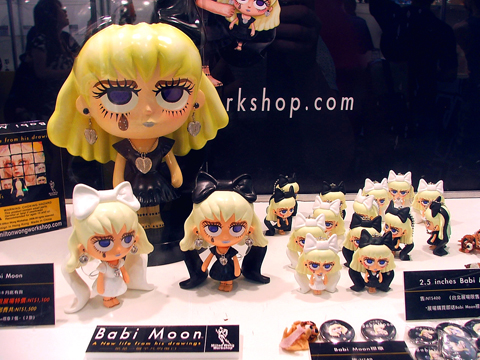
PHOTO: CATHERINE SHU, TAIPEI TIMES
"It is a really important event for exposing our designs to the Asian market," says Nishiyama. "It's very important for us to be here, not only for us to participate, but also to see our friends and fellow designers."
The festival began in 2004 when Jen Huang (黃仁壽), director of toy distributor Monster Taipei (台北怪獸國際有限公司), and fellow members of Toy League Taiwan (台灣設計師玩具創作核心), were inspired by Hong Kong's Toycon and decided to find a similar way to bring Taiwanese and Hong Kong toy artists together in Taipei.
"In the beginning there wasn't really a particular purpose or a reason for the festival. It was just for fun, because we all like toys and we wanted to gather our friends together," says Huang.
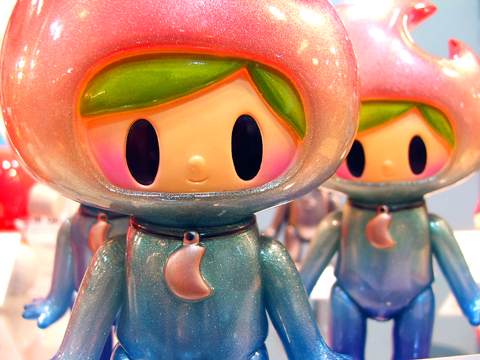
PHOTO: CATHERINE SHU, TAIPEI TIMES
Word of the event started to spread, and the event's scope quickly mushroomed. This year, Huang expects to sell 20,000 tickets, compared to the 7,000 or 8,000 attendees at the first exhibition in 2004, which was then called the Hong Kong Taipei Designer Toy Exhibit (香港台北創作玩具展). Nearly 90 exhibitors from around the world will participate, three times as many as at the first festival.
The beginning of the designer toy trend, or urban vinyl, as it is also called, is commonly attributed to Michael Lau (瀏覽), a Hong Kong artist who in the late 1990s began making limited-edition vinyl figures based on a comic he created. Other artists soon followed suit, and the craze spread throughout Asia and then on to the rest of the world. The terms designer toy and urban vinyl are often used interchangeably because many of the figures are made from high-quality plastic and vinyl. Their creators often have fine arts or graphic design backgrounds, and the toys are usually produced in limited runs.
Collectible vinyl toys are now becoming increasingly ubiquitous in Taiwan as convenience stores and other retailers use them as marketing tools. Celebrity designer Demos Chiang (蔣友柏), the grandson of Chiang Kai-shek (蔣介石), recently designed a line of figures based on Chinese gods for the Family Mart convenience store chain. This past spring, Hi-Life convenience stores released a line of Tofu Oyako promotional items, a collaboration that was facilitated by Huang in his role as the Taiwan distributor for Medicom Toys, which produces many Devilrobots designs.
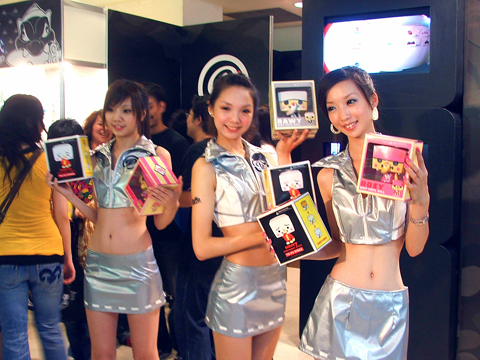
PHOTO: CATHERINE SHU, TAIPEI TIMES
Such tie-ins have helped expand the Taiwanese appetite for designer toys. Kate Wu (吳姿華), a 22-year old Taichung college senior, says she first started collecting designer toys two years ago when 7-Eleven released a line of 12 figures based on the signs of the Zodiac. She is now a huge fan of C.i.Boys, a chubby, big-headed figure with teeny little arms by Hong Kong design team Red Magic Holdings. Wu, who attended the festival with several friends, arrived extra early on Thursday to make sure she got one of the C.i.Boys festival exclusives given away to the first 500 attendees.
"I like them because they are cute, very cute and very round," says Wu, gesturing to the C.i.Boys display case behind her. Wu added that she sees the figures, which are issued in limited editions customized by different designers, as art pieces rather than playthings.
One of the reasons that designer toys appeal to people is because they allow them to enjoy art without being intimidated by it, says American artist and toy designer Tim Biskup, who will be signing autographs at the festival today.
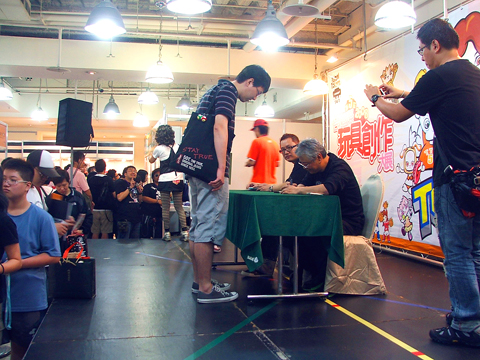
PHOTO: CATHERINE SHU, TAIPEI TIMES
"The art world is sort of like an opaque world; it's not as concerned about entertaining people or presenting interesting things for them to look at as maybe it should be, so people are getting their fix of visual stimulation from other places," says Biskup, "Vinyl toys are a perfect example of a way that people can embrace art inexpensively. It is very user-friendly."
Most collectors treat their designer toys just like that - as miniature pieces of artwork - and keep them on display or carefully stored in their original packaging, a reasonable reaction considering that the price of each of these toys can range from several hundred to upwards of several thousand NT dollars.
But Biskup believes the line between designer toys and ordinary playthings doesn't have to be so black-and-white. He is often sent new designer toys that frequently end up in the hands of his 5-year-old daughter.
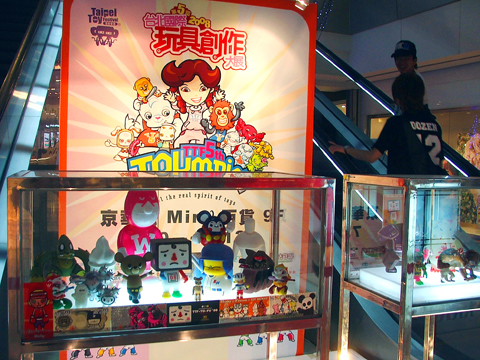
PHOTO: CATHERINE SHU, TAIPEI TIMES
"I've always reveled in being in a position where I get to take a new figure and give it to my daughter and see what she does with it, even though it might be worth a fortune at some point," Biskup says, "I just want to see it getting played with. That is what activates toys and brings them to life for me."
Taiwanese artist Kiyo Huang (黃基蜂), an exhibitor at the festival, had a similar philosophy in mind when designing his line of do-it-yourself, or DIY, Ongu toys. The 15cm-tall figures have blank, matte surfaces to draw and paint on.
"I discovered that a lot of young professional people really like toys but they are a little embarrassed to play with them, so I decided to create a slightly more basic character that will allow them to get back the feelings of playfulness and creativity that they had as children when they draw or write on it," says Huang, who is also the art director of Image-Tongue Design, a visual and media design firm.
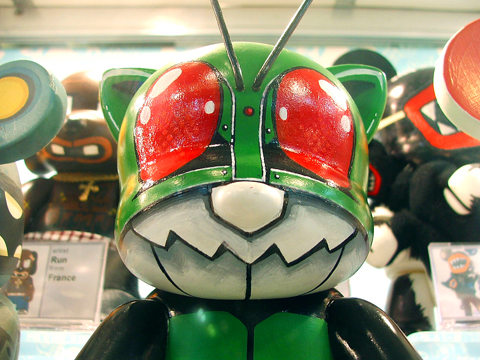
PHOTO: CATHERINE SHU, TAIPEI TIMES
According to Monster Taipei's Jen Huang, many of the attendees at the Taipei Toy Festival are male white-collar workers between the ages of 25 to 35. Lately, however, the age range has expanded to include high school and college students and people in their late 30s to early 40s. More women are also coming to the festival and purchasing designer toys; Huang estimates that nearly 40 percent of last year's attendees were female.
Designer toys are becoming increasingly popular not just in Taiwan, but throughout the world, Huang says, in part because modern life "is often full of stress and also perhaps a bit boring."
"Almost everyone plays with toys when they are younger, but as they grow older they feel as if they can't anymore because they are grown-ups," says Huang, who has more than 10,000 toys in his personal collection. "But now that designer toys are becoming more and more fashionable, more people start to allow themselves to think that toys aren't just for kids. So they tell themselves, hey, why not? I make my own money and I can buy my own toys now. It is a way to bring back their lost childhoods."
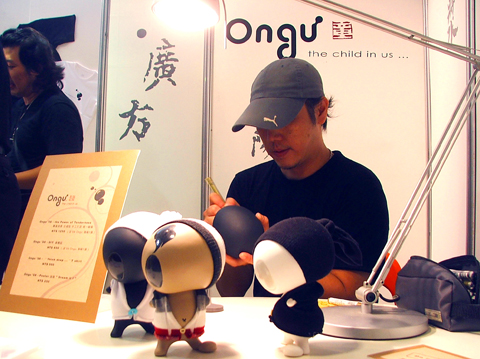
PHOTO: CATHERINE SHU, TAIPEI TIMES
 | Devilrobots
Devilrobots is a five-person design team (Shinichiro Kitai, Kenji Saito, Yoshizo Yoshimura, Takeshi Ikegami and Koto Nishiyama) from Japan. Their most popular toy series is based on the Tofu Oyako character, whose fan base in Taiwan has grown steadily since Devilrobots first participated in the Taipei Toy Festival four years ago. In fact, the idea for Smery Tofu, who pinches its nose as it contemplates its own stench, came out of a previous festival, when a Taiwanese designer friend suggested they do a character based on stinky tofu. The Devilrobots team went to a night market to try the malodorous snack out for themselves and their reaction, Nishiyama says, is captured in Smery Tofu's expression. |
 | Sea Eye
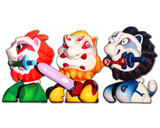
Taiwanese artist D-La (陳岳樟) of Sea Eye (婆娑之眼) drew on local iconography for his An-Ping Sword Lion toy series (安平劍獅). The character design, a stylized lion with a sword in its mouth, is based on emblems placed on houses in Tainan's An-Ping district that are meant to ward off evil spirits. Each of the three lions in the series also reference Taiwan's history; the red-maned, tattooed Dufor (杜芙兒) references the Dutch East India Company, which took control of Taiwan's ports in the 17th century, and the Chinese nickname for the trading company's sailors, hong mao (紅毛), or red hair. "By using traditional stories or legends for inspiration, Taiwanese toy designers can develop a style of our own, a unique product," says D-La. |
 | Old Master Q (老夫子) by EIB Studio and Joseph Wong
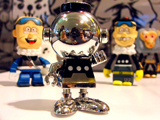
Characters from the enormously popular Chinese-language Old Master Q (老夫子) comics have been turned into countless children's toys and figurines over the past 45 years, but Joseph Wong (王澤), the head of OMQ Comics, wanted to try something new when he collaborated with Hong Kong design team EIB Studio. Wong, the son of Old Master Q creator Alfonso Wong (王家禧), said that working with the designers - Winson Ma, Husky Kevin, Ultraman and Danny Chan - was like playing in a jazz combo. "Each designer has their own particular designs and interests, but once we came together we said, 'let's jam and see what happens,'" said Wong, who signed figures on the festival's opening day. The EIB Studio team will also have an autograph session today. |
 | Ongu
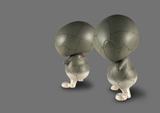
The simplicity of the Ongu figure, which has a chubby body, short limbs and a large, round head with a single glossy eye, allows collectors to project whatever they want onto the figure, just as small children create stories and assign characteristics to their favorite toys. "A lot of people have asked me what Ongu's background is, but my reply is that I hope everyone writes Ongu's backstory," says designer Kiyo Huang (黃基蜂). Ongu's do-it-yourself design allows collectors to flex their creative muscles, but Huang is also customizing the figures for customers at the Taipei Toy Festival. This year he plans to sketch a stylized peony on Ongu. "I chose the peony because it is a motif in traditional Chinese paintings, but I wanted to interpret it with a modern twist," says Huang. |
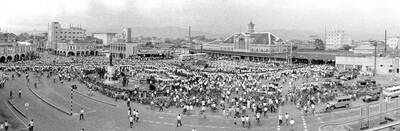
May 11 to May 18 The original Taichung Railway Station was long thought to have been completely razed. Opening on May 15, 1905, the one-story wooden structure soon outgrew its purpose and was replaced in 1917 by a grandiose, Western-style station. During construction on the third-generation station in 2017, workers discovered the service pit for the original station’s locomotive depot. A year later, a small wooden building on site was determined by historians to be the first stationmaster’s office, built around 1908. With these findings, the Taichung Railway Station Cultural Park now boasts that it has
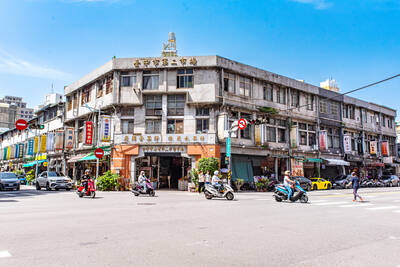
Wooden houses wedged between concrete, crumbling brick facades with roofs gaping to the sky, and tiled art deco buildings down narrow alleyways: Taichung Central District’s (中區) aging architecture reveals both the allure and reality of the old downtown. From Indigenous settlement to capital under Qing Dynasty rule through to Japanese colonization, Taichung’s Central District holds a long and layered history. The bygone beauty of its streets once earned it the nickname “Little Kyoto.” Since the late eighties, however, the shifting of economic and government centers westward signaled a gradual decline in the area’s evolving fortunes. With the regeneration of the once
In February of this year the Taipei Times reported on the visit of Lienchiang County Commissioner Wang Chung-ming (王忠銘) of the Chinese Nationalist Party (KMT) and a delegation to a lantern festival in Fuzhou’s Mawei District in Fujian Province. “Today, Mawei and Matsu jointly marked the lantern festival,” Wang was quoted as saying, adding that both sides “being of one people,” is a cause for joy. Wang was passing around a common claim of officials of the People’s Republic of China (PRC) and the PRC’s allies and supporters in Taiwan — KMT and the Taiwan People’s Party — and elsewhere: Taiwan and
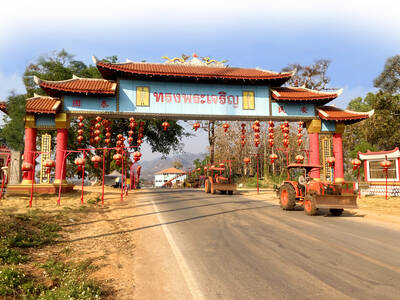
Perched on Thailand’s border with Myanmar, Arunothai is a dusty crossroads town, a nowheresville that could be the setting of some Southeast Asian spaghetti Western. Its main street is the final, dead-end section of the two-lane highway from Chiang Mai, Thailand’s second largest city 120kms south, and the heart of the kingdom’s mountainous north. At the town boundary, a Chinese-style arch capped with dragons also bears Thai script declaring fealty to Bangkok’s royal family: “Long live the King!” Further on, Chinese lanterns line the main street, and on the hillsides, courtyard homes sit among warrens of narrow, winding alleyways and



 RSS
RSS