


Most people climb to the summit of Mount Elbrus in about eight hours. It took me 14 years.
As students in southern Russia in the early 1990s, my friend Simon and I would stare through my kitchen window and marvel at its rounded twin peaks and icing sugar-smooth slopes, 60km away in the Caucasus. At 5,642m Elbrus is the highest mountain in Europe, one of the seven summits coveted by mountaineers who want to reach the highest point of each continent. My mountaineering experience amounted to a few hill climbs in the English Lake District and Wales’ Snowdonia but I promised myself I would return one day.
Only a few hundred western Europeans complete the climb each year, yet it is much less technically challenging than its lower Alpine rival, Mont Blanc: its cone shape and smooth sides make it accessible even for inexperienced peak baggers like me.
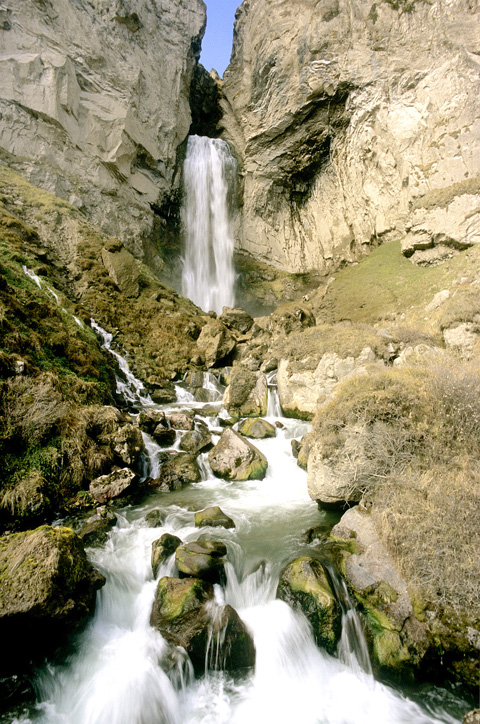
PHOTO: AP
Simon chose a Russian outdoor activity specialist because “they have a 75 percent success rate” and were cheaper than UK-based operators. They also allowed us to travel as a small group — just me and five male mountaineering mates and marathon runners — rather than join a larger team.
Pasha, our guide, greeted us with traditional Caucasian warmth, and a traditional Caucasian smile with a shining gold tooth, at Mineral Waters airport, a two-hour flight from Moscow and four hours by minibus from Azau, the main ski resort at the foot of Elbrus. But Courchevel this is not. Azau is, after all, in Kabardino-Balkaria, a semi-autonomous region of the Russian Federation, which grants it the freedom to be completely ignored, financially at least, by the government in Moscow.
First, we needed to acclimatize. Pasha led us on a gentle three-hour walk up Mount Cheget to around 3,000m from where we got our first view of Elbrus — brilliant white and forbidding. On the second day, we reached 3,600m on the romantically named All Communist Union Party mountain.
On the third day, we took the cable car to base camp. Priut-11 refuge, in the shadow of Elbrus’ twin peaks, is basic but adequate. It was once a diesel hut that supplied a state-of-the-art three-story hotel built in 1939. Campers now use the carcass of the ruined hotel as a windbreak.
Mountain views and our brilliant cook Nadya, a brass-blonde Ukrainian and nine-time summiteer, more than compensated for a bunkroom the size of a London cab. At 4,160m my first night sleeping at high altitude was fitful, but acclimatization is only one factor in summit success. In the Caucasus, the brightest day can be transformed by a cloak of cloud within minutes. The summit window is therefore narrow, between June and August. The sunny day before our planned ascent looked promising as we practiced walking on glass-blue ice in crampons and ice axe arrests.
At our last supper, Nadya revived our flagging appetites with chicken and apricot stew, but warned: “Just remember, it’s not hard, it’s just long, very long.” I decided to take the snowmobile the first 300m from base camp to the start of the summit climb with Zhenya, our second guide, and Simon, who didn’t want to let me “cheat alone.”
The Milky Way shone brightly as we set off at 5am. Zhenya stamped out a cigarette under his crampon and advised: “Relax your legs and think lazy steps.” We moved at a moonwalk pace. My heart was trying to beat an escape through my rib cage, my lungs struggled to catch the freezing air. Nobody had the energy to waste on talking. The only sound was the rhythmic hack of axes and the dull crunch of crampons on ice.
Darkness turned to gray, and the first victims of mountain sickness appeared out of the gloom. A lone mountaineer trudged past me down the slope, his face bile-green, his summit attempt clearly over.
At 5,000m we took a longer rest stop. Zhenya lit a cigarette that took an age to burn at this height and gave us an opportunity to rehydrate, refuel with jelly babies and admire the view in the first light. Low pressure at altitude acts as a lens, making mountains zoom in closer than they really are. We were now above the ridges of snaggle-tooth peaks that stretch out in a chain for 1,200km from the Black Sea to the Caspian. Our base camp at the Priut-11 refuge was just a tiny fleck.
Pasha and the five others caught up with us on the traverse, a single track that runs around the lower east summit towards the saddle, the dip between the twin peaks. Although it’s not steep — about a 25 percent gradient — it’s very precipitous with sheer drops on either side of the track. One false footing here could have sent me skidding down the glacier into a crevasse — just one of many ways that takes the lives of an average of 12 climbers a year.
It was after 10am when we left our backpacks at the saddle for the final section. Without my pack I felt liberated. In my mind, I was fleet of foot and wanted to stride ahead. In reality, I was probably as ashen and wobbly as the others. But I was in the grip of summit fever, the euphoria caused by high altitude that endangers climbers with exuberant confidence, and it pulled me up the steepest incline.
We passed a final spur and the mountain opened up across a wide snowfield towards the summit: a small pyramid of white. Summit fever seized everyone, Simon forgot his fatigue, Myles got color back in his cheeks and Colin shouted at an American trying to urinate upwind from us.
Pasha called us to a halt. “Felicity, ladies first,” he cried, inviting me to take the lead for the first time. After 14 years of waiting, I counted every step — 15 — before I got to the top and I became, for 20 all-too-short minutes, the highest woman in Europe.
Pasha hurried us off the summit. The weather was closing in and cloud rapidly envelopes the mountain.
After an overnight stop at Azau, we rewarded ourselves with a few days in the spa town of Kislovodsk, where Russian aristocracy flocked in the 19th century to cure everything from heart disease to depression. As I soaked my aching muscles in a “Narzan bath” of hot, fizzy mineral water I pondered my next summit.
The nine-day trip was organized through the Russian-based Extreme Group (www.extremegroup.ru). The best time of the year to go is June through August.

Last week, Viola Zhou published a marvelous deep dive into the culture clash between Taiwanese boss mentality and American labor practices at the Taiwan Semiconductor (TSMC) plant in Arizona in Rest of World. “The American engineers complained of rigid, counterproductive hierarchies at the company,” while the Taiwanese said American workers aren’t dedicated. The article is a delight, but what it is depicting is the clash between a work culture that offers employee autonomy and at least nods at work-life balance, and one that runs on hierarchical discipline enforced by chickenshit. And it runs on chickenshit because chickenshit is a cultural
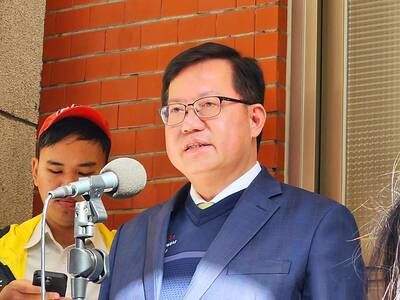
By far the most jarring of the new appointments for the incoming administration is that of Tseng Wen-tsan (鄭文燦) to head the Straits Exchange Foundation (SEF). That is a huge demotion for one of the most powerful figures in the Democratic Progressive Party (DPP). Tseng has one of the most impressive resumes in the party. He was very active during the Wild Lily Movement and his generation is now the one taking power. He has served in many of the requisite government, party and elected positions to build out a solid political profile. Elected as mayor of Taoyuan as part of the
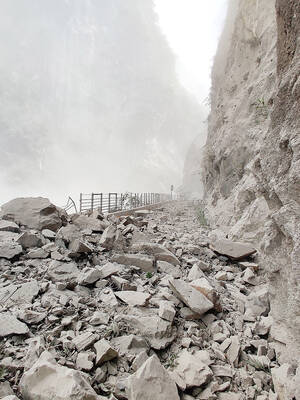
Moritz Mieg, 22, lay face down in the rubble, the ground shaking violently beneath him. Boulders crashed down around him, some stones hitting his back. “I just hoped that it would be one big hit and over, because I did not want to be hit nearly to death and then have to slowly die,” the student from Germany tells Taipei Times. MORNING WALK Early on April 3, Mieg set out on a scenic hike through Taroko Gorge in Hualien County (花蓮). It was a fine day for it. Little did he know that the complex intersection of tectonic plates Taiwan sits

When picturing Tainan, what typically comes to mind is charming alleyways, Japanese architecture and world-class cuisine. But look beyond the fray, through stained glass windows and sliding bookcases, and there exists a thriving speakeasy subculture, where innovative mixologists ply their trade, serving exquisite concoctions and unique flavor profiles to rival any city in Taiwan. Speakeasies hail from the prohibition era of 1920s America. When alcohol was outlawed, people took their business to hidden establishments; requiring patrons to use hushed tones — speak easy — to conceal their illegal activities. Nowadays legal, speakeasy bars are simply hidden bars, often found behind bookcases


 RSS
RSS