

Dhia Jabbar hides his oud in a sack when he walks down the street in his Baghdad neighborhood.
He used to teach students in the back room of a photo shop, where the sound could not be heard. But last week, militia gunmen invaded the store, destroying his instrument and ordering him to stop teaching. He had dreamed of a performing career, but now he has lost hope.
“Iraq is dead,” he says.

PHOTO: NY TIMES NEWS SERVICE
Seven thousand miles away, Rahim Alhaj, who fled Iraq in 1991, carries his oud without a second thought through the streets of Albuquerque, New Mexico, where he now lives. In New York, Washington and other cities, he plays for audiences of hundreds. An album he recorded was recently nominated for a Grammy Award.
The two musicians are bound by their passion for the oud, a pear-shaped instrument whose roots run deep in Iraq’s history. Some say that in its music lies the country’s soul.
Both men trained at the same prestigious conservatory in Baghdad. Both have a deep love for traditional Iraqi melodies.
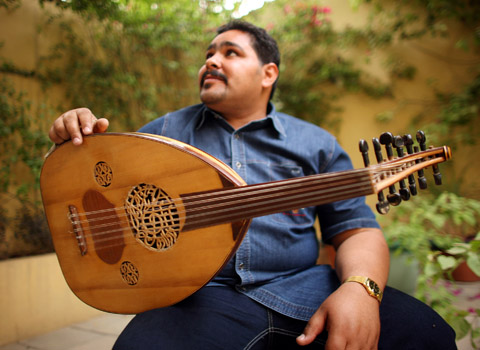
PHOTO: NY TIMES NEWS SERVICE
But Jabbar, 29, and Alhaj, 40, are also tied together by having watched — one from close up, one from far away — their country’s descent into sectarian violence.
Alhaj worries constantly about his mother and brother, who still live in Baghdad’s dangerous Sadr City neighborhood, in a house without electricity or running water. When there is fighting between Mahdi Army militia members and US and Iraqi forces there, as has been the case virtually every day in recent weeks, he calls his family frantically.
“It’s hard because I’m so far away from them and so far from their struggle, and I feel helpless,” he said.
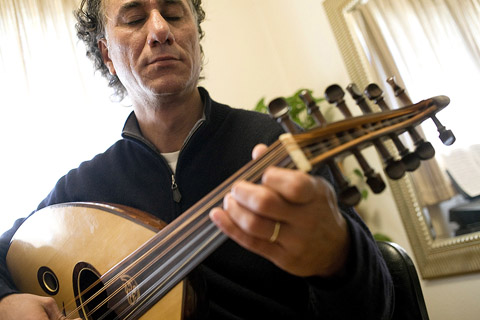
PHOTO: NY TIMES NEWS SERVICE
The violence he reads about in the newspaper stirs troubled dreams: images of being tortured, as he was in the 1980s under Saddam Hussein’s government, or of seeing people being executed.
In 2004, he returned to Baghdad to give a concert at his family’s house. The friends he grew up with, he said, wore beards and felt uncomfortable listening to him play; secular music was considered haram, forbidden. An oud maker he knew was forced to build his instruments secretly in a tiny workshop on his roof.
One morning, Alhaj awoke in his family’s home to hear his niece singing a famous Iraqi love song. But the lyrics had been changed; the words no longer spoke of romantic love, but only of God, of heaven and damnation.
“What happened?” Alhaj asked. “What happened?”
Jabbar watched the transformation of Baghdad in real time. He saw religious fervor engulf the street outside his family’s house in the Shaab neighborhood, where he used to sit outside and play for passers-by. Salons and casual concerts — once common — became rare and clandestine. The teaching and performing jobs that used to await talented oud players when they finished training disappeared.
“I have lost 10 years of my life,” he said, “the years that I worked to be able to play for people.”
Iraq was once famous for its oud players. The instrument was a common sight in Iraqi households, much like the guitar in the US. According to one legend described in Grove Music Online, a standard reference, the oud was invented by Lamak, a descendant of the biblical Cain. When his son died, Lamak is said to have hung his remains in a tree and seen in the skeleton the bowled body and elegant neck.
A ninth-century jurist in Baghdad extolled the oud’s healing powers, as did Muhammad Shihab al-Din, a 19th-century writer. “It places the temperament in equilibrium,” he wrote. “It calms and revives hearts.”
Even Saddam Hussein was not immune to the instrument’s charms. He is reported to have received an oud, made from rare woods and inlaid with ivory, from a famous maker, Mohammed Fadhel. Saddam ordered a renowned oud player to teach him how to play, but arriving in the dictator’s presence, the man was so terrified he could not speak. Another oudist summoned to replace him gave Saddam two lessons, the story goes.
As a child, Jabbar fell asleep to music on his father’s tape recorder. Later, he sang national songs in a choir in secondary school. At 18, late for a professional musician, he took up the oud, studying the mysteries of the Iraqi maqam, the complex system of tonal sequences and improvisation passed from master to student.
“I was born to learn it,” he said.
When US tanks rolled into Baghdad in 2003, Jabbar was filled with excitement.
“I used to sit with my friends and talk about our dreams and what would become of Baghdad after the invasion,” he said. “I was expecting that Baghdad would be just like Hollywood. We were moving around freely. Sometimes we would go home at 2am.”
But the new freedom did not last. He heard whispered stories of musicians who had been threatened by religious extremists. One of his professors was attacked while driving from Syria to Baghdad. The gunmen smashed the man’s oud, and said they would kill him if he continued to play. A month later, the professor fled Iraq.
“I started to be more careful and not to talk about my studies,” Jabbar said. “I used to say that I was studying painting or history or to become an English teacher.”
In some neighborhoods, he could carry his oud without much fear. In others, he said, “it was suicide to carry it with me.”
He plays where he can, in occasional festivals, in secret gatherings with friends. Once in a while, he stops by the shop of an oud maker, Ahmad Al-Abdalli, on a winding street of central Baghdad’s market district.
“Before this, many players would come here and gather and play and sing, and when they go home, they are relieved and happy,” Abdalli said. “But now, they do not come, or if they come, they are only one or two at a time and they play for only a few minutes, so as not to attract the attention of the fanatics.”
Jabbar owns a valuable oud, built, like Saddam’s, by Mohammed Fadhel, an instrument so precious even his wife may not touch it. But he thinks about selling the instrument.
Alhaj, too, owned a Mohammed Fadhel, given to him decades ago by his teacher in Baghdad. He used to sleep with it next to him. He even talked to it, worrying his parents.
But in 1991, when he left Iraq, slipping into Jordan, a border guard confiscated the oud. As he saw it disappear, Alhaj recalled, he started shaking and became ill. “This is the saddest moment of my entire life,” he said.
He arrived in the US in 2000, after years in Syria, and a refugee worker found him a job at a McDonald’s. “What kind of institute is that?” Alhaj said he asked. “Do they teach Arabic classical music there?”
Eventually, he began to perform again. He does what he can to keep Iraqi oud music alive, giving concerts to benefit Iraqi children and talking to audiences about the oud and its history.
He knows he is lucky to be able to play freely, to be able to speak out without fear. “I have a chance to raise my voice here,” he said.
He rejoiced when the Saddam regime fell, he said, but he opposed the US invasion. Sometimes the thought crosses his mind that “there is a soldier there, and I do not know if he is killing my brother.”
Jabbar, for his part, jokes that he harbors a secret fantasy.
“I am going to make a coup d’etat and make everyone in all the neighborhoods play the oud,” he said. “It will be a revolution.”
Qais Mizher, Anwar J. Ali and Ali Hameed contributed reporting

The Han Kuang exercises in August simulated the repelling of attackers from the People’s Republic of China (PRC). One scenario saw the PRC seizing Taipei International Airport (Songshan airport) in a daring helicopter assault. The airport is a key military operations center, and its seizure or destruction in a PRC invasion would be inevitable. Yet that is hardly the only conflict involving Songshan. Taipei Mayor Chiang Wan-an’s (蔣萬安) recent, surprising suggestion that the airport be converted to an AI park is just the latest variation on an old theme. Replacing Songshan airport with some kind of green or park space

The South China Morning Post (SCMP) article from earlier this month on how Beijing would govern a post-annexation Taiwan (Amber Wang, “Beijing’s policy advisers map out how post-reunification Taiwan could be governed,” Oct. 6, 2026) is a reminder that even “peaceful” (coerced) occupation by the People’s Republic of China (PRC) will beggar Taiwan. The “scholars” cited in the SCMP piece argued that Taiwan would be governed in a manner similar to Hong Kong. As I observed in my piece for Monday (“Beijing’s intimidation tactics in Taiwan and beyond,” Oct. 12, 2026), that claim is simply a form of cognitive warfare. One

Since Russia invaded more than four years ago, Ukraine has become a global leader in military drone innovation, enabling its forces to grind a much larger enemy to a stalemate. But this technological force multiplier has come with an unsettling vulnerability: Ukrainian drone makers are highly dependent on electronics made by China, a key Russian ally. Ukraine’s greatest fear is that the Chinese government could severely restrict its access to these critical parts. It also worries that Russian defense companies that need these same supplies could be given preferential treatment by Chinese factories. Over the past two years, Ukraine has sought to break
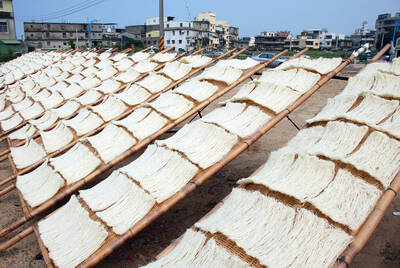
Oct. 19 to Oct 25 For many in Hsinchu, the cold, dry October winds bring uncomfortable weather. But in the past, rice noodle makers waited all year for these winds. Laid out on bamboo racks by the Keya River (客雅溪), freshly made noodles dried in the wind without compromising their quality or texture. The ideal conditions, it was once said, were 70 percent wind and 30 percent sun. Most producers were concentrated in the Nanshih (南勢) area, which became known as Mifenliao (米粉寮, literally “rice noodle shed”). The work in the early days was entirely manual and physically grueling, often starting


 RSS