


Rock 'n' roll, unlike jazz, blues, cabaret and classical music, has never figured out what to do with ageing deities. No one told Duke Ellington or Arthur Rubinstein or Lionel Hampton or Andres Segovia to stop playing when they turned 30, 40, 50 or, for that matter, 90. Smoothies such as Tony Bennett retain a strong appeal well into their 80s; they are not thought of as old, but as venerable. Luciano Pavarotti's declining gifts in his autumnal years were graciously overlooked by his adherents out of respect - or perhaps even gratitude - for his youthful triumphs. People knew that he was finished. That was no reason to stop adoring him. As for blues singers, not only does the public not resent their being a bit long in the tooth, they expect them to be old, acting as if BB King and Robert Johnson and Muddy Waters were born brandishing canes and foraging about for their reading glasses.
Only in the rock genre does the ageing process make the public feel uncomfortable; only in the world of rock do middle-aged performers feel pressure to exit the scene before they start making fools of themselves. Sometimes this pressure comes from the public, but the most vehement exhortations to blow town come from music critics and pundits who, with the exception of a few chosen ones - Bob Dylan, Leonard Cohen, Patti Smith, Neil Young, David Bowie and other beneficiaries of some sort of cultural coolness pass - would like all the Claptons and Collinses and Joels and Stewarts to get off the stage, go into retirement, take up Scottish country dancing, move to Spain, play more cribbage, or just curl up and die.
This year, Michael Jackson, Madonna and Prince will turn 50. Even for those of us who never seriously believed that any of the Beatles would actually turn 64 - which John Lennon and George Harrison did not - it is hard to believe that this trio of performers, who once symbolized the insolence and iconoclasm and adrenaline of youth, are now walking museum pieces, just as it is hard to believe that former teen idols Johnny Depp and Keanu Reeves are now both in their 40s. It is not just that people such as this become famous when they are young; to a large degree these people become famous because they are young.

PHOTO: AP
Ageing performers whose records are ignored and whose concerts no longer sell out often grumble that the music they are recording today is just as good as it ever was. This is not true: Rock stars never do work in their 30s that approaches the quality and originality of the work of their teens and 20s. Fame brings too many distractions, even the mildest affluence is the implacable enemy of creativity, and, most important, musical styles change and musicians can rarely change with them. A sure sign of panic is the statutory David Byrne/Peter Gabriel/Paul Simon trip to the developing world in search of inspiration.
But even more to the point is that being just slightly older than the audience was always part of the Faustian marketing arrangement. Pop music, which is as much about demographics and style as it is about culture, is for the most part produced by the young and targeted at the young. This is because young people do not want to listen to their parents' music, even if their parents' music is listenable. It also means that performers need to get started early and clean up quick because the spotlight dims fast. Audiences may grudgingly accept that they themselves are ageing, but they expect their idols to remain young forever. The results are often grotesque: singers who cannot remember the lyrics, lead guitarists who cannot remember what key they are supposed to be playing in, drummers who cannot keep the beat, flautists who can no longer support themselves on a single leg, rhythm guitarists who have to do the entire show sitting on a chair. Some performers can survive the stigma of age, but most rock stars end up playing private parties in Los Angeles, corporate functions in Osaka, free concerts in Paramus, New Jersey. If they are lucky.
None of the rules governing ageing rock stars applies to Jackson, Madonna and Prince, just as none of them applies to Mick Jagger or Aretha Franklin. These performers are like Queen Elizabeth II; they can rule as long as they like because they have the scepter. Economists may charge that this is unfair and counterproductive: a misallocation of resources that obstructs the rise of subsequent generations. Jackson, Madonna and Prince don't care about that, and neither, by the looks of it, does the Queen.

PHOTO: AP
The three stars came to fame by very different paths and have stayed famous in very different ways: Jackson was on top of the world as a child, then washed up at age 20, then the biggest star in the world at age 25, and now appears to be down for the count. Prince was up, then down, then way, way, way down and is now back on top. Madonna has never left the big time since she arrived in it, has never experienced a serious career slump. She's like the iPod; she came out of nowhere, and no one is quite sure how she became as huge as she became.
Stylistically, the three have little in common, nor do their careers resemble one another's. The tightest link between them is that they all grew up in America's heartland: Jackson in Gary, Indiana, Madonna in the suburbs of Detroit, Prince in Minneapolis. This may prove that young people marooned in the provinces are more ambitious than kids who grow up in New York and Los Angeles. Or it may just be a coincidence.
Then there's the fact that Prince is a rock star, and a remarkably important one, while Madonna and Jackson are mainstream pop stars. Prince and Madonna are linked by appearances in memorable motion pictures (Desperately Seeking Susan, Purple Rain) that somehow managed to survive their woeful acting, and each made one of the most ghastly motion pictures ever (Under the Cherry Moon, The Next Best Thing). Madonna actually made more than one of the ghastliest movies ever: Shanghai Surprise and Who's That Girl? are right up there in the Hall of Shame, too. Nor is Body of Evidence anything to write home about. This flirtation with Hollywood suggests that both Prince and Madonna would have liked to break out of the pop music straitjacket and establish themselves as stars in another genre, but had to throw in the towel, Prince because his pencil-thin moustache made him look like an out-of-work gigolo, Madonna because her arboreal acting actually got worse over the years.
Jackson, Madonna and Prince took entirely different paths to the top and have dealt with the maturation process in entirely different ways. Jackson, a child star who has now been in the public consciousness for more than four decades, pre-empted the question of getting too old for the rock star job by undergoing a physical and psychological transformation that turned a very handsome, very likable young man into a reclusive, grotesque, anti-social freak. Jackson, the biggest star in the world in the 38 years since The Beatles broke up, never had to worry about looking preposterous at the age of 50; he had started to look preposterous by the age of 35. It is impossible to say if Jackson, because of the child molestation charges that have dogged him for many years, could ever make the kind of comeback Prince has pulled off, as it would require a massive shift of attitudes on the part of the public. The public is ultimately forgiving, although it seems unlikely.
Less gifted than Jackson or Prince - as a singer, as a dancer, as a musician - Madonna is really a cabaret act who somehow managed to find a colossal world stage. Long the beneficiary of a cowed or indulgent press so smitten by Madonna the in-your-face feminist that it takes little note of her laughable acting, mechanical dancing and bubblegum song catalogue, she has begun to resemble Mount Rushmore: a revered icon whose fundamental cheesiness goes unnoticed because she's been around so long. Because she has been reinventing herself from the beginning - pop star, dominatrix, ingenue, fallen-away Catholic, matinee idol, children's book author, philosopher, Kabbalah devotee, political activist, Michigan suburbanite with phony British accent - Madonna has never had to compete with a single youthful image that is frozen in her fans' minds, in the way that the Rolling Stones or Sinead O'Connor or even Britney Spears has had to. There have been so many Madonnas that at this point one more incarnation isn't going to make much difference. Nor can there be any denying that by constantly shifting the target, she has made a little go a long way. She is a guerrilla chanteuse who always makes sure the battle is fought on her turf. And she works hard for the money, a lot harder than most of her male contemporaries.
Prince has also had several distinct phases to his career, though he never completely stopped being Prince. Hardcore fans remember his daring quasi-burlesque act long before the public discovered him in the Purple Rain era. By then, some of his early fans already felt he was going soft. No matter. Arriving on the grand stage at the same moment that Jackson was recording intergalactic hits such as Billy Jean and Beat It, Prince had to accept the somewhat thankless role as the second most fascinating, second most compelling, second weirdest star in pop music for several years. He then launched into a long phase of career self-immolation - refusing to be called Prince, warring with his record company, releasing too many records too often with too little top-quality material on them - basically sabotaging his professional life through a mixture of pique, self-indulgence and personal idiosyncrasy. When he finally did make his astounding comeback a few years back, a triumph that culminated in his appearance at the Super Bowl half-time show last January followed by his month-long residency in London in August, he was coming back from the dead. Prince hadn't been a vital force in music for years. He had been written off as a guy who used to be big in the 80s.
Of course, the truth is, Prince is not a vital force in today's music, nor are his two celebrated contemporaries. True, nobody who can bring a record company to its knees or rewrite the rules of concert promotion the way Madonna has, or who has risen from the ashes to have the biggest-grossing tour of the year and play the Super Bowl the way Prince has, can fairly be called a has-been. Yet none of the three artists turning 50 exerts any real creative importance over the music scene any more. Jackson doesn't make records and he doesn't tour.
Prince's shows are the very highest-class nostalgia - terrific, but certainly not anything new. The same is true of his recordings: the new stuff sounds like the old stuff. As for Michigan's most famous alumna, people don't come to Madonna shows to hear new songs; they come to see Madonna.
Unlike pathetic has-beens who peddle their musty wares from one provincial town to the next, Madonna and Prince play in huge venues and command huge ticket prices. But musically, the shows are the same as the shows Joe Cocker and the Lovin' Spoonful and the survivors of Yes are doing these days. They're oldies' shows.
Nobody associated with popular music ever wants to believe that it is first, last and foremost a business, much less that it is a business in which the same rules apply as in any other sphere of economic activity. In real life, middle-aged people cling to their high-paying jobs for as long as possible, resenting the younger employees nipping at their heels, all the while reassuring themselves that the youngsters can't get the job done the way they can. This sounds like every middle-aged rock star who ever lived, every former headliner who once played the Hollywood Bowl and is now playing small clubs in Norway and the cultural center in Amiens. Nobody ever gives up a good job, with a nice salary and benefits and lots of prestige just because younger people think that they're out of step with the times or because they've stopped being cool. People in their 50s and 60s have more important things to do than worry about being cool.
Decades ago, critics wondered out loud how Jagger was possibly going to be able to keep a straight face singing Street Fighting Man when he had reached 30. Then they wondered how he would do it at 40. There was a general consensus that Jagger was starting to look a bit silly exhorting his fans to man the barricades at age 50, but now that he is well past 60 and the Stones have just finished another record-smashing three-year tour, it is no longer pertinent or relevant to ask how a near-septuagenarian can continue to strut and fret his two hours upon the stage the way he does, singing about revolutions that didn't happen, social upheavals that never occurred. A long, long time ago, Jagger made it clear that he was not giving up his job, not only because of the money and the adulation, but because the evidence seemed to suggest that, even though it was indeed only rock 'n' roll, he rather liked it. Prince and Madonna probably feel the same way: as long as the crowds keep coming, as long as they keep cheering, and as long as they keep paying, we're going to keep going out on the road. What Michael Jackson is thinking is anybody's guess.
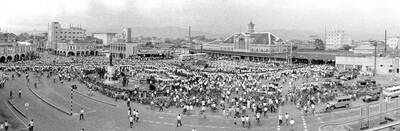
May 11 to May 18 The original Taichung Railway Station was long thought to have been completely razed. Opening on May 15, 1905, the one-story wooden structure soon outgrew its purpose and was replaced in 1917 by a grandiose, Western-style station. During construction on the third-generation station in 2017, workers discovered the service pit for the original station’s locomotive depot. A year later, a small wooden building on site was determined by historians to be the first stationmaster’s office, built around 1908. With these findings, the Taichung Railway Station Cultural Park now boasts that it has

Wooden houses wedged between concrete, crumbling brick facades with roofs gaping to the sky, and tiled art deco buildings down narrow alleyways: Taichung Central District’s (中區) aging architecture reveals both the allure and reality of the old downtown. From Indigenous settlement to capital under Qing Dynasty rule through to Japanese colonization, Taichung’s Central District holds a long and layered history. The bygone beauty of its streets once earned it the nickname “Little Kyoto.” Since the late eighties, however, the shifting of economic and government centers westward signaled a gradual decline in the area’s evolving fortunes. With the regeneration of the once

In February of this year the Taipei Times reported on the visit of Lienchiang County Commissioner Wang Chung-ming (王忠銘) of the Chinese Nationalist Party (KMT) and a delegation to a lantern festival in Fuzhou’s Mawei District in Fujian Province. “Today, Mawei and Matsu jointly marked the lantern festival,” Wang was quoted as saying, adding that both sides “being of one people,” is a cause for joy. Wang was passing around a common claim of officials of the People’s Republic of China (PRC) and the PRC’s allies and supporters in Taiwan — KMT and the Taiwan People’s Party — and elsewhere: Taiwan and

Perched on Thailand’s border with Myanmar, Arunothai is a dusty crossroads town, a nowheresville that could be the setting of some Southeast Asian spaghetti Western. Its main street is the final, dead-end section of the two-lane highway from Chiang Mai, Thailand’s second largest city 120kms south, and the heart of the kingdom’s mountainous north. At the town boundary, a Chinese-style arch capped with dragons also bears Thai script declaring fealty to Bangkok’s royal family: “Long live the King!” Further on, Chinese lanterns line the main street, and on the hillsides, courtyard homes sit among warrens of narrow, winding alleyways and


 RSS
RSS