


Last month Spain passed a law that doesn't make much sense on its face but says quite a lot about Europe in the new century.
The parliament, fulfilling a campaign promise from 2004 by Prime Minister Jose Luis Rodriguez Zapatero, ordered that families wanting to unearth bodies of relatives killed during the Spanish Civil War of the late 1930s or who suffered as a political consequence of General Francisco Franco's four-decade regime should get full cooperation from the state, and at the same time that every province in the country must remove remaining monuments to Franco.
Unearth the past - and erase it. Never mind that over the years most of these monuments have already been carted off, making the law largely toothless and symbolic. Even so, in the debates over it, nobody here has talked much about the inherent contradiction.
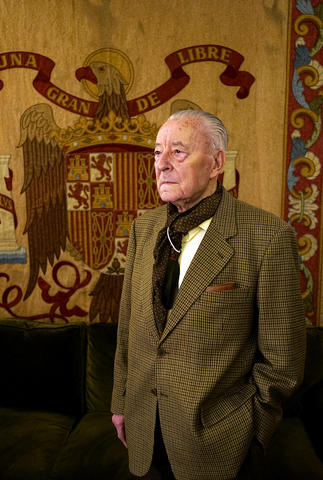
PHOTO: NY TIMES NEWS SERVICE
Or is it a contradiction? "A new generation has begun to look at the past," Santos Julia, a senior historian of the post-Franco years, explained to me one recent morning. "They're the grandchildren of the civil war. My generation wanted to discuss what happened without a sense of culpability. The grandchildren look on the same years of reconciliation as an unending concession, and it is time to fix blame."
Survivors build monuments to remember the dead, and tear down the statues of the tyrants who killed them, but mostly in vain. Statues and memorials inscribe history, which each generation rewrites to suit itself. In Budapest, Hungary, statues of Communist idols have been relocated to a park on the city outskirts to become virtual headstones at a kind of kitsch graveyard. Russia, in its dash to prosperity, remains conspicuously reluctant to rehash the past, but it also removed many signs of Soviet rule.
And of course nobody has scrutinized public symbols and spaces more than the Germans, for whom nearly every stone and street sign has provoked a fresh monument. The meeting room for the German foreign minister in Berlin is an example of the extent to which the Germans have gone even in private. Originally the office for the head of the Nazi state bank, then taken over by Erich Honecker, the East German leader, who met in it with his Politburo, the room was left nearly intact after the Wall fell when the Foreign Ministry moved in, so that where paintings of Marx and Engels once hung behind Honecker's chair, faded rectangles were left as cautionary reminders.
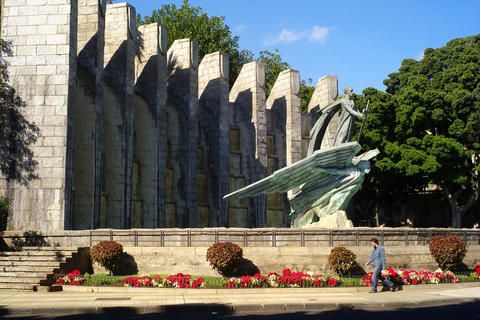
PHOTO: NY TIMES NEWS SERVICE
Spain is different, though, having endured a civil war. With their traditional fear of deep, dark demons in their soul, Spaniards, after Franco's death and during the transition to democracy, entered into what has long been called here a pact of silence, which the new law clearly aims to undo. As the historian Hugh Trevor-Roper put it 40 years ago, about a different regime, "A single personal despot can prolong obsolete ideas beyond their natural term, but the change of generations must ultimately carry them away." You might say that in Spain's case the change now comes a generation late.
I recently drove the 45 minutes to revisit Santa Cruz del Valle de los Caidos, the Valley of the Fallen, Franco's most megalomaniacal monument. The highway passed by bulls, those reared for bullfights, grazing in green fields, then abruptly rose into snow and gloom. During the 1950s, thousands of prison laborers tunneled hundreds of yards into a solid granite mountain ridge to build one of the world's biggest and most lugubrious basilicas and a Civil War memorial, beneath a cross nearly 50 stories high.
The site expressed Franco's desire for national atonement. His rule, as Raymond Carr, a Franco historian, once wrote, was not really a victory of the Falange, the Spanish version of fascism, "but of Catholic, conservative Spain over the liberal Spain of the Second Republic." And Franco, on his crusade to save Christian civilization, modeling himself after monarchs like Philip II, intended to echo the monastic austerity of Philip's nearby Escorial.
The architecture brings Albert Speer more to mind. The remains of murdered Republicans were unearthed from mass graves and trucked to the valley to be mixed with dead Nationalists, so it could be designated a place for all civil war victims. Even today most Spaniards aren't aware that Republicans are buried there along with Franco and the founder of the Falange Party, Franco's onetime rival, Jose Antonio Primo de Rivera.
The site culminates at the high altar with the graves of those two men, a fresh bouquet of flowers laid on each tombstone. Four hundred thousand people a year are still said to visit the place, although it was nearly deserted the other afternoon. A young Spanish family meandered glumly through the cold and silence, gazing up at the glowering statues of soldiers and saints. On the slushy plaza outside, the view toward Madrid and the giant cross disappeared behind black clouds.
"The idea that Spaniards have actually been unable to talk about the past is rubbish," Charles Powell, a historian, said, citing many books, movies and television programs about the civil war. But public declarations are one thing, he elaborated. In many villages where neighbors betrayed one another, and even husbands and wives don't easily talk about the war, a common policy is still don't ask, don't tell.
Long before the law was passed, nearly all Franco monuments were removed under socialist and conservative governments. But it was done quietly, without a public airing of the issues, as if the democracy were too fragile to bear the conversation, some say, although probably because Spaniards who had lived through the last Franco years had simply come to the conclusion that it was best and so wished to move on. This, however, still left a gap.
Even today you must comb through an English translation of a glossy guidebook to the Valle de los Caidos to find a passing remark about the prison laborers. In Madrid an avenue is still named Caudillo, after Franco, and another is named after the division of soldiers Franco sent to aid the Nazis. In Santander, although soon to be replaced by a parking garage on orders of the conservative local government, there's a statue of Franco on horseback that can bring to mind the statues of Jefferson Davis and Stonewall Jackson in American Southern towns where mayors and police chiefs are now often black.
Beatriz Rodriguez-Salmones, 63, who handles cultural affairs for the conservative Popular Party in parliament, is exasperated by the new law. Digging up graves is any family's right, she said, although she pointed out that the relatives of the poet Federico Garcia Lorca do not want to disturb the grave where his corpse was dumped along with the bodies of bullfighters and banderilleros because it would demean the nature of his death. What happens now, she asked, when the banderilleros' descendants want to dig the grave?
"But monuments have nothing to do with graves," she went on. "Probably 90 percent of the Franco monuments are already gone. We've had amnesties. We've recognized the rights of exiles. We compensated professors who lost their jobs. We changed streets names, the flag, always trying not to hurt one another." She said Zapatero is making an issue of monuments to appease parliamentary allies: "Separatists, Republicans, radicals." He needs their votes, she added, "and the votes from the Catalan and Basque regions - from those who look for confrontation."
She has a point. Now watered down from when it was called a law of "historical memory," as if such a thing could have ever been legislated, the law excludes objects of religious and artistic significance (the determination of art being left notably unclear). Not even at the Valle de los Caidos will anything likely happen except that political rallies have been banned, a provision intended to thwart the annual tributes on Nov. 20, the anniversary, as it happens, of both Franco and Primo de Rivera's deaths. But nobody seems to know whether this can be enforced.
I made a last stop at the apartment of Blas Pinar, 89. A couple of years back, on the prime minister's orders, a statue of Franco was spirited away in the middle of the night from a plaza in Madrid. Pinar and others protested. The founder of the ultra-rightist Fuerza Nueva, he greeted me, eager to launch headlong into a kind of stump speech for the old dictatorship, pausing, from time to time, to gasp through a tracheotomy tube.
His complaint about the transition, unlike that of the new generation of leftists, was that it was a political wolf in sheep's clothing. "A trick," he called it, "billed as reform but in fact a rupture, which changed the most fundamental elements of society: protection of the family, moral and religious values, the unity of Spain."
Now even the monuments are being removed, "the final blow," as he put it: "The law of historical memory is anti-historical because it tries to erase the memory of Franco, and all the good that he did for Spain." Prohibiting Francoists from gathering at the Valle de los Caidos will not change anything, he warned. "The place has always had a particular significance. You can never separate Franco from it."
I hated to agree with anything he said. But legislating monuments doesn't rectify injustices of the past, it just fumbles with the symbols of history, reminding us why we devise them in the first place. Ultimately, monuments gain meaning when we imbue them with it, otherwise they join the statues of cruel monarchs and bloody generals that have become the civilized backdrop to our parks and plazas.
You might say Spain's situation after Franco's death was not unlike a marriage: each side holding in reserve those remarks that would do the other side most harm. Silence created a bond. It's golden, as the saying goes; statues and plaques are just metal and stone. That said, the new law, forged by the children of this silence, paradoxically injects these rusting symbols with fresh significance for a new century.
From the last quarter of 2001, research shows that real housing prices nearly tripled (before a 2012 law to enforce housing price registration, researchers tracked a few large real estate firms to estimate housing price behavior). Incomes have not kept pace, though this has not yet led to defaults. Instead, an increasing chunk of household income goes to mortgage payments. This suggests that even if incomes grow, the mortgage squeeze will still make voters feel like their paychecks won’t stretch to cover expenses. The housing price rises in the last two decades are now driving higher rents. The rental market
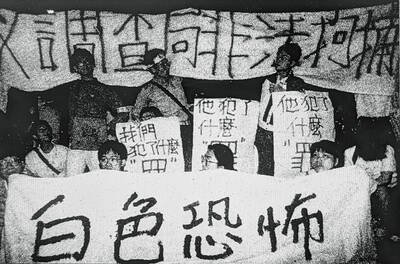
July 21 to July 27 If the “Taiwan Independence Association” (TIA) incident had happened four years earlier, it probably wouldn’t have caused much of an uproar. But the arrest of four young suspected independence activists in the early hours of May 9, 1991, sparked outrage, with many denouncing it as a return to the White Terror — a time when anyone could be detained for suspected seditious activity. Not only had martial law been lifted in 1987, just days earlier on May 1, the government had abolished the Temporary Provisions Effective During the Period of National Mobilization for Suppression of the Communist
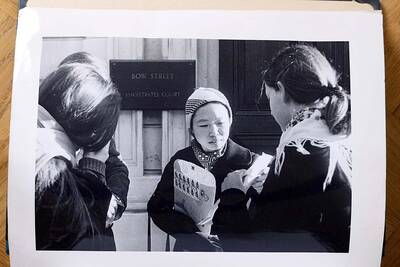
Fifty-five years ago, a .25-caliber Beretta fired in the revolving door of New York’s Plaza Hotel set Taiwan on an unexpected path to democracy. As Chinese military incursions intensify today, a new documentary, When the Spring Rain Falls (春雨424), revisits that 1970 assassination attempt on then-vice premier Chiang Ching-kuo (蔣經國). Director Sylvia Feng (馮賢賢) raises the question Taiwan faces under existential threat: “How do we safeguard our fragile democracy and precious freedom?” ASSASSINATION After its retreat to Taiwan in 1949, the Chinese Nationalist Party (KMT) regime under Chiang Kai-shek (蔣介石) imposed a ruthless military rule, crushing democratic aspirations and kidnapping dissidents from
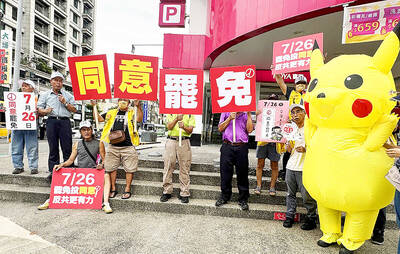
Fundamentally, this Saturday’s recall vote on 24 Chinese Nationalist Party (KMT) lawmakers is a democratic battle of wills between hardcore supporters of Taiwan sovereignty and the KMT incumbents’ core supporters. The recall campaigners have a key asset: clarity of purpose. Stripped to the core, their mission is to defend Taiwan’s sovereignty and democracy from the Chinese Communist Party (CCP). They understand a basic truth, the CCP is — in their own words — at war with Taiwan and Western democracies. Their “unrestricted warfare” campaign to undermine and destroy Taiwan from within is explicit, while simultaneously conducting rehearsals almost daily for invasion,


 RSS
RSS