


For many of the chic and well-to-do here in the capital of Iran, a country where women are required by law to conceal the shapes of their bodies, Simin Ghodstinat's designs provide a sort of middle way. Her clothes are elegant, luxurious and expensive - all while staying well within the religious authorities' strictly enforced boundaries of propriety.
Ghodstinat's outfits are long and enveloping. They are usually made of several pieces of hand-woven and hand-dyed Indian fabrics, all in lively colors and based on traditional Persian, Kurdish, Afghan or Indian designs. And they have become something of a phenomenon among Tehran's small minority of wealthy women.
"They are so comfortable and convenient for Iran," said Mojdeh Abedi, a 36-year-old lawyer in the city. "I can wear them outside, I can wear them in the evening and even overseas."
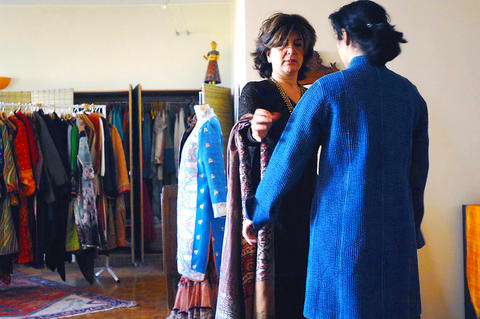
PHOTO: NY TIMES NEWS SERVICE
Another regular customer, Vida Ansari, 73, who said she often shopped at Armani stores or American brand-name stores, said she received compliments overseas for the things she bought from Ghodstinat. "People ask me even in New York and Washington where I have bought my clothes when I wear them," Ansari said.
Women's clothing has been a battlefield since the Islamic revolution in 1979, when the religious authorities in the government first required women to wear long, loose coats and cover their hair. A police corps was created to enforce the new moral codes. Dark, drab colors were made mandatory. And the religious police have regularly cracked down on women who defy the strictures that govern appearance.
The latest crackdown started this summer with the arrest of hundreds of women. But it seems to have had little effect. Although there are women who wear the head-to-toe chador on the street, there are still many who wear short coats or small head scarves that show some of their hair.
The police department announced last month that it would arrest women who wore long boots over their pants or hats instead of head scarves. But many women defy the rules, especially the one about long boots. If a woman refuses to wear the head scarf, she can be jailed for 10 days to two months, according to the country's Islamic Penal Code.
Limits on color became less strict, and fashion shows were permitted after the election of a reformist president, Mohammed Khatami, in 1997. Critics said the dark colors had caused depression among women and children. Gradually, the authorities allowed schoolchildren to wear colorful head scarves and coats instead of dark colors.
"The existence of such designers shows that society is developing, and that includes fashion and clothing as well," said Shabnam Rahmati, a reporter who has covered fashion for the daily Shargh, which was shut down by the government. "They emerged under the presidency of Khatami when more freedom was granted on other levels, too."
Ghodstinat's clothes, however, leave no room for criticism by the moral police.
"These clothes give a queenish posture because they are long, have a lot of textile and are traditional," she said at her home in north Tehran. She uses part of her large living room to exhibit the outfits, and she also sells them in a boutique in Dubai.
Ghodstinat, 57, said her designs were the result of her own "process of growth." After living in Europe and America between the ages of 13 and 34, she returned to Iran.
"I was Westernized, but I was never comfortable - it did not feel right," she said. "Most designers constantly say how they want to make women look sexy. I don't want women to be viewed as objects."
While adhering to the religious guidelines, her clothes differ from those shown at several government-endorsed fashion shows staged recently to encourage women to wear black head-to-toe chadors or dark, shapeless coats.
"If you are in love with color and textile, you fall in love with these Indian fabrics and get inspired to do something with them," she said. "The colors in the clothes remind me of the colors onstage."
Ghodstinat's clothing line is called Tradition, because, she said, she copies classical Middle Eastern and South Asian designs and updates them. Her Afghan-style skirts are ankle-length, unlike the traditional Afghan skirts that sweep the floor. And her Kurdish-style dresses have long sleeves that can be wrapped around the waist like a belt.
Her popular coats, based on the coats men wore in Iran during the Qajar period 100 years ago, have bell-shaped sleeves, are pinned at the waist and come in short lengths to wear over a longer skirt, or in longer lengths.
Her unusual color combinations, like bright green with brown, or pink and a touch of silver, have attracted women who are tired of wearing the traditional dark, restrained palette.
"These clothes give a kind of body language which is very dignified," she said.

Sept.16 to Sept. 22 The “anti-communist train” with then-president Chiang Kai-shek’s (蔣介石) face plastered on the engine puffed along the “sugar railway” (糖業鐵路) in May 1955, drawing enthusiastic crowds at 103 stops covering nearly 1,200km. An estimated 1.58 million spectators were treated to propaganda films, plays and received free sugar products. By this time, the state-run Taiwan Sugar Corporation (台糖, Taisugar) had managed to connect the previously separate east-west lines established by Japanese-era sugar factories, allowing the anti-communist train to travel easily from Taichung to Pingtung’s Donggang Township (東港). Last Sunday’s feature (Taiwan in Time: The sugar express) covered the inauguration of the

The corruption cases surrounding former Taipei Mayor and Taiwan People’s Party (TPP) head Ko Wen-je (柯文哲) are just one item in the endless cycle of noise and fuss obscuring Taiwan’s deep and urgent structural and social problems. Even the case itself, as James Baron observed in an excellent piece at the Diplomat last week, is only one manifestation of the greater problem of deep-rooted corruption in land development. Last week the government announced a program to permit 25,000 foreign university students, primarily from the Philippines, Indonesia and Malaysia, to work in Taiwan after graduation for 2-4 years. That number is a

This year’s Michelin Gourmand Bib sported 16 new entries in the 126-strong Taiwan directory. The fight for the best braised pork rice and the crispiest scallion pancake painstakingly continued, but what stood out in the lineup this year? Pang Taqueria (胖塔可利亞); Taiwan’s first Michelin-recommended Mexican restaurant. Chef Charles Chen (陳治宇) is a self-confessed Americophile, earning his chef whites at a fine-dining Latin-American fusion restaurant. But what makes this Xinyi (信義) spot stand head and shoulders above Taipei’s existing Mexican offerings? The authenticity. The produce. The care. AUTHENTIC EATS In my time on the island, I have caved too many times to

In a stark demonstration of how award-winning breakthroughs can come from the most unlikely directions, researchers have won an Ig Nobel prize for discovering that mammals can breathe through their anuses. After a series of tests on mice, rats and pigs, Japanese scientists found the animals absorb oxygen delivered through the rectum, work that underpins a clinical trial to see whether the procedure can treat respiratory failure. The team is among 10 recognized in this year’s Ig Nobel awards (see below for more), the irreverent accolades given for achievements that “first make people laugh, and then make them think.” They are not


 RSS
RSS