


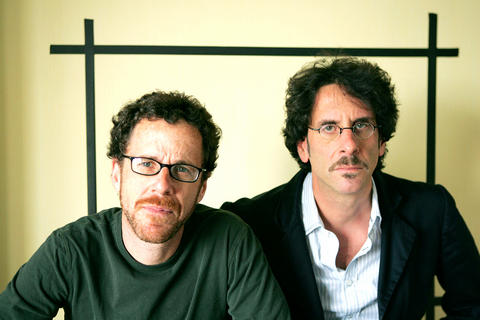
I’m framing up the Coen brothers as if they’re appearing in one of their own movies. From where I’m seated, I can see Joel, the longer, skinnier, more languid of the pair, stretched out almost full-length in the foreground, his legs on a coffee table and his torso resting almost horizontal on a couch. He fills the lower half of my frame, looking vaguely reminiscent of Henry Fonda balancing on his chair outside the barbershop in My Darling Clementine. Brother Ethan meanwhile is more animated, providing a more compact, roving vertical in the middle distance to balance the supine Joel, and tittering where Joel is prone to drawl.
And yes, they do finish each other’s sentences. Sort of. Like this, for instance, in answer to the question “How many animals have you killed in your movies?”
Joel: “Oh ... plenty.”
Ethan: “Uh ... cows in O Brother, Where Art Thou?”
Joel (pensively): “Couple of cows in that one. Blew up a rabbit and a lizard, another dog in this one ... “
Ethan (chuckling): “Yeah, we’ve killed a LOT of animals!”
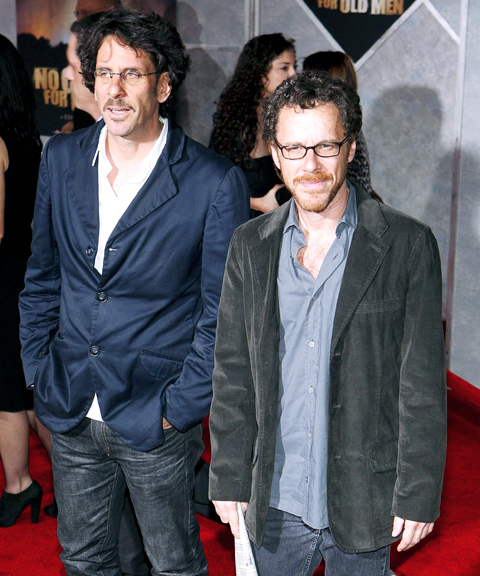
In the next few weeks, expect to hear the phrase “return to form” used incessantly about the brothers Coen. Their searing adaptation of Cormac McCarthy’s most approachable, albeit most pulpy, novel, No Country for Old Men, has earned admiration and mainstream attention in America of an intensity which hasn’t come the Coens’ way since the Oscar success of Fargo or the rapturous cult that has coalesced around The Big Lebowski.
After two comedies — Intolerable Cruelty and a remake of Alexander Mackendrick’s The Ladykillers — generally deemed the least interesting outings of their career, the Coens have delivered a manhunt-thriller of mesmerizing violence and remarkable narrative leanness, an almost academically precise exercise in the building and maintenance of unbearable tension and anxiety in the audience, and superficially reminiscent of the Texas noir of their debut, Blood Simple.
Shot under merciless southwestern skies by their usual cinematographer, Roger Deakins, and telling of the inexorable destruction of three men with utterly conflicting moral codes, it’s the soberest movie they’ve yet made: arid, spare, and mercifully free of the self-defeating collegiate cynicism that sometimes mars even their best work. It has the starkness of Fargo (though it is yellow where Fargo was a symphony in white), the random viciousness of Miller’s Crossing, and the ecstatic stylization of The Man Who Wasn’t There. No Country for Old Men proves that the Coens’ technical abilities, and their feel for a landscape-based western classicism reminiscent of Anthony Mann and Sam Peckinpah, are matched by few living directors.
Peckinpah is the director whose themes and concerns — masculinity and self-preservation among them — sit foremost in the mind when reading the McCarthy novel and when seeing the movie, which is a faithful, almost verbatim adaptation. The brothers are amenable to the comparison. Ethan: “We were aware of the basic link just by virtue of the setting, the south-west, and this very male aspect of the story. Hard men in the south-west shooting each other — that’s definitely Sam Peckinpah’s thing. We were aware of those similarities, certainly.” Joel: “Especially in the section of the movie where Woody Harrelson makes an appearance. He reminded us of a Peckinpah character in a certain way.” Ethan: “Yeah, you show a hard-on guy in a western-cut suit and it already looks like a Peckinpah movie. Same kind of shorthand.”
No Country for Old Men, set in 1980, follows three men in the aftermath of a drug deal gone wrong, out in the hostile desert borderlands. A man named Llewellyn Moss (Josh Brolin) finds US$2m in cash among many corpses while out hunting antelope, and is subsequently pursued throughout the movie, across the border and back, by a terrifying freelance assassin named Anton Chigurh, whose literally unspeakable name is redolent of the evil he does — he murders two people in the first five minutes, garroting the first with a pair of handcuffs, killing the second with a compressed-air slaughterhouse stun-gun. Chigurh is played by Javier Bardem in an extraordinary moptop haircut borrowed from ... well, Monkee Peter Tork maybe, or one of the Rutles. Meanwhile, local sheriff Tommy Lee Jones pursues them both, chastened by the killing he sees and realizing that someone must save Moss from this incarnation of bottomless malevolence.
Is Tommy Lee Jones as scary as he looks, by the way? “Oh, he’s a big pussycat!” laughs Ethan. But he sounds a little nervous. “He wants to pretend that he’s scary,” offers Joel, to which Ethan adds: “Let’s just say he doesn’t suffer fools gladly, but he’s fine.” But he’s essential to the film’s integrity, isn’t he? “He grew up there. He’s from San Saba, Texas, not far from where the movie takes place. He’s the real thing regarding that region. There’s a short list of people who could play that part at the basic level of the qualities you need: age, screen presence and the need to really inhabit that region and that landscape.”
I have to ask about Bardem’s hair, which manages to be simultaneously terrifying and ridiculous. “That bowl is fantastic,” says Joel. “We saw that hair in a photograph of a guy in a bar in a Texas border town in 1979, and we just copied it.” “Yeah,” giggles Ethan, “Javier really embraced it enthusiastically!” Bardem himself spoke of the haircut to the LA Times: “You don’t have to act the haircut; the haircut is acting by itself ... so you don’t have to act weird if you have that weird haircut.”
Rounding out the film’s trio of protagonists is the relative newcomer Josh Brolin, who here steps into a new dimension, and one step closer to stardom. Ethan: “He came in late in the day, after Tommy and Javier. Since it’s about three guys circling each other, what we were afraid of was two very compelling performers and then you cut to the dull guy. We were setting that bar kind of high.”
“We were very unsatisfied with everyone we saw before he showed up,” adds Joel. “We needed the same combination we had with Tommy: someone with equal weight who could authentically be part of that landscape. Those two things together ... we were surprised how difficult it was, and we weren’t happy until he walked in. Without him the whole thing would have been out of whack.”
This is not the first time the Coens have returned from an artistic impasse. There was speculation that they were tapped out when the exhaustingly zany The Hudsucker Proxy was poorly received a decade ago. Yet they soon sprang back with Fargo, their most famous movie, followed by Lebowski, their masterpiece.
But things in the early 2000s seemed a little more serious. For a start, the brothers were no longer directing scripts that had fermented and matured in the hothouse of their shared brain; they were adapting novels and rewriting other people’s scripts. This seemed like a very bad sign. This more recent impasse started when a long-cherished project, an adaptation of To the White Sea by James “Deliverance” Dickey, fell apart. In retrospect, it seems like a signpost to No Country for Old Men. The White Sea project was about an American airman shot down in second world war Japan who witnesses the Tokyo firebombing and then, insanely, tries to make his way home to Alaska. It shares many things with No Country, particularly a fascination with processes, the mechanics of things, machismo, and lengthy sequences without dialogue or music.
“Yes,” says Joel, “that’s definitely true, something that we had both thought about to a certain extent. In fact we mentioned Dickey’s book to Cormac a few times when we talked to him about anything relating to the book.” “This one sort of displaced that project in a lot of ways,” adds Ethan.
“Jeremy Thomas was producing it,” Joel continues, “and Jeremy is the patron saint of lost causes in the cinema — he seems to make all these interesting movies that everyone thinks are impossible to get made. He got very close to getting the financing for it, which on the face of it is just an insane proposition — a movie with the firebombing of Tokyo in it, that’s very expensive and somewhat marginal. But he came close.”
It sounds like Slaughterhouse-Five, minus the sci-fi, married to John Boorman’s Hell in the Pacific. “That’s exactly right,” says Joel. “Hell in the Pacific is a good example of the same sorts of things we have here in No Country: almost no dialogue, a bizarre score, and guys fighting and doing lots of stuff with their hands.” That was your first adaptation? “We have written things for other people that haven’t got made,” says Joel. “Actually, the Dickey book was the first adapted thing that almost rose to the level of getting produced.”
Much of the dialogue in No Country is taken from the book almost word for word. Joel: “Ethan once described the way we worked together as: one of us types into the computer while the other holds the spine of the book open flat. That’s why there needs to be two of us — otherwise he’s gotta type one-handed. That’s how you ‘collaborate’ with someone else.” Ethan: “Paperback novels just won’t lie open properly! They flip shut.”
One wonders what a sci-fi movie by the Coens — who have done noir, screwball, a kind of western, even a musical of sorts — would look like. “Neither of us is drawn to that kind of fiction,” says Ethan of sci-fi. “There are movies that we both like. I don’t know that that would ever happen, and I don’t quite know why.” Joel knows: “I don’t think we could get our minds around the whole spacesuit thing.”
Instead, they have a script of their own that they’d like to film. “We’ve written a western,” says Joel, “with a lot of violence in it. There’s scalping and hanging ... it’s good. Indians torturing people with ants, cutting their eyelids off.” Ethan: “It’s a proper western, a real western, set in the 1870s. It’s got a scene that no one will ever forget because of one particular chicken.” And so, yet another innocent creature prepares to die for the Coen brothers’ art.

Aug. 4 to Aug. 10 When Coca-Cola finally pushed its way into Taiwan’s market in 1968, it allegedly vowed to wipe out its major domestic rival Hey Song within five years. But Hey Song, which began as a manual operation in a family cow shed in 1925, had proven its resilience, surviving numerous setbacks — including the loss of autonomy and nearly all its assets due to the Japanese colonial government’s wartime economic policy. By the 1960s, Hey Song had risen to the top of Taiwan’s beverage industry. This success was driven not only by president Chang Wen-chi’s

Last week, on the heels of the recall election that turned out so badly for Taiwan, came the news that US President Donald Trump had blocked the transit of President William Lai (賴清德) through the US on his way to Latin America. A few days later the international media reported that in June a scheduled visit by Minister of National Defense Wellington Koo (顧立雄) for high level meetings was canceled by the US after China’s President Xi Jinping (習近平) asked Trump to curb US engagement with Taiwan during a June phone call. The cancellation of Lai’s transit was a gaudy

From Godzilla’s fiery atomic breath to post-apocalyptic anime and harrowing depictions of radiation sickness, the influence of the nuclear bombings of Hiroshima and Nagasaki runs deep in Japanese popular culture. In the 80 years since the World War II attacks, stories of destruction and mutation have been fused with fears around natural disasters and, more recently, the Fukushima crisis. Classic manga and anime series Astro Boy is called “Mighty Atom” in Japanese, while city-leveling explosions loom large in other titles such as Akira, Neon Genesis Evangelion and Attack on Titan. “Living through tremendous pain” and overcoming trauma is a recurrent theme in Japan’s

As last month dawned, the Democratic Progressive Party (DPP) was in a good position. The recall campaigns had strong momentum, polling showed many Chinese Nationalist Party (KMT) lawmakers at risk of recall and even the KMT was bracing for losing seats while facing a tsunami of voter fraud investigations. Polling pointed to some of the recalls being a lock for victory. Though in most districts the majority was against recalling their lawmaker, among voters “definitely” planning to vote, there were double-digit margins in favor of recall in at least five districts, with three districts near or above 20 percent in


 RSS
RSS