

Christine Stuart, a communications professor at Pennsylvania State University (Penn State), stood at the chalkboard and taught her students strategies for mingling at their forthcoming class party.
"Don't monopolize," she said cheerfully. "You need to get around the room." She listed the three easiest forms of conversation - cliches, facts and opinions - on the board and urged students to make index cards with opening lines for starting conversations: "Gee, this sangria is great, don't you think?" or "Sure is humid today."
Although one student let out a little snort when asked to think of every conversation as having an "intro," "body" and "conclusion," most of the class quietly wrote down everything on the board.
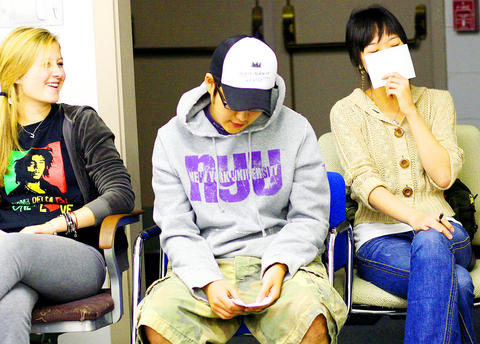
PHOTO: NY TIMES NEWS SERVICE
When Stuart asked a question, she got, at best, monosyllabic answers uttered at low pitch. The nervous tension in the room seemed tangible as students handed in their homework, a detailed list of their personal goals for the semester: talk to a stranger, go to professors' office hours, sound more confident on the phone, offer three opinions in class, greet an authority figure, learn to enter conversations.
"Sometimes I'm like, 'Wait, how old are we?'" said Elena Kashkan, a sophomore, after class. She had avoided seminars her first year, opting instead for large lectures where she would never have to speak. "I need to learn to care less about what other people think of me," she said. "It's not like I want to be that quiet girl in the corner."
Although the class, Speech Anxiety, sometimes resembles therapy, it serves a practical purpose: helping students graduate. Penn State's first "reticence course," taught in 1965, consisted of 16 students who were going to drop out rather than take the university's required speaking course. Today, there are three courses a semester with some 20 students each, and more than a dozen other institutions have adopted or designed similar programs.
Because speaking well is often crucial to getting a job - and to sounding educated - nearly half of American colleges and universities require a public speaking or communications course, according to the National Communication Association. Even universities without a requirement have put more emphasis on speaking in class, developing courses labeled "speaking intensive" in departments not associated with class participation.
A CRUCIAL SKILL
Speech Anxiety, which fulfills Penn State's requirement, allows undergraduates to ease their way into public speaking, first in groups, then in front of the professor and finally in front of the class; on rare occasions, students can bring friends to stand next to them for support. To be admitted to the course, students must demonstrate in an interview the extent of their reticence, defined as "chronic silence due to a fear of foolishness." If they waltz into the interview, hold out their hand, smile and introduce themselves, they're usually deemed not right for the course.
Some students are simply shy or experience stage fright; others are paralyzed in social situations. In extreme cases, an instructor might suggest a visit to university health services. Communications professors are not equipped to provide counseling, and they make an effort to avoid talking about their students' feelings. They don't try to identify the root of a student's anxiety. Instead, they focus almost exclusively on behavior.
"These are the quietest classes you'll ever be in," says Beau Bingham, an assistant lecturer at the University of Wyoming. The reticence course he teaches, which covers social conversations, group discussions and public speaking, began seven years ago because of concerns students would drop out.
"There's a whole population of students out there who go through their college career and don't get their degree because they can't bear to take public speaking," he says. He lets people into the class based on their scores on the Personal Report of Communication Apprehension, a widely administered test that asks students to rate their identification with statements like "Ordinarily I am very tense and nervous in conversations" or "While giving a speech, I get so nervous I forget facts I really know."
CALMING TECHNIQUES
Some campuses hold speech labs to teach calming techniques, like deep breathing, positive visualization and systematic desensitization. In the last five years, more than 20 campuses, including Hamilton College, Randolph-Macon College and Arizona State University, have opened labs where students practice speaking and receive individualized feedback.
"I've had students stop speeches halfway through because they're sobbing or vomiting," says Meg McConnaughy, director of the Communication Assessment and Learning Lab at Arizona State University. "If you're too scared to speak, you're not going to get your ideas across, and that's an absolute tragedy."
McConnaughy and others in the field maintain that speaking anxiety can be as debilitating as any formally recognized learning disorder. According to research published in the academic journal Communication Quarterly, the average college GPA of students with communication apprehension is a half-point lower than that of students without it.
NO ONE IS PERFECT
In Speaking Confidently, a class for reticent students at the University of Nebraska, Omaha, classmates look one another in the eye before speeches and repeat scripted positive statements: "No one is perfect or fully competent in all aspects of life," "They can't feel my heart beat," "I can be myself."
Some experts question whether it's really possible, or necessary, to ease the anxiety of highly apprehensive speakers. A new branch of thinking, called communibiology, argues that the problem is one of nature, not nurture. "For most people, there is no solution," says James McCroskey, a professor at the University of Alabama, Birmingham. "Except maybe for gene replacement," he adds with a laugh.
A leading scholar in the study of communication apprehension, he says forcing students to talk in public can be counterproductive. His research, he adds, shows that students nervous about speaking learn less if they anticipate having to communicate in class. Rather than paying attention, they fret about whether they'll be called on and what they will say.
John Daly, a professor at the University of Texas, Austin, teaches a 500-student lecture class on interpersonal communication. He says the benefits of talking in class are overstated. "There's a theory in this culture that class participation is the way to learn, and I don't know if I buy that completely," he says. "Unless you can make a really strong argument that the ability to talk about the topic is vital to understanding, you're doing this population of students a real disservice, causing them incredible discomfort."
And yet, students clamor to get into the reticence courses - this year, Penn State had to close interviews two days early because all openings were filled - and many describe the class as a turning point in their time at college.
"It was much easier to learn to talk when I was in a big room of people who had my problem," says Nathan Belanger, a junior at Penn State. He used to lose track of his thoughts, fall silent for periods of time and contemplate giving up and walking out of the classroom. He says his grades have improved.
"Not being able to voice my own opinions really hurt," he says. "I never figured out what I'm so afraid of. I'm just relieved I found a way to get around whatever it is."
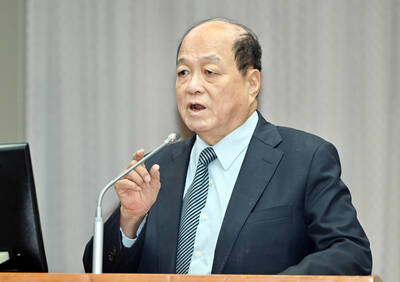
The Nuclear Safety Commission (NSC, 核安會) on Sept. 24 approved the re-operation plan that Taiwan Power Co (Taipower, 台電) filed in March for the Ma-anshan Nuclear Power Plant in Pingtung County, after three rounds of review and 589 comments. Taipower now has to carry out the work in the plan and its own inspections on ageing, radiation and seismic resistance, then report back to the commission for review and on-site checks. Minister of Economic Affairs Kung Ming-hsin (龔明鑫) has named 2028 as the earliest restart. The NSC has given no date. THE DEBATE No challenge has been identified as to whether Ma-anshan
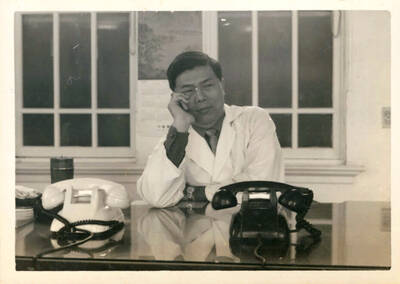
Oct. 12 to Oct. 18 After 11 years in prison on Green Island, Yen Shih-hung (顏世鴻) was finally due for release when a camp guard asked him for NT$20,000 to help pay his bride price. Yen refused. The next day, officials deemed that he had “failed to improve his thinking” and ordered him to undergo further political reeducation on Siaoliouciou (小琉球), where prisoners were also subjected to forced labor. He spent another 19 months there before regaining his freedom in January 1964. Yen’s punishment stemmed from his joining the Taiwan Provincial Student Affairs Committee

Cognitive warfare, says the Ministry of National Defense (MND), is the People’s Republic of China’s (PRC) use of “political, economic, cultural, military and legal means, with the intent to divide internal unity and undermine social stability” in Taiwan. Last week offered several examples. PRC media in October last year reported that the Chongqing Municipal Public Security Bureau had opened an investigation into Democratic Progressive Party (DPP) Legislator Puma Shen (沈伯洋), the DPP’s mayoral candidate for Taipei in next month’s election, for “Taiwan independence” activities. This was a cognitive warfare ploy, designed to unsettle the targeted person and to establish the idea

In pandemic preparedness work, scientists like to focus on the technical challenges: identifying pathogens, diagnosing infections, understanding their effects and developing vaccines and treatments. Each step promises progress through human innovation, investment and planning. The WHO, for example, brings experts together to identify and prioritize emerging disease threats and collect the evidence needed to prepare for them. But preparedness depends on more than scientific innovation. As the past week has shown, politics is the elephant in the room in all of this. No one could have predicted we would be talking about pneumonic plague, and that the death of a single


 RSS
RSS