


Thirteen members of Sheik Faisal Chilab's family were slain by militants. The US military arrested him twice. Three of his four sons were detained too.
Chaos and fighting were so widespread he couldn't farm his land in this "triangle of death'' region south of Baghdad. His date palm groves went untended.
Sometimes he couldn't leave his home for days.
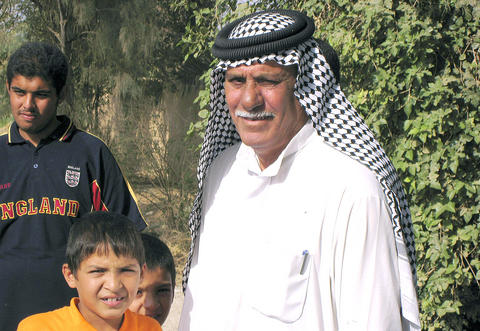
PHOTO: AP
So, he struck a deal with the Americans. The Sunni Arab clan chief now has 500 tribesmen battling al-Qaeda in Iraq and Shiite militiamen. The US military pays them.
Chilab and his men, nevertheless, still view the Americans as occupiers, reminisce about the days of Saddam Hussein and are deeply suspicious of the Shiite-dominated government.
Pragmatism among Iraq's once-dominant Sunni Arabs explains the paradox.
But the new relationships US forces have built with one-time enemies are fragile and dangerous - constructed on the Middle East proverb "The enemy of my enemy is my friend.'' The short-term payoff, however, has been significant.
Two months after the 500-strong "Awakening Brigade'' began deployment at 10 checkpoints across the lands of Chilab's Saidat clan, residents move freely and are tending their fields.
Raids by US and Iraqi forces are now rare and about 30 families have returned after fleeing the district's extreme violence.
The use of tribal forces has significantly reduced violence in other areas as well. It began in Iraq's west - the vast Anbar province. As it spread to Chilab's region south of Baghdad, the concept made gains as well in Baghdad and adjacent Diyala province.
Prime Minister Nouri al-Maliki's Shiite government has reluctantly supported these new alliances, but demands the tribal militias come under state control to prevent future sectarian warfare.
Chilab, his sons and grandchildren were home Friday to receive well-wishers on the first day of the Muslim Eid al-Fitr feast that marks the end of the fasting month of Ramadan.
Over coffee, tea and a lunch of lamb, rice and salad, the Chilabs and their guests - all in robes and black-and-white checkered head coverings - spent four hours explaining to a reporter why they launched their "awakening'' movement, what they hoped to gain from it and why they found it necessary to ally themselves with the Americans.
They spoke of the hardships of their agricultural community - their torment at the hands of the Shiite Mahdi Army and al-Qaeda militants. They gave voice, too, to the divisive fallout in the community as a result of the new security arrangements.
Some of those gathered Friday carried AK-47 assault rifles, others had two-way radios.
"We want to reverse the marginalization of the Sunni Arabs and gain a bigger share of Iraq's wealth and political power,'' said Ahmed Ghazi, a veteran of Saddam's army.
"Our awakening is our response to accusations that we are terrorists,'' he said.
Saddam's name came up often, especially in comparison with the Shiite regimes that have run Iraq since the US invasion toppled the dictator just over four years ago.
None of the roughly two dozen men gathered in Chilab's large reception room praised the former dictator, but many said they missed the Saddam-era subsidies on fertilizer, seeds and machinery.
Regardless of their opposition to the US presence in Iraq, none of the men at the feast criticized the clan's new alliance with American forces. The deal was seen as the only option to secure their homes and property.
"Without the Americans, there would have been no awakening here,'' said Ghazi.
But they complained American forces had not delivered on promises made during negotiations that established their 500-strong force.
Detained clan members not charged with crimes have not been released as promised, they said. Services - electricity, water and fuel supplies - have not improved significantly.
"We cannot say that America is bad, but what it has done to us is not good,'' Chilab said, fingering his crimson prayer beads.
"If they don't meet their end of the bargain then we will be freed of our own obligation,'' said the clan leader, who is in his mid-60s.
His men promised the Americans - he calls them occupiers - to bring an end to mortar attacks or roadside bombs targeting US and Iraqi forces in the area. They vowed to forge cordial relations with neighboring Shiite clans - no small task for local Sunnis, many of whom worked in Saddam's government, army, security agencies and military industry.
Chilab's decision to forge an alliance with the Americans was of immense importance.
Youssifiyah lies astride the route from Baghdad to the Shiite shrine cities of Najaf and Karbala. Millions visit each year.
Hundreds of pilgrims to the holy places have been killed on the road.
Like the Mahmoudiyah region farther south, Youssifiyah has been an al-Qaeda stronghold since 2004. It is viewed as one of the most dangerous areas for the US military and has been a major theater of sectarian violence.
The region's importance and violent past shows in the number of army and police checkpoints - about 10 in all - on the 20km of highway that separate Baghdad and Youssifiyah.
The 6km stretch of secondary road leading to Chilab's house has five army checkpoints, built with concrete blast walls and metal barricades.
While Saidat's Awakening Brigade is a modest band, it has been effective.
The men, mostly in their 20s, are armed with assault rifles, machine-guns and rocket propelled grenades. Their headquarters is a shoddily built, windowless hut in the middle of a field. There is one desk and some bamboo chairs.
The only thing hanging on the gray wall is a US-supplied aerial map of the area.
The Americans pay a monthly wage of US$300 to members of the force; officers receive US$600. The US military gave them gray shirts and yellow jerseys with glow-in-the-dark white stripes. That prevents them being mistaken for insurgent during nighttime operations.
The agreement with the Americans is for the entire force eventually to be absorbed into Iraqi government security apparatus.
Al-Maliki's tottering government is balking.
But as an almost immediate payoff for its alliance with the Americans, the relationship between clan residents and the mainly Shiite army unit deployed on the main road have improved dramatically.
"They used to be so harsh with us during house raids and searches at checkpoints,'' recounted Salah, one of Chilab's sons.
"It's different now,'' he said after shaking hands and exchanging kisses on the cheek with two young army soldiers at a checkpoint.
"Let us know if you need anything,'' Salah told the soldiers.
The Saidat is one of 14 Shiite and Sunni clans that make up the Zobeid tribe. The Saidat in the Youssifiyah area number around 3,000, of whom 150 have been killed since 2003. The Iraqi government has 100 more in detention; 36 are in US custody.
The continued presence of al-Qaeda in areas next to the Saidat clan remains a constant worry.
Of 22 members of his clan that were Saddam-era army officers, Chilab said only two have volunteered to join the Awakening Brigade.
"They fear being killed,'' he said, running his right hand across his throat to suggest that al-Qaeda militants would slaughter them.
The Saidat's alliance with the Americans also strained relations with clans that inhabit al-Qaeda controlled lands nearby. Chilab travels with four armed guards and has received several telephone threats.
One of the guests on Friday, who identified himself only as Bilal, suddenly broke into English to warn the reporter that Chilab could not talk as openly as he would like about the Awakening Brigade.
"Sir, "he said, "the sheik cannot trust everyone in this room."

For many people, Bilingual Nation 2030 begins and ends in the classroom. Since the policy was launched in 2018, the debate has centered on students, teachers and the pressure placed on schools. Yet the policy was never solely about English education. The government’s official plan also calls for bilingualization in Taiwan’s government services, laws and regulations, and living environment. The goal is to make Taiwan more inclusive and accessible to international enterprises and talent and better prepared for global economic and trade conditions. After eight years, that grand vision is due for a pulse check. RULES THAT CAN BE READ For Harper Chen (陳虹宇), an adviser
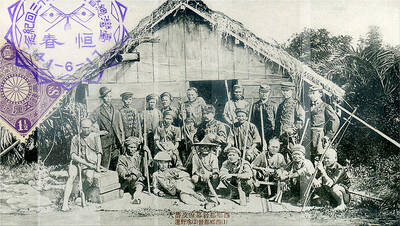
Traditionally, indigenous people in Taiwan’s mountains practice swidden cultivation, or “slash and burn” agriculture, a practice common in human history. According to a 2016 research article in the International Journal of Environmental Sustainability, among the Atayal people, this began with a search for suitable forested slopeland. The trees are burnt for fertilizer and the land cleared of stones. The stones and wood are then piled up to make fences, while both dead and standing trees are retained on the plot. The fences are used to grow climbing crops like squash and beans. The plot itself supports farming for three years.

The breakwater stretches out to sea from the sprawling Kaohsiung port in southern Taiwan. Normally, it’s crowded with massive tankers ferrying liquefied natural gas from Qatar to be stored in the bulbous white tanks that dot the shoreline. These are not normal times, though, and not a single shipment from Qatar has docked at the Yongan terminal since early March after the Strait of Hormuz was shuttered. The suspension has provided a realistic preview of a potential Chinese blockade, a move that would throttle an economy anchored by the world’s most advanced and power-hungry semiconductor industry. It is a stark reminder of

The last couple of weeks spectators in Taiwan and abroad have been treated to a remarkable display of infighting in the Chinese Nationalist Party (KMT) over the supplementary defense budget. The party has split into two camps, one supporting an NT$800 billion special defense budget and one supporting an NT$380 billion budget with additional funding contingent on receiving letters of acceptance (LOA) from the US. Recent media reports have said that the Taiwan People’s Party (TPP) is leaning toward the latter position. President William Lai (賴清德) has proposed NT$1.25 trillion for purchases of US arms and for development of domestic weapons


 RSS
RSS