


On a recent summer afternoon, a tiny cafe called La Petit Epicerie, in the heart of Nantes, was packed with diners. Pascaline Lelard, a local real estate agent, tres a la mode, sat down at a communal table with a flourish, spreading out her black flounced skirt and smoothing her wavy blonde hair behind one ear. She chatted briefly with the owner, Christophe L'Hermiteau, who returned with a large salad, dressed with sesame seeds and herbs, anointed with a slice of toast topped with tzatzki and smoked salmon. Lelard then turned to me, sitting alone with a red notebook, jotting down details on the interior (antique tables, a banquet laden with home-made desserts).
"I come here twice a week," she said, as though we'd been conversing. "Have you been here before? No? Well you absolutely must try the salmon. I insist!" and with that she made two sharp slices with her knife into her salmon and pushed her salad toward me.
Outside, it sputtered rain off and on. "Il pleut sur Nantes," the French chanteuse Barbara sang in the 1960s, "Donne-moi la main." It's raining in Nantes. Give me your hand.
PHOTOS: NY TIMES NEWS SERVICE
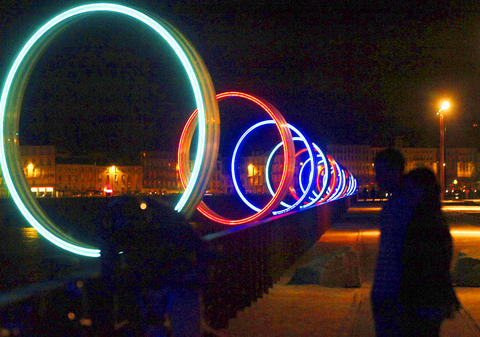
The opening phrase of the song fits this friendly, elegant - albeit rainy - city on the banks of the Loire, which, this summer, unveiled a series of impressive urban revitalization projects that have been drawing tourists from across France. Through Sept. 1, the city is playing host to Estuaire 2007 - the first of what will become a biennale art event and which features contemporary art installations in Nantes and all the way down the Loire to the seaside town of St Nazaire, about 64km away.
But while Estuaire 2007 has inspired a mountain of French press praising the "new locomotive" (as Le Monde called it) that is drawing tourists to the city, Nantes also has made a series of architectural, conceptual and cosmetic changes that have transformed industrial neighborhoods into magnets for locals and tourists alike. This urban renewal effort, combined with the city's inherent joie de vivre, is making Nantes, France's sixth largest city, the arbiter of what might be called Atlantic Coast chic.
But even while Nantes has become fashionable, it has also remained surprisingly welcoming. Everywhere I went, I was engaged by locals. Nantes, they told me, boasts France's best quality of life. "I hated the Cote D'Azur," said Jerome Chiron, 26, a native Nantias, on my last night in town. "I lived in Nice. I prefer Nantes."
NEW LEASE ON LIFE
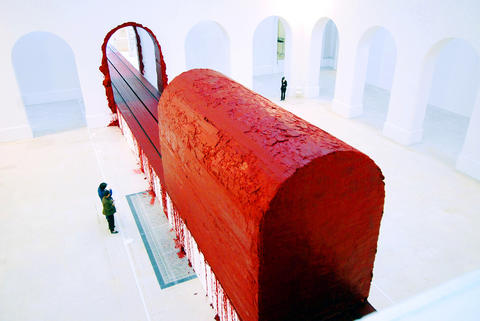
The best place to begin exploring Nantes is the newly polished Chateau des Ducs de Bretagne - a monument to the city's history, built over the course of centuries, beginning with the 15th. This was the home of Anne de Bretagne - twice Queen of France - who bound Brittany to France, quelling rebellions while securing rights for her region. Originally situated directly on the Loire, the branch of the river that once ran in front of the chateau was filled in the 18th century as the city expanded. In the 20th century the chateau was briefly taken over by occupying Germans - in fact, Nantes was an important part of the French Resistance network. (A nearby monument commemorates 50 executed Resistance hostages.)
After the war there was much debate over the palace. Now, after 25 years of discussion, and 15 years of restoration, the doors reopened in February. It has become a city museum, a restaurant (Les Oubliettes, the Forgotten, named for the prisoners who languished in palace cells hundreds of years ago) and an exhibition space. Rarely has a local history museum been so engaging and interactive.
On the day I visited, it was crowded with local school groups. "What is the opposite of a slave?" asked a teacher leading a group of middle-schoolers around the museum, which is laid out like a scavenger hunt, enticing visitors to climb towers, duck through doors, and wind around corners once cordoned off for nobility. "A free man!" called out a handful of students.
We were in what would have once been the most controversial room in Nantes - devoted to the city's role in the French slave trade. Not far from the chateau, magnificent 18th-century town houses with iron balustrades and intricately carved stone work were built with slave money. More than any other city in France, Nantes was immersed in the trade of human cargo; hundreds of thousands of African men, women and children were transported to the New World on slave ships that sailed from Nantes.
In the museum, displays are straightforward and gruesome - iron collars, plans for ships laid out for maximum "storage." The audio guide dissects how the slave trade clashed with Enlightenment ideals but notes that the wealth it produced made merchants reluctant to end it. As late as the mid-1980s Nantes' role in the slave trade was a wound the city had barely begun to address. The school children listened, rapt, to descriptions of the Atlantic passage, their faces a mix of ethnic heritages, a reminder of France's colonial history.

France's colonies provided the raw materials - sugar for one - that helped drive important industries in Nantes. Some of those industrial sites have now been transformed into cultural centers that are fast becoming the heart of Nantais nightlife.
Le Lieu Unique, a former biscuit factory, is now home to an art exhibition space, a bar/cafe, a restaurant and shops. With its defining symbol - a massive, colorful, beaux-arts cupola outside - the former factory manages to be simultaneously edgy and modern while eschewing kitsch. Inside, exposed concrete is set against cages that provide office space. At the bar, red and orange leather seats hold locals in business suits and artsy students alike. One flight down is Hammam Zein, a Middle Eastern-style spa and bathhouse.
Nantes' colonial links can also be found in the city's newest downtown attraction, located on the Ile de Nantes, once an entirely industrial area.
HIPSTER HANGOUTS
Le Hangar a Bananes, a former warehouse, opened this spring and is the site of ridiculously cool bars like IDN Cafe and L'Alter Cafe and restaurants like Le Cargo. Crowds of Nantais have begun arriving in droves to imbibe, dance, see art and generally revel in an entirely new neighborhood on the Loire. IDN has a post-60s decor, with sci-fi photographs and light fixtures made from fishbowls filled with bubbling water.
Back in downtown, 20-somethings frequent bars in the area called Le Bouffant, like L'Ascenseur with funky yellow wall murals and a soul/funk soundtrack. This is where I met Chiron, who preferred Nantes to Nice. "It's hip and hipper," he sighed, referring to the city. "But what can you do?"
My last morning I was rewarded with a bit of sun. I strolled from the Passage Pommeraye, an 1840s three-story shopping arcade with magnificently carved statues where I mulled purchasing avant-garde jewelry cast in everything from gold to rubber, and then across town to the Musee des Beaux Arts with its small but excellent collection of contemporary art - and back again. Everywhere, the streets were filled with people, enjoying - at last - a break in the rain.
NANTES: SURPRISINGLY FASHIONABLE, ALWAYS WELCOMING
HOW TO GET THERE
Air France offers flights via Hong Kong and Paris starting at NT$26,000 for a return excluding taxes.
WHERE TO STAY
Hotel Pommeraye (2 rue Boileau, 33-2-4048-7879; www.hotel-pommeraye.com) is centrally located and has a great staff and modern decor. Doubles start at US$81.
Hotel La Perouse (3 allee Duquesne, 33-2-4089-7500; www.hotel-laperouse.fr) is avant-garde yet welcoming. Prices start at US$109 a night.
WHERE TO EAT
La Petite Epicerie (14 rue du Chateau, 33-2-4048-6591).
Tabl'o Gourmand (6 alle Duquesne, 33-2-4047-5770, and 12 rue du Chateau, 33-2-5182-7913; www.tablo-gourmand.com) presents open-faced sandwiches, large salads, and desserts in two city locations.
Perched above the Loire with a panoramic view, L'Atlantide is an upper-crust mainstay (Centre des Salorges, 16 Quai Ernest Renaud, 33-2-4073-2323; www.restaurant-atlantide.net).
La Cigale is a fantastic 1895 Brasserie (4 Place Graslin, 33-2-5184-9494; www.lacigale.com).
WHERE TO HANG OUT
At the newly rehabbed Hangar a Bananes (21 Quai des Antilles; www.hangarabananes.com) you'll find the mod IDN Cafe (33-2-5182-8871) and Le Cargo restaurant (33-2-5182-8612).
Le Chateau des Ducs de Bretagne, 4 place Marc Elder, 33-2-5117-4948; www.chateau-nantes.fr.
Musee des Beaux-Arts de Nantes, 10 rue Georges-Clemenceau, 33-2-5117-4500.
Estuaire 2007 runs until Sept. 1. More details are at www.estuaire.info.
Source: NY TIME NEWS SERVICE

Sept.16 to Sept. 22 The “anti-communist train” with then-president Chiang Kai-shek’s (蔣介石) face plastered on the engine puffed along the “sugar railway” (糖業鐵路) in May 1955, drawing enthusiastic crowds at 103 stops covering nearly 1,200km. An estimated 1.58 million spectators were treated to propaganda films, plays and received free sugar products. By this time, the state-run Taiwan Sugar Corporation (台糖, Taisugar) had managed to connect the previously separate east-west lines established by Japanese-era sugar factories, allowing the anti-communist train to travel easily from Taichung to Pingtung’s Donggang Township (東港). Last Sunday’s feature (Taiwan in Time: The sugar express) covered the inauguration of the

The corruption cases surrounding former Taipei Mayor and Taiwan People’s Party (TPP) head Ko Wen-je (柯文哲) are just one item in the endless cycle of noise and fuss obscuring Taiwan’s deep and urgent structural and social problems. Even the case itself, as James Baron observed in an excellent piece at the Diplomat last week, is only one manifestation of the greater problem of deep-rooted corruption in land development. Last week the government announced a program to permit 25,000 foreign university students, primarily from the Philippines, Indonesia and Malaysia, to work in Taiwan after graduation for 2-4 years. That number is a
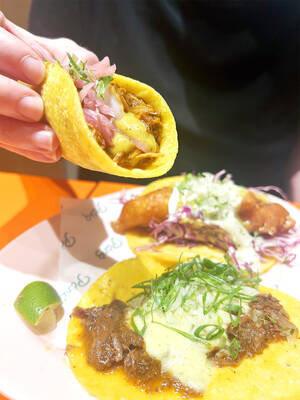
This year’s Michelin Gourmand Bib sported 16 new entries in the 126-strong Taiwan directory. The fight for the best braised pork rice and the crispiest scallion pancake painstakingly continued, but what stood out in the lineup this year? Pang Taqueria (胖塔可利亞); Taiwan’s first Michelin-recommended Mexican restaurant. Chef Charles Chen (陳治宇) is a self-confessed Americophile, earning his chef whites at a fine-dining Latin-American fusion restaurant. But what makes this Xinyi (信義) spot stand head and shoulders above Taipei’s existing Mexican offerings? The authenticity. The produce. The care. AUTHENTIC EATS In my time on the island, I have caved too many times to

In a stark demonstration of how award-winning breakthroughs can come from the most unlikely directions, researchers have won an Ig Nobel prize for discovering that mammals can breathe through their anuses. After a series of tests on mice, rats and pigs, Japanese scientists found the animals absorb oxygen delivered through the rectum, work that underpins a clinical trial to see whether the procedure can treat respiratory failure. The team is among 10 recognized in this year’s Ig Nobel awards (see below for more), the irreverent accolades given for achievements that “first make people laugh, and then make them think.” They are not


 RSS
RSS