


Perhaps it was inevitable that skateboarding would produce the nine-year-old Puehse twins.
With tremendous talent, Nic and Tristan Puehse (pronounced PEW-zah) of Shingle Springs, California, outside Sacramento, have become a grass-roots marketing phenomenon. Their ability has taken them to China and onto The Ellen DeGeneres Show. They have 14 sponsors, including Nike and Gatorade. And they are the stars of one of the most popular skateboarding videos on YouTube, a clip that has been viewed more than 2.5 million times since it was posted in January.
None of this would have been possible without the support of their father, Michael, a man with a vision, a video camera and a marketing plan.
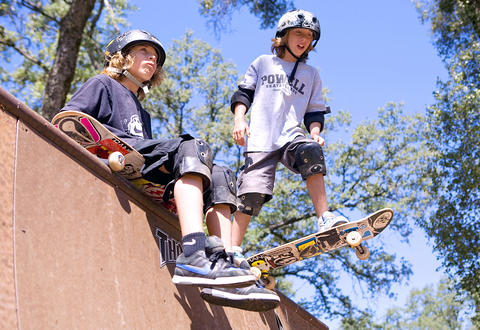
PHOTO: NY TIMES NEWS SERVICE
"If they continue to progress like they're doing, there's no doubt they're going to be pro," said Michael Puehse, who has helped his sons' careers by sending videotapes of the boys to potential sponsors since they were 6.
The twins' emergence has taken place in a US$5 billion skateboard industry that is increasingly turning to the very youngest skaters, some as young as 7, to promote its products. Almost half of the US' estimated 11 million skateboarders - 43 percent - are between 6 and 11, according to the market research company Board-Trac.
Sonja Catalano, the president of the California Amateur Skateboard League, had to create a new division for sponsored skaters 10 and younger to accommodate their growing ranks.
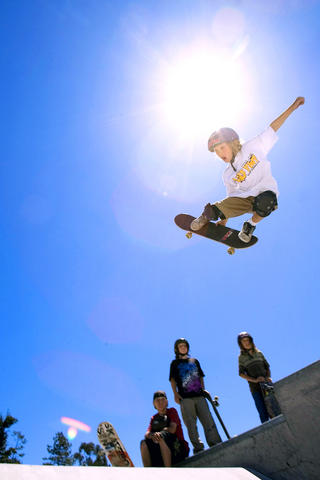
PHOTO: NY TIMES NEWS SERVICE
"These kids do videos there on YouTube," she said in June at a league competition in the Santa Cruz Mountains. "They're on MySpace.com. They have resumes. Down South, it's a little crazy. Half of them have Hollywood agents."
Although the value of sponsorships starts out modestly for the youngest - usually free equipment, apparel and minimal monetary payment - the rewards are great for those who continue to excel. Ryan Sheckler, 17, first won an X Games gold medal four years ago. Today, he earns in the low six figures in prize money alone, with sponsorship deals adding significantly to that. Nyjah Huston was 11 when he competed on the Dew Action Sports Tour and at the X Games in the summer of 2006, earning tens of thousands in prize money.
Catalano remembers skateboarding before the X Games and the great expectations. She helped found the league 28 years ago with Frank Hawk, the father of the skateboarding star Tony Hawk.
"We didn't used to have any parents," Catalano said. "That's what drew a lot of kids to skateboarding, and that's what drew a lot of kids to skateboard contests in the first place."
"It was their thing," she added.
But while skateboarding may still be the kids' thing, parents have now embraced it as well.
At a league competition in June, cars unloaded children with helmets, pads and skateboards at a skate park surrounded by soaring redwoods. In a scene somewhere between a Little League game and a punk rock concert, parents cheered as music blared and an MC called out tricks performed by skaters, some of whom had only recently completed kindergarten.
One of those competitors, Drake Riddiough, is 8. He did not know sponsorship existed when Jason Crum spotted him at a competition in the summer of 2006. Crum had created Half Pint Skateboards that same year to fill a void in the booming youth market. Crum noticed that most of those at skate parks were younger than 12, but they were using boards that often were too big and featured gory graphics.
Half Pint currently has a team of eight skaters under sponsorship, including Riddiough, from across California and Nevada. During one recent week Crum received 10 e-mail messages and seven telephone calls from skaters seeking sponsorship. But he says he is selective, looking for talent, a good attitude and good parents.
"The majority of the damage control I've had to do as a sponsor of little kids is avoiding some of the parents," he said. "Whenever I come back from a road trip, I always come back to a couple of jaded e-mails."
But not all parents are seeking sponsorship. Larry and Shari Midler did not plan to raise a skateboarding prodigy. It just happened when they moved to California three years ago from Westport, Connecticut.
Alex Midler has shown promise, leading the league's Southern California series' 8-and-under division. That has attracted the attention of sponsors and skate shop managers, who want to give him free merchandise.
"As soon as he goes to a skate park and does a kick flip, people start surrounding him and asking, 'Are you sponsored?'" Shari Midler said.
Although Alex wants to be, the Midlers are still learning what it all means.
"With these younger kids, especially with clothing or shoe companies, they see somebody, there's a model," Catalano said.
The Midlers have sought help from Peter Townend, a former world surfing champion whom they met through a mutual acquaintance. Townend's son Tosh began skating in amateur events at age 11. Today, he is 22 and a top street skater.
"Without good advice, you just get eaten alive by all these sharks swimming around in the water," Peter Townend said.
De Ville Nunes has been trying to sign the Puehse twins to a contract. Nunes is the team manager for Powell Skateboards, which backed Tony Hawk when he turned pro in 1982 at 14, surprisingly young for the time.
Nunes typically scouts the league events in Southern California. It is a competitive milieu. Two skaters that he had sponsored, ages nine and 10, were signed by a rival company.
Nunes said he was impressed with the Puehse twins' willingness to try any terrain or trick. For now, the Puehses have simple goals. "My goal is to become a pro skateboarder and do the MegaRamp before I'm 10," Nic said about a nine-story ramp that launches riders more than 21m.
After that, the sky's the limit.

By global standards, the traffic congestion that afflicts Taiwan’s urban areas isn’t horrific. But nor is it something the country can be proud of. According to TomTom, a Dutch developer of location and navigation technologies, last year Taiwan was the sixth most congested country in Asia. Of the 492 towns and cities included in its rankings last year, Taipei was the 74th most congested. Taoyuan ranked 105th, while Hsinchu County (121st), Taichung (142nd), Tainan (173rd), New Taipei City (227th), Kaohsiung (241st) and Keelung (302nd) also featured on the list. Four Japanese cities have slower traffic than Taipei. (Seoul, which has some

In our discussions of tourism in Taiwan we often criticize the government’s addiction to promoting food and shopping, while ignoring Taiwan’s underdeveloped trekking and adventure travel opportunities. This discussion, however, is decidedly land-focused. When was the last time a port entered into it? Last week I encountered journalist and travel writer Cameron Dueck, who had sailed to Taiwan in 2023-24, and was full of tales. Like everyone who visits, he and his partner Fiona Ching loved our island nation and had nothing but wonderful experiences on land. But he had little positive to say about the way Taiwan has organized its

The entire Li Zhenxiu (李貞秀) saga has been an ugly, complicated mess. Born in China’s Hunan Province, she moved to work in Shenzhen, where she met her future Taiwanese husband. Most accounts have her arriving in Taiwan and marrying somewhere between 1993 and 1999. She built a successful career in Taiwan in the tech industry before founding her own company. She also served in high-ranking positions on various environmentally-focused tech associations. She says she was inspired by the founding of the Taiwan People’s Party (TPP) in 2019 by Ko Wen-je (柯文哲), and began volunteering for the party soon after. Ko

During her 2015 trip to Taiwan, Sophia J. Chang (張詠慧) got fewer answers than she’d hoped for, but more revelations than she could have imagined. “That was the year I last saw my grandmother. She was in hospice care in Tainan, and it was painful to see her in bed, barely able to open her eyes,” says Los Angeles-born Chang. “The grandma I’d known, a fantastic cook and incredibly kind, was already gone.” After their visit, Chang and her grandfather went back to his apartment. There she asked him how he’d met her grandmother. “He hesitated, then started talking a bit.


 RSS
RSS