


David Macaulay could be called the wizard of architectural history. In 23 books over three decades, his arresting pen-and-ink illustrations have explored everything from the construction of ancient pyramids to the subterranean systems that support a modern metropolis.
Often marketed to children, these books are equally popular with adults, who appreciate their ability to use a primarily visual language to make history, architecture and engineering clear to laymen.
The first major retrospective of the 60-year-old Macaulay's work opened last week at the National Building Museum here: David Macaulay: The Art of Drawing Architecture, a tour of his work and his methods. Macaulay assisted with the exhibition and was present for The Big Draw, an opening-day event in which visitors may try their own hands at drawing exercises. The show, in fact, encourages this sort of family-friendly viewer participation with sketching stations throughout the gallery.
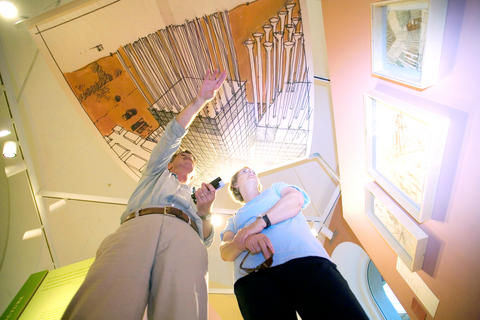
PHOTO: NY TIMES NEWS SERVICE
Macaulay was trained as an architect at the Rhode Island School of Design, but never practiced. Instead, after brief stints as an interior designer and high school art teacher, he returned to the college as an illustration instructor, a position he still holds.
His first children's book, Cathedral, detailing the methods used to build Gothic churches, was published in 1973 and established a formula he has returned to many times - in Pyramid and Castle, for example. He examined the construction of a Roman town in City and the maze of pipes and tunnels under modern cities in Underground. He is perhaps best known for The Way Things Work, which reveals the mechanical and electronic innards of everything from radio telescopes to automatic transmissions.
Much as Macaulay's books deconstruct the built world, the retrospective seeks to "explode and explain" his creative process, said Kathleen Franz, an assistant professor of history at American University, who served as the exhibition's curator. This is most apparent in the first section, Visual Archaeology, which tries to reverse-engineer Mosque, his latest book, published in 2003.
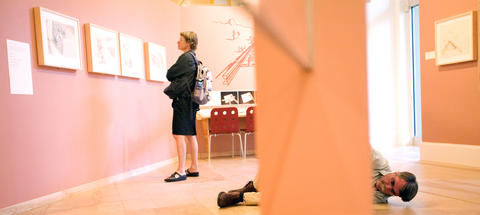
PHOTO: NY TIMES NEWS SERVICE
Mosque, which Macaulay has called his response to the events of Sept. 11, explores the construction of 16th-century Ottoman mosques. Visitors to the museum watch an edited version of the home video that Macaulay shot during a research trip to Istanbul, and may page through a reproduction of the sketchbook he kept on the trip. Some of the hundreds of preliminary drawings he made as he chose images for the book are also displayed. (Tellingly, Macaulay refers to his own creative process as "linear chaos.")
In a world of computer-aided design, he continues to do all his drawings by hand, in pen and ink. For this book he also built and photographed a paper architectural model to capture more effectively various angles of the mosque's interior.
Macaulay is known for selecting surprising points of view, and this aspect is highlighted in a section of the show called Playing With Perspective. Here you find his pioneering "worm's eye" depictions of building foundations and city traffic from Underground; his fish-eye view of a medieval hall from Castle; and his pigeon's-eye panoramas of Rome from his fable of love, Rome Antics.
To reinforce the theme, the curators have blown up some of Macaulay's sketches and affixed them to the floor, suspended them from the ceiling or transferred them to glass panes, forcing the viewer to engage in the action - looking down, up or through - suggested by the illustration's perspective.
Innovative methods of describing structure and scale are more of Macaulay's strong points. To illustrate the comparative sizes of the world's great domes, he depicted how five of these architectural wonders - the Hagia Sophia, St. Peter's Basilica, Les Invalides, the US Capitol and the Pantheon - could fit inside a sixth, the Houston Astrodome.
In 2003, to celebrate the 100th anniversary of the Williamsburg Bridge, he wrote an "Op-Art" piece for The New York Times, Want to a Build a Bridge? that included a scale silhouette of the bridge with instructions for cutting it out and constructing a newsprint model. (An example of the results is on display.)
Also on view are the sketchbooks that Macaulay used while planning Building Big (2000), his look at the engineering feats that make bridges, tunnels, skyscrapers and domes possible. Franz said her intent had been to demonstrate how Macaulay uses drawing to pose problems - both of engineering and of illustration - and solve them. ("Avoid predictable and dull chronological history of bridge building," reads one sketchbook note to self.)
The exhibition's final section, dedicated to Macaulay's more fanciful, satiric and political work from the late 1970s and early 1980s, may be the least familiar to visitors. Yet, at least for adults, it may prove the most rewarding.
Macaulay often draws parallels between his own work and that of the 18th-century Italian draftsman Giovanni Battista Piranesi, popular for his engravings and etchings of romanticized landscapes. He shares Piranesi's fascination with ruins; many of Macaulay's images in this section of the show focus on remnants of modern structures in some imagined future.
Some images he created in 1976 for a series called Great Moments in Architecture are in the style of Piranesi, and his 1982 Veduta della stazione grand central, which depicts the post-apocalyptic ruins of Grand Central Terminal in Manhattan, makes clear reference to Piranesi's art.
There is a playful aspect to some of this work. Noseschwanstein from 1976 is an image of a grand castle perched on a mountainous proboscis. His 1979 book Motel of Mysteries is a subtle satire of a field with which Macaulay has often been linked: archaeology. In it he humorously postulates the destruction of American civilization in a catastrophic avalanche of junk mail. Then, 2,000 years in the future, an archaeologist stumbles across the ruins of a motel and must decipher the function and meaning of the artifacts he finds inside. Unsurprisingly, the archaeologist gets most of it wrong.
There is also a haunting quality to some drawings. In Unbuilding, from 1980, Macaulay imagines the dismantling of the Empire State Building by a fictional Saudi prince who has purchased the structure to have it rebuilt in his kingdom's oil fields. The book's plot reflects the era's anxieties about energy independence, economic decline and famous landmarks' falling under foreign ownership.
But the images of a symbolic building slowly stripped down to I-beams will resonate with viewers today as it recalls photographs of the World Trade Center's steel skeleton poking above the wreckage of ground zero.
Last week, Viola Zhou published a marvelous deep dive into the culture clash between Taiwanese boss mentality and American labor practices at the Taiwan Semiconductor (TSMC) plant in Arizona in Rest of World. “The American engineers complained of rigid, counterproductive hierarchies at the company,” while the Taiwanese said American workers aren’t dedicated. The article is a delight, but what it is depicting is the clash between a work culture that offers employee autonomy and at least nods at work-life balance, and one that runs on hierarchical discipline enforced by chickenshit. And it runs on chickenshit because chickenshit is a cultural
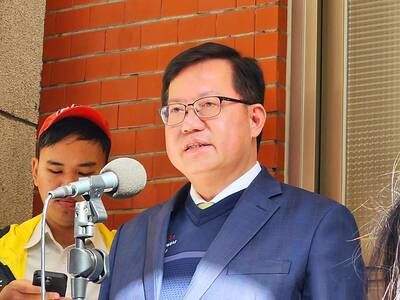
By far the most jarring of the new appointments for the incoming administration is that of Tseng Wen-tsan (鄭文燦) to head the Straits Exchange Foundation (SEF). That is a huge demotion for one of the most powerful figures in the Democratic Progressive Party (DPP). Tseng has one of the most impressive resumes in the party. He was very active during the Wild Lily Movement and his generation is now the one taking power. He has served in many of the requisite government, party and elected positions to build out a solid political profile. Elected as mayor of Taoyuan as part of the
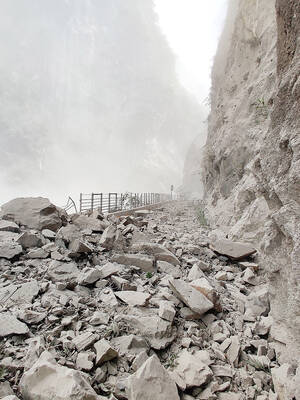
Moritz Mieg, 22, lay face down in the rubble, the ground shaking violently beneath him. Boulders crashed down around him, some stones hitting his back. “I just hoped that it would be one big hit and over, because I did not want to be hit nearly to death and then have to slowly die,” the student from Germany tells Taipei Times. MORNING WALK Early on April 3, Mieg set out on a scenic hike through Taroko Gorge in Hualien County (花蓮). It was a fine day for it. Little did he know that the complex intersection of tectonic plates Taiwan sits

When picturing Tainan, what typically comes to mind is charming alleyways, Japanese architecture and world-class cuisine. But look beyond the fray, through stained glass windows and sliding bookcases, and there exists a thriving speakeasy subculture, where innovative mixologists ply their trade, serving exquisite concoctions and unique flavor profiles to rival any city in Taiwan. Speakeasies hail from the prohibition era of 1920s America. When alcohol was outlawed, people took their business to hidden establishments; requiring patrons to use hushed tones — speak easy — to conceal their illegal activities. Nowadays legal, speakeasy bars are simply hidden bars, often found behind bookcases


 RSS
RSS